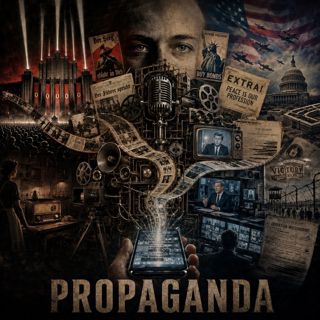

Nazi Propaganda & The American Mirror

Nazi Propaganda & The American Mirror

The word propaganda began as something holy. In sixteen twenty-two a committee of cardinals in Rome coined it to mean the spreading of the faith, and in this episode I follow that single word as it curdles across the bloodiest century human beings have ever managed to produce.

This is the story of how mass persuasion got built, who built it, and the deeply uncomfortable truth that the most murderous propaganda machine in history did not invent its methods from nothing. It borrowed them, and some of what it borrowed, it borrowed from us.

We start with Edward Bernays, the nephew of Sigmund Freud and the father of public relations, the man who sold cigarettes to American women as torches of freedom and who learned to his horror that Joseph Goebbels kept his books on a shelf in Berlin. From there we trace the dress rehearsal of yellow journalism and the sinking of the Maine, the Creel Committee of the First World War, and the corpse-factory lie that taught a whole generation to disbelieve the real death camps when the reports finally came.

Then we walk straight into the Nazi machine itself, told without flinching and without sensationalism, through Goebbels and the big lie, the People's Receiver that put the Führer's voice in every German kitchen, Leni Riefenstahl's beautiful and monstrous films, the Cathedral of Light, the Reichstag fire, the cleaned-up Berlin Olympics, and the quiet horror of the language of euphemism, the soft clean words laid over genocide so the clerks could do the work without ever naming it.And then I turn the camera around, onto the country that crossed an ocean to destroy that machine and built machines of its own.

The racist campaign against the Japanese that walked off the screen and into the internment camps. The permanent Cold War apparatus, the secret funding of broadcasters and magazines, Bernays and the Guatemala coup, the Church Committee, and COINTELPRO, including the letter the Federal Bureau of Investigation wrote trying to drive Doctor King to suicide.

The Gulf of Tonkin, the Pentagon Papers, the incubator testimony of nineteen ninety, the weapons of mass destruction that were never there, the Mission Accomplished banner, the generals on your television secretly reading the Pentagon's lines, and the wall that quietly came down in twenty twelve.I want to be clear about something, because the cheap version of this story gets it wrong. America is not Nazi Germany, the difference in scale is the size of the abyss, and the men who died to stop the real thing deserve better than that lazy equation.

The machine was never a German machine. It was a human machine, the levers work on all of us, and the most disturbing history in this whole account is not the history of the men who lied. It is the history of how gratefully the rest of us believed them, and how that same machine now lives in your pocket and sleeps on your nightstand.

Have a forgotten historical mystery, disturbing event, unsolved crime, or hidden conspiracy you think deserves investigation?

Send your suggestions to brian@paranormalworldproductions.com.

Disturbing History is a dark history podcast exploring unsolved mysteries, secret societies, historical conspiracies, lost civilizations, and the shadowy stories buried beneath the surface of the past.

Follow the show and enable automatic downloads so you never miss a deep dive into history’s most unsettling secrets.

Because sometimes the truth is darker than fiction.

Tämä jakso on lisätty Podme-palveluun avoimen RSS-syötteen kautta eikä se ole Podmen omaa tuotantoa. Siksi jakso saattaa sisältää mainontaa.

Jaksot(154)

The 1990's

The 1990's

On July 16, 1990, Time magazine put a group of young adults on its cover beneath the word “twentysomething” and asked whether they were laid back, late blooming, or simply lost. The story said they st...

30 Syys 1h 12min

The Siege At Ruby Ridge

The Siege At Ruby Ridge

Listener discretion is advised. This episode contains descriptions of real-life violence and death, including the shooting deaths of a fourteen-year-old boy, his mother, and a federal law enforcement ...

27 Syys 1h 18min

The 1980's

The 1980's

The 1980s began with 52 Americans still being held hostage in Tehran and ended with crowds tearing open the Berlin Wall. Between those two moments came one of the most turbulent, contradictory decades...

25 Syys 1h 9min
Halley's Comet

Halley's Comet

On the night of May 18, 1910, people across the world waited for Halley’s Comet to kill them.Hotels in New York opened their rooftops. Miners in Pennsylvania refused to go underground. A religious sec...

23 Syys 1h 1min
The Freeway Killer

The Freeway Killer

This episode discusses sexual violence against children and teenagers, torture, and murder and is not suitable for younger audiences. Listener discretion is strongly advised. On the night of June 11, ...

21 Syys 1h 19min
The 1970's

The 1970's

The 1970s opened in conflict.On April 30, 1970, President Richard Nixon announced the expansion of U.S. military operations into Cambodia.Days later, four students were killed by the Ohio National Gua...

18 Syys 1h 2min
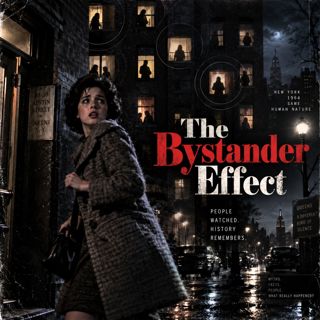
The Bystander Effect

The Bystander Effect

On March 27, 1964, The New York Times published a story that would become one of the most famous examples of human indifference ever told. According to the report, 38 people in Queens watched as 28-ye...

16 Syys 1h
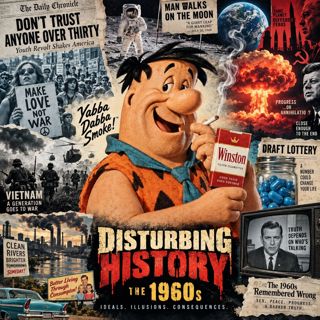
The 1960's

The 1960's

Everybody knows the line: “Don’t trust anyone over thirty.” It became shorthand for an entire generation, even though the man who said it was a 24-year-old Berkeley graduate student who would turn thi...

13 Syys 1h 2min

Suosittua kategoriassa Yhteiskunta

olipa-kerran-otsikko
i-dont-like-mondays
seitseman
sita
siita-on-vaikea-puhua
hupiklubi
uutiscast
download
poks
antin-palautepalvelu
mamma-mia
kaksi-aitia
kolme-kaannekohtaa
yopuolen-tarinoita-2
rss-murhan-anatomia
aikalisa
rss-palmujen-varjoissa
gogin-ja-janin-maailmanhistoria
vallattomat
kummitusjuttuja