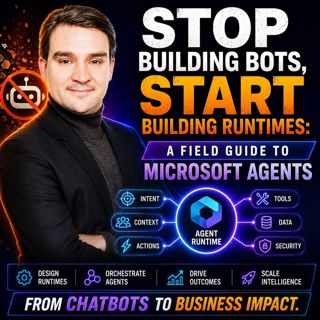
Stop Building Bots, Start Building Runtimes: A Field Guide to Microsoft Agents

Stop Building Bots, Start Building Runtimes: A Field Guide to Microsoft Agents

Everyone is calling Build 2026 the AI conference. Most of the attention went toward new copilots, voice experiences, and increasingly capable models. But beneath the headlines, Microsoft quietly introduced something far more significant. The real story is not about another AI feature. It is about the emergence of a completely new infrastructure layer for enterprise computing. For years, organizations approached AI as a chatbot problem. Build a conversational interface, connect it to some data, add a few prompts, and call it an AI strategy. That approach worked for experimentation, but it was never designed for scale. Chatbots forget context, struggle with governance, and become increasingly difficult to manage as more departments begin building their own solutions. What Microsoft is building now is fundamentally different. We are moving from assistants that answer questions to agents that operate as active participants inside the enterprise.

THE FOUR-LAYER MODEL THAT CHANGES EVERYTHING

One of the most important concepts emerging from Microsoft's latest announcements is the idea that agents should no longer be viewed as products. They should be viewed as layers within a larger system. Most organizations currently evaluate AI by comparing products. They ask whether they should use Copilot, Copilot Studio, Azure AI Foundry, GitHub Copilot, or Security Copilot. That approach creates confusion because these technologies solve very different problems. The better way to think about agents is through architecture. The modern agent stack consists of four distinct layers:
  • Experience Layer
  • Agent Layer
  • Runtime Layer
  • Governance Layer
Each layer serves a unique purpose. Each layer has different stakeholders. And each layer introduces different operational requirements. Organizations that understand this distinction can scale successfully. Organizations that ignore it often end up with fragmented deployments and duplicated effort.

WHY IDENTITY IS THE REAL STORY

The most important announcement from Build 2026 was not a new agent. It was identity. Historically, automation systems operated through shared service accounts. Scripts, bots, and integrations all ran under generic credentials that nobody really owned. This created security blind spots and made auditing nearly impossible. When something happened, it was difficult to determine which system actually performed the action. Microsoft's new model changes that entirely. Every agent now receives its own identity inside Microsoft Entra. Every agent becomes a first-class principal within the organization. It has its own permissions, its own audit trail, and its own lifecycle. This seemingly small architectural change creates enormous downstream benefits:
  • Least-privilege access
  • Full auditability
  • Conditional Access enforcement
  • Individual credential management
  • Instant revocation capabilities
For the first time, agents are being treated like actual actors inside the enterprise rather than invisible background processes. This shift enables governance at a scale that simply wasn't possible before.

THE RISE OF AGENT INFRASTRUCTURE

Most organizations are still focused on building individual agents. The problem is that individual agents are only part of the story. Real business value emerges when agents work together. A retrieval agent gathers information. An analysis agent interprets it. A communication agent creates output. A coordinating agent manages the workflow. Suddenly, what looked like a chatbot becomes an operational system. This is where Azure AI Foundry Agent Service enters the picture. Foundry provides the runtime environment where agents actually execute. It handles:
  • Memory management
  • Session persistence
  • Multi-agent orchestration
  • Tool discovery
  • State management
Instead of developers spending months building infrastructure, they can focus on defining agent behavior while Microsoft manages scaling, networking, and execution behind the scenes. This dramatically reduces complexity and accelerates deployment timelines.

THE SHADOW AGENT PROBLEM

One of the most fascinating challenges discussed in this episode is something many organizations have not yet recognized. The Shadow Agent problem. Building agents is becoming incredibly easy. Governance is not. As a result, business units increasingly create their own agents without involving IT. Sales teams build lead qualification agents. Operations teams create workflow automations. Individual departments experiment with Copilot Studio and Power Platform. Before long, dozens or even hundreds of agents are operating across the organization without centralized visibility. This creates significant risks:
  • Duplicate functionality
  • Excessive permissions
  • Compliance concerns
  • Data leakage risks
  • Lack of ownership
Agent 365 is Microsoft's answer to this challenge. It provides centralized discovery, governance, identity management, auditing, and policy enforcement across the entire agent ecosystem. The goal is not to stop innovation. The goal is to make innovation manageable.

FROM ASSISTANCE TO AUTOMATION

The biggest change is not technical. It is organizational. For years, AI systems were designed to assist humans. The human remained the primary actor while AI provided recommendations and suggestions. The new generation of agents flips that relationship. The agent executes. The human supervises. Sales qualification becomes automated. Security triage becomes automated. Financial reconciliation becomes automated. Humans focus on judgment, strategy, relationships, and decision-making while agents handle repetitive operational work. This fundamentally changes how organizations think about productivity. Instead of helping employees complete tasks faster, agents begin completing entire categories of tasks on their own. Humans shift toward oversight, governance, and exception handling.

THE FUTURE ISN'T MORE CHATBOTS

Build 2026 may ultimately be remembered as the moment agents stopped being experimental technology and started becoming enterprise infrastructure. The organizations that succeed over the next decade will not be the ones with the most chatbots. They will be the ones that understand identity, governance, orchestration, runtime architecture, and multi-agent systems. They will build platforms rather than isolated tools. The future of enterprise AI is not conversational. The future of enterprise AI is operational. And Microsoft has just laid the foundation for that future.

Become a supporter of this podcast: https://www.spreaker.com/podcast/m365-fm-modern-work-security-and-productivity-with-microsoft-365--6704921/support.

Tämä jakso on lisätty Podme-palveluun avoimen RSS-syötteen kautta eikä se ole Podmen omaa tuotantoa. Siksi jakso saattaa sisältää mainontaa.

Jaksot(690)

Everything Microsoft Didn't Tell You About Teams with Everything Microsoft Didn't Tell You About Teams with Josh Blalock [MVP]

Everything Microsoft Didn't Tell You About Teams with Everything Microsoft Didn't Tell You About Teams with Josh Blalock [MVP]

Microsoft Teams has evolved from a simple collaboration platform into the digital workplace at the heart of modern business. But behind every successful Teams meeting lies far more than software. In t...

3 Heinä 45min
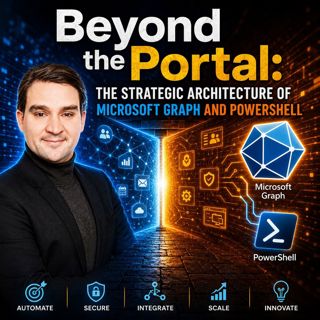
Beyond the Portal: The Strategic Architecture of Microsoft Graph and PowerShell

Beyond the Portal: The Strategic Architecture of Microsoft Graph and PowerShell

For years, Microsoft 365 administration has been defined by portals. Administrators spend their days inside the Microsoft 365 Admin Center, Exchange Admin Center, SharePoint Admin Center, Teams Admin ...

3 Heinä 1h 10min

Think Like an Attacker: Microsoft Security Exposure Management with Uros Babic [MVP-MCT]

Think Like an Attacker: Microsoft Security Exposure Management with Uros Babic [MVP-MCT]

Traditional cybersecurity focuses on vulnerabilities, alerts, and dashboards. Attackers don't. They look for opportunities, weak identities, exposed cloud resources, excessive permissions, forgotten e...

2 Heinä 1h 9min

EXTENSIBILITY FIRST: Building .NET Systems That Survive Change with Miguel Castro [MVP]

EXTENSIBILITY FIRST: Building .NET Systems That Survive Change with Miguel Castro [MVP]

Software rarely fails because developers cannot write code. It fails because applications are designed for today's requirements instead of tomorrow's changes. In this episode of the m365.fm Podcast, M...

1 Heinä 1h 4min

The Death of the UI: Why CUA is the End of SaaS as We Know It

The Death of the UI: Why CUA is the End of SaaS as We Know It

For more than forty years, enterprise software has been built around one fundamental assumption: humans need graphical interfaces to interact with machines. Dashboards, forms, navigation menus, search...

1 Heinä 1h 8min

Microsoft Copilot Adoption: What Actually Works - With Chris Hinch [Microsoft]

Microsoft Copilot Adoption: What Actually Works - With Chris Hinch [Microsoft]

Artificial Intelligence has moved beyond experimentation and into the heart of modern business. Yet while organizations are investing heavily in Microsoft Copilot, many struggle to achieve meaningful ...

30 Kesä 54min
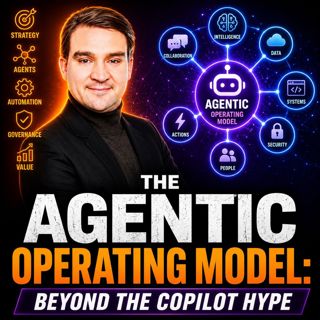
The Agentic Operating Model: Beyond the Copilot Hype

The Agentic Operating Model: Beyond the Copilot Hype

Most organizations believe they are implementing AI transformation. In reality, many are simply deploying chat interfaces on top of existing systems. While copilots and retrieval-based AI solutions ha...

30 Kesä 1h 14min

Suosittua kategoriassa Politiikka ja uutiset

uutiscast
aikalisa
ootsa-kuullut-tasta-2
rss-ootsa-kuullut-tasta
rss-podme-livebox
rss-vaalirankkurit-podcast
tervo-halme
otetaan-yhdet
politiikan-puskaradio
rss-asiastudio
aihe
the-ulkopolitist
rss-kaikki-uusiksi
rss-raha-talous-ja-politiikka
rss-girls-finish-f1rst
rikosmyytit
rss-360-podi
rss-fingo-podcast
rss-kuka-mina-olen
rss-ulkopoditiikkaa