From Closed to Open: Shortening Sales Cycles with Stephen Goldberg

From Closed to Open: Shortening Sales Cycles with Stephen Goldberg

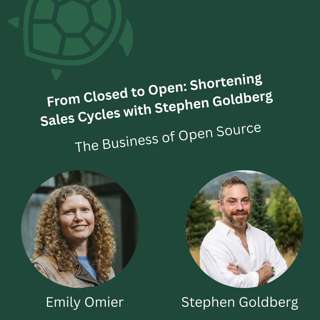
This week on The Business of Open Source, I chatted with Stephen Goldberg, co-founder of Harper, about the process of taking Harper from a closed-source software company to a open source company. I already talked to Ethan Arrowood about the transition to open source, but Stephen was able to give a founders perspective about why Harper wanted to move to open source, why it wasn’t launched as an open source company from the very beginning and why they choose the moment in question to go open source.


He says that 80 to 90% of the effort around taking a big piece of Harper open source was around communication, both external and internal. It’s not that difficult to change an license or to push something onto GitHub, but a successful open source launch is about so much more than that.


Here’s what we talked about:


  • The board pushed back a lot, mostly because they felt like going open source was going to complicate things for the company and they were worried that the risks outweighed the benefits
  • Stephen was convinced that even as a closed-source company, their customers weren’t paying for their code, but rather for their services. Harper also sells to large enterprises, and he was convinced this type of customer doesn’t want to cowboy their tech stack.
  • There has been a massive positive impact on the company’s sales cycles. The sales cycles are shorter and require less effort from Harper’s team; it’s also psychologically easier when someone asks him to prove that the product does what he promises — he just has to ask tell them to verify for themselves.
  • They haven’t gotten many outside contributions and that was never the goal, but they do get bug reports. This has significantly reduced their costs of support, because the bug reports are often very detailed and identify where in the code there is a problem. Not only that: customers are able to figure out when the “bug” is actually a problem on their side, and that reduces support volume considerably.
  • AI coding agents have dramatically increased the value of an open source project, because when the agent is able to see the software’s code directly, it’s able to build on top of it and integrate it into the system but more effectively than if it were working with docs. This was a huge win that they didn’t expect.


The bottom line: If you understand your business model, going open source has a lot of upsides and the risks are not as scary as you think. However, getting advice along the way is critical, and you should work with people who understand open source companies if you’re going open source.

If you're considering going from closed to open source and you'd like help on the product strategy and the communication part... that's what I do. You might consider working with me.

Tämä jakso on lisätty Podme-palveluun avoimen RSS-syötteen kautta eikä se ole Podmen omaa tuotantoa. Siksi jakso saattaa sisältää mainontaa.

Jaksot(275)

Does AI Make Open Core Models More Difficult? with Sam Alba

Does AI Make Open Core Models More Difficult? with Sam Alba

Today on The Business of Open Source I spoke with Sam Alba, co-founder of Mendral, formerly of Dagger, and the first hire at Docker. We talked a lot about about how AI is changing the developer tools ...

2 Heinä 39min
Closed to Open Source Series: Doing Open Source "Right" with Ethan Arrowood

Closed to Open Source Series: Doing Open Source "Right" with Ethan Arrowood

One of the myths that swirl around the open source company ecosystem is that all open source companies started as an open source project that then suddenly got traction, and followed by the founders f...

22 Kesä 40min
The Value of Code is Dropping to Zero with Yann Lechelle

The Value of Code is Dropping to Zero with Yann Lechelle

In this episode of The Business of Open Source, I talked with Yann Lechelle, Executive President of :Probabl.Perhaps the most interesting part of the conversation was about whether or not there is a r...

15 Kesä 42min
Why the World Needs the Agentic AI Foundation with Manik Surtani

Why the World Needs the Agentic AI Foundation with Manik Surtani

In this episode of The Business of Open Source, I spoke with Manik Surtani, one of the co-founders of the Agentic AI Foundation and the CTO at the foundation. This is part of the series I’m working on...

8 Kesä 34min

The AI-Induced Death of A Bug Bounty Program with Glauber Costa

The AI-Induced Death of A Bug Bounty Program with Glauber Costa

The Business of Open Source is back! I’m starting a series about AI and open source this week. I reached out to Glauber Costa, founder of Turso, after reading a post of his on LinkedIn about how bot-w...

1 Kesä 43min

Changing Your Price Anchor with Anais Concepcion

Changing Your Price Anchor with Anais Concepcion

There’s a new episode of The Business of Open Source today! It’s been a while. I talked with Anais Concepcion about a program she’s been testing at Grist to give free activation codes for the enterpri...

11 Helmi 32min

Earning Trust with Tom Hacohen

Earning Trust with Tom Hacohen

This week on The Business of Open Source, I spoke with Tom Hacohen, CEO and founder at Svix. We kicked off the conversation by talking about why Svix is an open core company… but Tom still initially d...

8 Loka 202535min

Suosittua kategoriassa Liike-elämä ja talous

sijotuskasti
psykopodiaa-podcast
mimmit-sijoittaa
rss-oivalluksia-rahasta-elamasta
ostan-asuntoja-podcast
rss-rahapodi
rahapuhetta
rss-sami-miettinen-neuvottelija
rss-rahamania
rss-ammattipodcast
herrasmieshakkerit
syo-nuku-saasta
vapauta-supervoimasi-podcast
asuntoasiaa-paivakirjat
rss-kahavia-ja-markkinointia-podcast
rss-kaikki-koroista
rss-markkinointitrippi
rss-perho-rajoilla
rss-inderes
rss-doulapodi