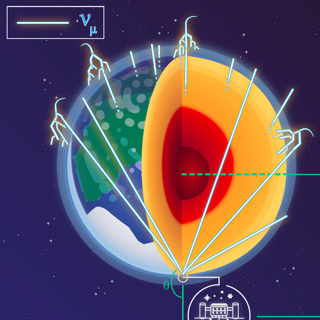

X-Raying the Earth: Neutrino Tomography at the South Pole

X-Raying the Earth: Neutrino Tomography at the South Pole

Welcome back to the podcast! Today, we are exploring a groundbreaking new way scientists are looking deep inside our planet. For a century, our understanding of the Earth's interior has relied almost entirely on seismic waves and gravity. But what if we could use cosmic "ghost particles" to scan the Earth instead?


In this episode, we dive into a fascinating new study from the IceCube Neutrino Observatory located deep in the glacial ice at the South Pole. Using 10.7 years of data, scientists have successfully mapped the Earth's radial density profile using high-energy muon neutrinos. We discuss how these neutrinos, which usually pass right through matter undetected, become partially blocked by the Earth at extremely high energies (above ~10 TeV). By measuring how these particles are absorbed as they travel through different layers of the planet at different angles, researchers can essentially take a tomographic scan of the Earth's interior using the weak nuclear force.


Tune in to hear how this cutting-edge method has been used to independently calculate the Earth's mass and polar moment of inertia, yielding results that are completely consistent with traditional seismology and the Preliminary Reference Earth Model (PREM). We also discuss what this means for the future of planetary science and how next-generation neutrino telescopes will bring even sharper resolution to the hidden layers beneath our feet.


Reference mentioned in this episode: Abbasi, R., et al. (IceCube Collaboration). "High-Energy Neutrino Tomography of the Earth’s Interior with IceCube." arXiv:2607.02644v1 (July 2026).


Acknowledements: Podcast prepared with Google/NotebookLM. Illustration credits: IceCube Collaboration

Tämä jakso on lisätty Podme-palveluun avoimen RSS-syötteen kautta eikä se ole Podmen omaa tuotantoa. Siksi jakso saattaa sisältää mainontaa.

Jaksot(123)

Supernovae, TDEs, and Scintillation: How ASKAP and Rubin Are Mapping the Variable Universe

Supernovae, TDEs, and Scintillation: How ASKAP and Rubin Are Mapping the Variable Universe

In this episode, we dive into how astronomers are combining the power of the Australian Square Kilometre Array Pathfinder (ASKAP) and the Vera C. Rubin Observatory to capture the dynamic, ever-changin...

16 Loka 20min

JWST and MeerKAT Team Up: Uncovering the Most Distant Fast Radio Burst Yet

JWST and MeerKAT Team Up: Uncovering the Most Distant Fast Radio Burst Yet

Fast Radio Bursts (FRBs) are millisecond-duration radio signals originating from deep space. In this episode, we explore the groundbreaking discovery of FRB 20240304B, detected by the MeerKAT radio te...

12 Loka 20min

GRB 221009A: Measuring Relativistic Jets using Radio Interferometry

GRB 221009A: Measuring Relativistic Jets using Radio Interferometry

In this episode, we explore high-precision Very Long Baseline Interferometry (VLBI) radio observations of GRB 221009A, the brightest gamma-ray burst ever detected. Using the Global-VLBI network at 5 G...

8 Loka 21min

Unveiling GRB 240825A: Cosmic Dust, JWST, and a Supernova in Hiding

Unveiling GRB 240825A: Cosmic Dust, JWST, and a Supernova in Hiding

In this episode, we explore the cosmic mystery of GRB 240825A, a gamma-ray burst detected at redshift z = 0.659. Its short rest-frame duration and hard prompt emission initially pointed toward a compa...

5 Loka 14min

From GeV to EeV: A Data-Driven View of Cosmic Rays

From GeV to EeV: A Data-Driven View of Cosmic Rays

How do high-energy particles traveling across the universe reach Earth, and what are they made of? In this episode, we explore the Global Spline Fit (GSF), a comprehensive framework that unifies cosmi...

2 Loka 24min

From Blazars to Supernovae: Fermi’s Deepest High-Energy Sky Survey

From Blazars to Supernovae: Fermi’s Deepest High-Energy Sky Survey

In this episode, we dive into the release of the Fourth Catalog of Hard Fermi-LAT Sources (4FHL). Utilizing 16 years of continuous data from NASA's Fermi Gamma-ray Space Telescope, this catalog provid...

29 Syys 23min

GRB 220706A: The Longest-Lived Gamma-Ray Burst Engine Ever Seen

GRB 220706A: The Longest-Lived Gamma-Ray Burst Engine Ever Seen

In this episode, we explore the extraordinary discovery of GRB 220706A, a record-shattering cosmic explosion at redshift z = 0.8577. While most gamma-ray burst engines die down within minutes, X-ray f...

24 Syys 19min

Chasing Kilonovae: How LIGO-India Multiplies Multimessenger Discoveries

Chasing Kilonovae: How LIGO-India Multiplies Multimessenger Discoveries

In this episode, we explore the future of multimessenger astronomy as neutron star–black hole (NSBH) mergers take center stage. While binary neutron star collisions have delivered iconic multimessenge...

18 Syys 21min

Suosittua kategoriassa Tiede

tiedekulma-podcast
utelias-mieli
rss-mita-tulisi-tietaa
rss-duodecim-lehti
rss-hereilla
docemilia
rss-kasvikutsut
rss-vaasan-yliopiston-podcastit
rss-poliisin-mieli
rss-kasvatuspsykologiaa-kaikille







