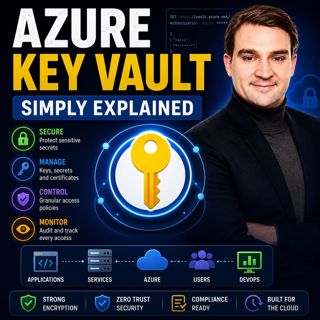
Azure Key Vault - Simply Explained
Every modern application relies on secrets—API keys, database passwords, connection strings, encryption keys, and certificates. Yet one of the biggest security mistakes developers and administrators still make is storing these credentials directly inside source code, configuration files, or deployment pipelines. In this episode of Microsoft Knowledge Nuggets on M365 FM, Mirko Peters explains Azure Key Vault in plain English, showing how Microsoft helps organizations securely store, manage, rotate, and protect sensitive information across Azure. Whether you're a developer, cloud architect, DevOps engineer, security professional, or IT administrator, this episode explains why Azure Key Vault has become a fundamental building block of every secure cloud architecture.

WHAT IS AZURE KEY VAULT?
Azure Key Vault is Microsoft's fully managed cloud service for securely storing secrets, encryption keys, and digital certificates. Rather than embedding sensitive credentials inside applications, organizations store them centrally inside Key Vault where Azure handles security, availability, patching, and auditing. Applications retrieve secrets only when needed, significantly reducing the risk of accidental exposure while simplifying credential management across development, testing, and production environments.

SECRETS, KEYS, AND CERTIFICATES
Azure Key Vault supports three primary object types: secrets, cryptographic keys, and certificates. Secrets include API keys, passwords, connection strings, and storage account keys. Cryptographic keys protect encrypted workloads such as Azure Storage, SQL databases, and virtual machines using customer-managed encryption. Certificates simplify TLS and SSL lifecycle management through centralized storage, automated renewal, and secure deployment across applications and services. Versioning allows previous secret values to remain available for rollback scenarios while simplifying password rotation and operational recovery.

UNDERSTANDING ACCESS CONTROL
Security depends not only on where secrets are stored but also on who can access them. The episode explains why Azure Role-Based Access Control (RBAC) has become Microsoft's recommended permission model, replacing legacy access policies. You'll learn the differences between management-plane and data-plane permissions, Key Vault Reader, Secrets User, Secrets Officer, Contributor, and Owner roles, along with the principle of least privilege that minimizes unnecessary access throughout an organization.

MANAGED IDENTITY ELIMINATES PASSWORDS
One of Azure's most powerful security features is Managed Identity. Instead of storing client secrets inside applications, Azure automatically creates secure identities for services such as App Service, Azure Functions, Virtual Machines, AKS, Synapse, Logic Apps, and Azure Data Factory. These identities authenticate directly with Microsoft Entra ID and securely retrieve secrets from Azure Key Vault without developers managing credentials manually. This significantly reduces attack surfaces while simplifying cloud-native authentication.

AVOIDING COMMON SECURITY MISTAKES
The episode also highlights one of the most common Key Vault configuration mistakes: relying on legacy access policies together with overly broad Contributor permissions. Organizations should migrate to Azure RBAC, audit existing permissions regularly, separate development, test, and production vaults, enable Soft Delete and Purge Protection, and limit access using dedicated Key Vault roles. Combined with monitoring, audit logging, and Microsoft Entra ID, these practices dramatically improve overall cloud security while reducing operational risk.

KEY TAKEAWAYS
Azure Key Vault is much more than a secure password manager. It is the central trust anchor for modern Azure security, enabling applications to authenticate without embedded credentials while protecting secrets, encryption keys, and certificates throughout their lifecycle. Combined with Microsoft Entra ID, Azure RBAC, Managed Identity, and Zero Trust principles, Azure Key Vault helps organizations build secure, scalable, and compliant cloud solutions that are easier to manage and significantly harder to compromise.

Become a supporter of this podcast: https://www.spreaker.com/podcast/m365-fm-modern-work-security-and-productivity-with-microsoft-365--6704921/support.

Tämä jakso on lisätty Podme-palveluun avoimen RSS-syötteen kautta eikä se ole Podmen omaa tuotantoa. Siksi jakso saattaa sisältää mainontaa.

Jaksot(726)

AVD vs Windows 365: Choosing the Right Virtual Desktop Strategy for the AI Era with Dieter Kempeneers [MVP] & Dominiek Verham [MVP]

AVD vs Windows 365: Choosing the Right Virtual Desktop Strategy for the AI Era with Dieter Kempeneers [MVP] & Dominiek Verham [MVP]

Virtual desktops are entering a new era. Remote work has become standard, AI-powered PCs are reshaping endpoint computing, and organizations are looking for secure, scalable, and cost-effective ways t...

14 Heinä 1h
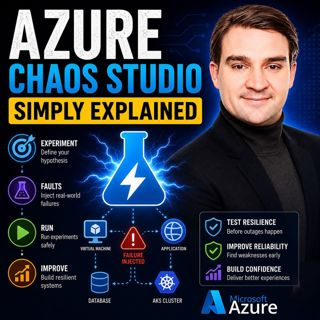
Azure Chaos Studio - Simply Explained

Azure Chaos Studio - Simply Explained

Cloud applications rarely fail because of a single bug. More often, they fail because of unexpected combinations of network latency, overloaded servers, unavailable databases, or infrastructure outage...

14 Heinä 14min

Your AI Landing Zone Is A Liability

Your AI Landing Zone Is A Liability

Most organizations believe deploying Azure OpenAI is as simple as provisioning another Azure resource. Create an endpoint, generate an API key, connect your application, and start building AI experien...

14 Heinä 1h 21min

Data Analysis Expressions (DAX) - Simply Explained

Data Analysis Expressions (DAX) - Simply Explained

If you've spent any time working with Power BI, you've almost certainly heard about DAX. Some people describe it as "Excel formulas for Power BI," while others treat it like a complex programming lang...

14 Heinä 15min

Graph API - Simply Explained

Graph API - Simply Explained

Microsoft Graph API is one of the most important technologies in the Microsoft ecosystem, yet it's often misunderstood. Is it a database? A service? Or simply another developer tool? In this episode o...

13 Heinä 12min
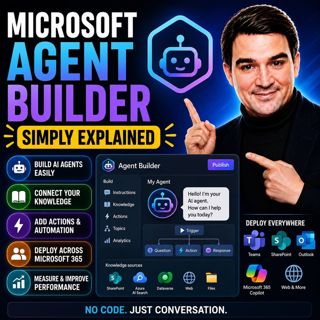
Microsoft Agent Builder — Simply Explained

Microsoft Agent Builder — Simply Explained

Building AI agents used to require developers, code, and complex AI platforms. Microsoft Agent Builder changes that completely. Built directly into Microsoft 365 Copilot, Agent Builder allows anyone t...

13 Heinä 15min
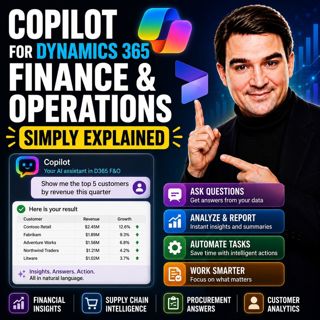
Copilot for Dynamics 365 Finance and Operations - Simply Explained

Copilot for Dynamics 365 Finance and Operations - Simply Explained

Finance teams have never struggled with a lack of data—they struggle with the time it takes to find, organize, analyze, and act on that information. Traditional ERP workflows often require switching b...

13 Heinä 11min

Suosittua kategoriassa Politiikka ja uutiset

aikalisa
uutiscast
ootsa-kuullut-tasta-2
rss-ootsa-kuullut-tasta
rss-seksicast
rss-podme-livebox
otetaan-yhdet
rss-vaalirankkurit-podcast
politiikan-puskaradio
tervo-halme
aihe
rss-girls-finish-f1rst
linda-maria
rikosmyytit
rss-aijat-hopottaa-podcast
rss-mita-tapahtuu
rss-merja-mahkan-rahat
rss-raha-talous-ja-politiikka
rss-asiastudio
rss-pinnalla