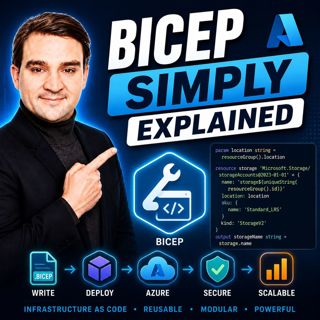
Bicep - Simply Explained
Deploying Azure resources through the Azure Portal is great for learning, but it quickly becomes difficult to repeat, document, and automate. That's where Bicep comes in. In this episode, we explain Microsoft's Infrastructure as Code language in plain English, showing how Bicep simplifies Azure deployments while providing consistency, automation, and version control. Whether you're an Azure administrator, cloud engineer, developer, or just starting your Infrastructure as Code journey, this episode will help you understand why Microsoft recommends Bicep as the future of Azure deployments.

WHY MANUAL DEPLOYMENTS DON'T SCALE
Creating Azure resources by clicking through the portal may seem fast, but it introduces inconsistency, human error, and poor documentation. Every manual deployment risks configuration drift, forgotten settings, and environments that no longer match each other. As organizations grow, these challenges become increasingly difficult to manage. Bicep solves this by replacing manual configuration with reusable deployment files that can be reviewed, version-controlled, and executed repeatedly with identical results.

UNDERSTANDING INFRASTRUCTURE AS CODE
Infrastructure as Code (IaC) is the practice of managing cloud infrastructure through source code instead of manual administration. Rather than describing deployment steps one by one, Bicep follows a declarative approach where you simply describe the desired end state. Azure Resource Manager determines how to provision resources while automatically handling deployment order and dependencies. This approach creates predictable, repeatable deployments that become the single source of truth for your cloud infrastructure.

WHY MICROSOFT CREATED BICEP
Before Bicep, Azure deployments relied primarily on ARM Templates written in JSON. While ARM remains extremely powerful, JSON templates can become lengthy, difficult to read, and challenging to maintain. Bicep was created to solve these problems without replacing Azure Resource Manager itself. Instead, Bicep compiles directly into ARM Templates behind the scenes, giving administrators the same deployment engine while dramatically improving readability, maintainability, and developer productivity.

WHAT MAKES BICEP DIFFERENT?
Bicep introduces a clean, domain-specific language designed specifically for Azure deployments. It removes unnecessary JSON syntax, automatically detects resource dependencies, supports reusable modules, simplifies parameter handling, and offers powerful tooling through Visual Studio Code. Features such as IntelliSense, syntax validation, real-time error detection, and string interpolation make writing Azure infrastructure significantly easier while reducing common deployment mistakes.

BICEP VS ARM TEMPLATES
Although both technologies ultimately deploy resources through Azure Resource Manager, the authoring experience is very different. Bicep files are significantly smaller, easier to understand, and require far less boilerplate code than equivalent ARM Templates. Automatic dependency inference removes the need for manually managing deployment order, while modular design encourages reusable infrastructure components that can be shared across multiple projects and teams. Microsoft now recommends Bicep as the preferred language for all new Azure Infrastructure as Code projects.

BICEP VS TERRAFORM
Bicep and Terraform both implement Infrastructure as Code but serve different purposes. Terraform excels in multi-cloud environments where Azure, AWS, and Google Cloud are managed together. Bicep focuses exclusively on Azure, offering immediate support for new Azure features, seamless Azure Resource Manager integration, and no external state file to maintain. For organizations building primarily on Microsoft Azure, Bicep often provides the simplest and most integrated deployment experience.

GETTING STARTED WITH BICEP
Starting with Bicep requires only Azure CLI and the official Microsoft Bicep extension for Visual Studio Code. Developers can create a simple .bicep file, deploy resources directly through Azure CLI or Visual Studio Code, and immediately begin managing Azure infrastructure using source-controlled deployment files. Because Bicep integrates naturally with GitHub Actions, Azure DevOps, and CI/CD pipelines, it becomes easy to automate deployments while maintaining consistent environments throughout the software development lifecycle.

THE POWER OF IDEMPOTENT DEPLOYMENTS
One of Bicep's greatest advantages is idempotency. Running the same deployment once, twice, or even one hundred times always produces the same desired infrastructure state. Existing resources remain unchanged unless the deployment file has been modified, eliminating duplicate resources and dramatically reducing configuration drift. Instead of relying on memory, documentation, or manual procedures, the Bicep file itself becomes the authoritative definition of your Azure environment.

KEY TAKEAWAYS

Bicep is Microsoft's modern Infrastructure as Code language for Azure. By simplifying ARM Template authoring while retaining the full power of Azure Resource Manager, Bicep enables organizations to automate deployments, improve collaboration, reduce human error, and manage cloud infrastructure through version-controlled source code. Whether you're deploying a single resource group or an enterprise-scale landing zone, Bicep provides a clean, maintainable, and future-ready foundation for Azure automation.

Become a supporter of this podcast: https://www.spreaker.com/podcast/m365-fm-modern-work-security-and-productivity-with-microsoft-365--6704921/support.

Tämä jakso on lisätty Podme-palveluun avoimen RSS-syötteen kautta eikä se ole Podmen omaa tuotantoa. Siksi jakso saattaa sisältää mainontaa.

Jaksot(740)

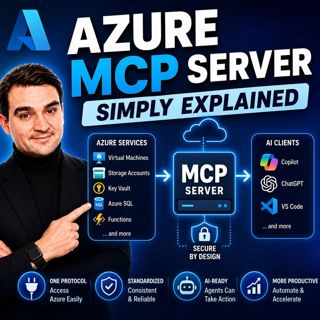
Azure MCP Server - Simply Explained

Azure MCP Server - Simply Explained

Artificial Intelligence is rapidly evolving from simply answering questions to actively performing real work. But for AI agents to become truly useful, they need secure access to cloud resources, data...

15 Heinä 17min
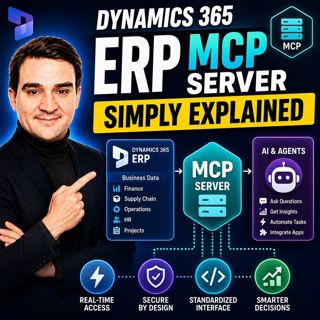
Dynamics 365 ERP MCP Server - Simply Explained

Dynamics 365 ERP MCP Server - Simply Explained

Artificial Intelligence is transforming how businesses interact with enterprise systems, but connecting AI assistants to ERP platforms has traditionally required custom APIs, complex integrations, and...

15 Heinä 13min
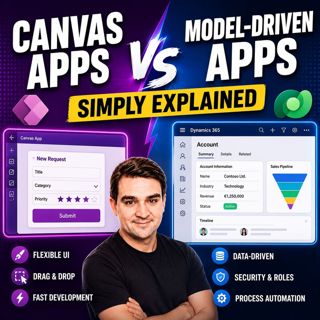
Canvas Apps vs Model-Driven Apps - Simply Explained

Canvas Apps vs Model-Driven Apps - Simply Explained

Microsoft Power Apps offers two primary ways to build business applications: Canvas Apps and Model-Driven Apps. At first glance they may appear similar, but they are designed for very different scenar...

15 Heinä 15min

Infrastructure as Code - Simply Explained

Infrastructure as Code - Simply Explained

Managing cloud infrastructure by clicking through the Azure Portal might work for a single virtual machine, but it quickly becomes slow, inconsistent, and difficult to maintain as environments grow. I...

15 Heinä 16min
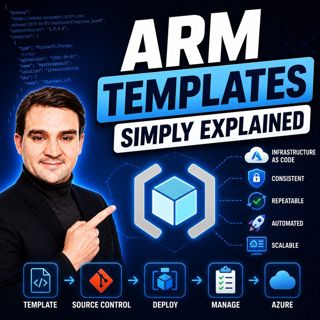
ARM Templates - Simply Explained

ARM Templates - Simply Explained

If you've ever built Azure resources by clicking through the Azure Portal, you've probably wondered how large organizations deploy identical environments over and over again without making mistakes. T...

15 Heinä 15min

Teams Telephony - Simply Explained

Teams Telephony - Simply Explained

Microsoft Teams Telephony transforms Microsoft Teams into a complete cloud-based business phone system, replacing traditional office PBXs with a modern, software-powered solution. In this episode, we ...

15 Heinä 17min
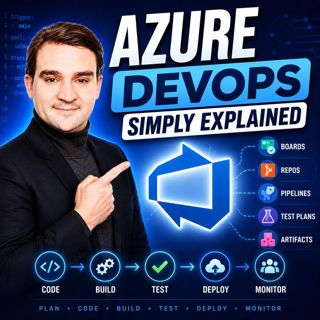
Azure DevOps - Simply Explained

Azure DevOps - Simply Explained

Azure DevOps is one of Microsoft's most comprehensive platforms for software development, yet many people mistakenly believe it's only for developers. In reality, Azure DevOps brings together project ...

15 Heinä 17min

Suosittua kategoriassa Politiikka ja uutiset

aikalisa
uutiscast
ootsa-kuullut-tasta-2
rss-ootsa-kuullut-tasta
rss-seksicast
rss-vaalirankkurit-podcast
rss-podme-livebox
otetaan-yhdet
politiikan-puskaradio
tervo-halme
aihe
linda-maria
rikosmyytit
mtv-uutiset-polloraati
rss-aijat-hopottaa-podcast
rss-merja-mahkan-rahat
rss-raha-talous-ja-politiikka
rss-tekoalyfoorumi
rss-asiastudio
rss-girls-finish-f1rst