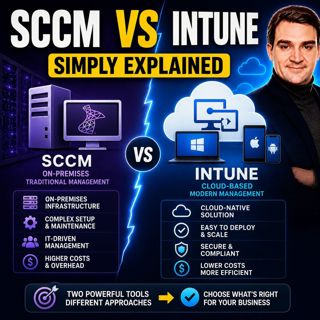

SCCM vs Intune - Simply Explained
SCCM (System Center Configuration Manager), now officially known as Microsoft Endpoint Configuration Manager (MECM), and Microsoft Intune are two of Microsoft's most important endpoint management solutions. While both help IT teams deploy software, manage devices, enforce security policies, and keep endpoints updated, they were built for completely different eras of IT. SCCM was designed for traditional on-premises corporate networks where everything lived inside the company's data center. Intune was built for today's cloud-first world, where employees work remotely, devices connect from anywhere, and management happens over the internet. Understanding these differences is essential when planning a modern endpoint management strategy.

SCCM: THE ON-PREMISES POWERHOUSE
SCCM has been the enterprise standard for Windows device management for more than two decades. Running on infrastructure that organizations build and maintain themselves, SCCM provides extremely deep control over Windows desktops and servers. IT administrators can deploy operating systems using task sequences, distribute complex applications with dependencies, manage software updates through Windows Server Update Services (WSUS), inventory hardware and software, generate highly detailed reports, and automate large-scale deployments across thousands of devices. While incredibly powerful, SCCM requires significant infrastructure including SQL Server, site servers, management points, distribution points, and experienced administrators to keep everything running smoothly.

INTUNE: THE MODERN CLOUD-NATIVE APPROACH
Microsoft Intune takes a completely different approach by moving endpoint management into the Microsoft cloud. There are no management servers to install, no SQL databases to maintain, and no distribution points to configure. Devices simply enroll over the internet and receive applications, security policies, compliance rules, and updates directly from Microsoft. Intune supports Windows, macOS, iOS, and Android from a single administration portal, making it ideal for organizations with remote employees, hybrid work, Bring Your Own Device (BYOD) programs, and globally distributed teams. Deep integration with Microsoft Entra ID, Conditional Access, Microsoft Defender, Windows Autopilot, and Microsoft 365 makes Intune a central component of Microsoft's Zero Trust security strategy.

SCCM VS INTUNE: WHICH IS BETTER?
The answer depends entirely on your environment. SCCM provides unmatched control for complex Windows deployments, server management, operating system imaging, advanced reporting, and highly customized application deployments. Intune excels in cloud-native device management, mobile device management, automated provisioning with Windows Autopilot, and managing users wherever they work. Organizations that primarily operate on-premises with large Windows environments often continue relying on SCCM, while businesses embracing cloud computing and remote work increasingly choose Intune as their primary management platform. Rather than replacing one another, both products complement different management scenarios and organizational requirements.

CO-MANAGEMENT: THE BEST OF BOTH WORLDS
Microsoft understands that most enterprises cannot migrate overnight, which is why Co-Management allows SCCM and Intune to manage the same device simultaneously. Organizations can gradually move workloads such as compliance policies, Windows updates, endpoint protection, and device configuration from SCCM into Intune while continuing to use SCCM for operating system deployment, server management, or complex software installations. This phased migration reduces risk, protects existing investments, and allows IT departments to modernize at their own pace without disrupting users or rebuilding their entire management infrastructure in one project.

WHICH SOLUTION SHOULD YOUR ORGANIZATION CHOOSE?
For organizations with highly customized Windows environments, large on-premises infrastructures, and advanced deployment requirements, SCCM remains one of the most capable endpoint management platforms available. For businesses adopting hybrid work, cloud-first infrastructure, mobile devices, and Microsoft 365, Intune represents the future of endpoint management. Many enterprises ultimately use both through Co-Management, combining SCCM's mature deployment capabilities with Intune's cloud-native flexibility and security. As Microsoft continues investing heavily in Intune and cloud management, understanding how both solutions work together has become increasingly important for every IT professional responsible for managing modern workplace devices.

Become a supporter of this podcast: https://www.spreaker.com/podcast/m365-fm-modern-work-security-and-productivity-with-microsoft-365--6704921/support.

Tämä jakso on lisätty Podme-palveluun avoimen RSS-syötteen kautta eikä se ole Podmen omaa tuotantoa. Siksi jakso saattaa sisältää mainontaa.

Jaksot(792)

Microsoft Fabric OneLake - Simply Explained

Microsoft Fabric OneLake - Simply Explained

Microsoft Fabric OneLake is the unified storage layer at the heart of Microsoft Fabric, designed to eliminate one of the biggest challenges in modern analytics: data duplication. Instead of every depa...

17 Heinä 14min
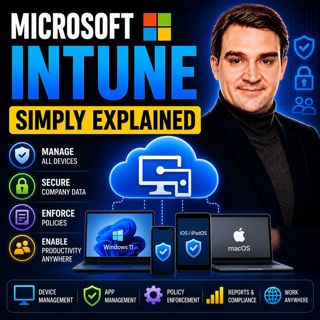
Microsoft Intune - Simply Explained

Microsoft Intune - Simply Explained

Microsoft Intune is Microsoft's cloud-based endpoint management platform that allows organizations to securely manage laptops, desktops, smartphones, tablets, and applications from a single web-based ...

17 Heinä 12min
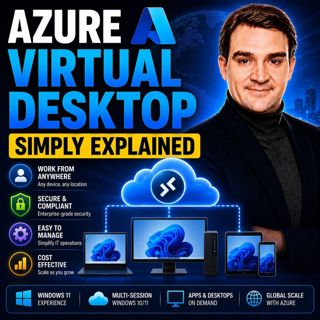
Azure Virtual Desktop - Simply Explained

Azure Virtual Desktop - Simply Explained

Azure Virtual Desktop (AVD) is Microsoft's cloud-based desktop virtualization platform that delivers a complete Windows desktop and business applications securely from Azure to virtually any device. I...

17 Heinä 18min
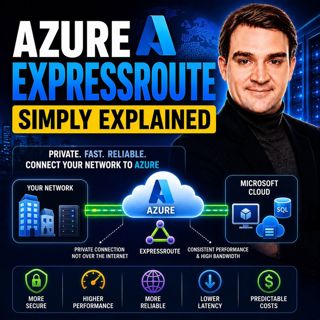
Azure ExpressRoute - Simply Explained

Azure ExpressRoute - Simply Explained

Azure ExpressRoute is Microsoft's private network connection service that links your on-premises infrastructure directly to Microsoft's global cloud network without using the public internet. Instead ...

17 Heinä 13min
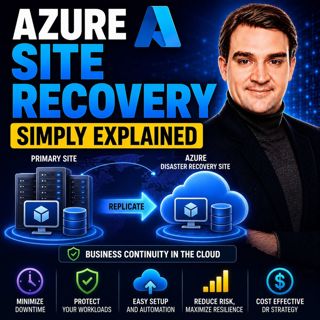
Azure Site Recovery - Simply Explained

Azure Site Recovery - Simply Explained

Azure Site Recovery (ASR) is Microsoft's disaster recovery service designed to keep your business running when an entire server, data center, or Azure region becomes unavailable. Instead of simply bac...

17 Heinä 14min
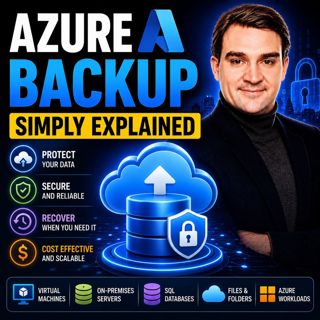
Azure Backup - Simply Explained

Azure Backup - Simply Explained

Azure Backup is Microsoft's fully managed cloud backup service that protects your virtual machines, databases, file shares, disks, and even on-premises servers without requiring backup servers, tapes,...

17 Heinä 16min
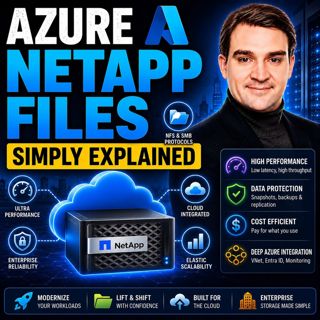
Azure NetApp Files - Simply Explained

Azure NetApp Files - Simply Explained

Azure NetApp Files (ANF) is Microsoft's enterprise-grade, ultra-high-performance file storage service built directly into Azure. Powered by NetApp's industry-leading storage technology, ANF delivers s...

17 Heinä 15min

Suosittua kategoriassa Politiikka ja uutiset

aikalisa
uutiscast
ootsa-kuullut-tasta-2
rss-ootsa-kuullut-tasta
rss-vaalirankkurit-podcast
rss-podme-livebox
rss-seksicast
otetaan-yhdet
tervo-halme
politiikan-puskaradio
aihe
linda-maria
rss-raha-talous-ja-politiikka
viela-yksi-sivu
the-ulkopolitist
mtv-uutiset-polloraati
et-sa-noin-voi-sanoo-esittaa
rss-sveriges-radio-finska
rss-fingo-podcast
rss-girls-finish-f1rst