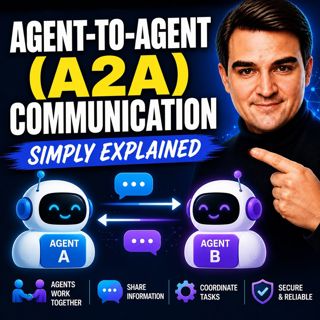
Agent-to-Agent (A2A) Communication - Simply Explained

Agent-to-Agent (A2A) Communication - Simply Explained

Welcome to another episode of Knowledge Nuggets with Mirko Peters. In this episode, we're exploring Agent-to-Agent (A2A) Communication, the open protocol that allows AI agents to discover one another, delegate work, and collaborate as intelligent teams. Today's AI agents are often highly specialized but isolated. One agent may excel at booking flights, another at checking weather, and another at managing IT tickets—but without a common communication standard, connecting them quickly becomes a maintenance nightmare. A2A solves this problem by providing a standardized way for AI agents to communicate regardless of which vendor or platform they were built on.

THE PROBLEM WITH ISOLATED AI AGENTS
Most AI agents today operate independently. As organizations build more specialized AI solutions, every new capability often requires custom integrations between agents. A travel assistant may need to communicate with weather, hotel, calendar, and airline services. Without a standard communication protocol, developers must create individual integrations between every pair of agents. Over time these point-to-point integrations become difficult to maintain, expensive to scale, and highly fragile. Every new agent increases complexity, creating what many developers describe as "integration spaghetti." A2A addresses this challenge by introducing a common communication protocol that allows independent AI agents to cooperate without requiring custom bridges between every service.

WHAT IS AGENT-TO-AGENT (A2A)?
Agent-to-Agent (A2A) is an open communication protocol that enables AI agents to exchange requests, delegate tasks, and return results. A useful analogy is HTTP for websites. Just as web browsers and servers communicate using HTTP, AI agents can communicate using A2A regardless of which platform they run on. The protocol is supported by major technology companies including Microsoft, Google, Cisco, Salesforce, SAP, and others through the Linux Foundation, making it an industry standard rather than a proprietary technology. A2A is built on familiar web technologies including HTTP and JSON-RPC, allowing developers to adopt it using existing networking and API knowledge. A2A VS MCP A2A is frequently compared with the Model Context Protocol (MCP), but the two solve different problems. MCP connects AI agents to tools, APIs, databases, and external systems. A2A connects AI agents directly to other AI agents. Rather than competing technologies, they complement one another. An AI agent may use MCP to retrieve information from a CRM system and then use A2A to delegate another portion of the overall task to a specialist AI agent. This creates both vertical integration with business systems and horizontal collaboration between intelligent agents.

AGENT CARDS
Every A2A-compatible agent publishes an Agent Card. Think of it as a machine-readable business card or résumé describing what an agent can do. The Agent Card contains information such as:
  • Agent name
  • Description
  • Skills
  • Endpoint URL
  • Authentication requirements
  • Supported input formats
  • Supported output formats
Agent Cards are published using a standard location (/.well-known/agent-card.json), allowing orchestrators to automatically discover specialist agents and understand their capabilities without manual configuration. This decentralized approach removes the need for a central registry while making it easy to introduce new agents into an existing ecosystem.

HOW A2A COMMUNICATION WORKS
Communication between agents takes place using standard HTTP requests carrying JSON-RPC messages. A2A supports three communication models depending on the workload. Instant responses are used for quick synchronous requests such as retrieving today's weather. Streaming responses allow agents to continuously report progress during longer-running operations using Server-Sent Events. Asynchronous tasks support workflows that may take minutes, hours, or even days. Each request receives a task identifier that allows progress tracking while the work continues in the background. Every interaction is represented as a task containing messages, structured content, attachments, or references to external files. Authentication relies on familiar technologies such as OAuth, bearer tokens, or API keys, making integration straightforward for enterprise environments.

THE ORCHESTRATOR-SPECIALIST PATTERN
Most production multi-agent systems follow the Orchestrator-Specialist architecture. The orchestrator receives the user's request, understands the overall objective, and decides which specialist agents should perform each part of the work. Specialist agents focus on a single business capability such as:
  • Flight booking
  • Hotel reservations
  • Weather forecasting
  • Ticket resolution
  • HR onboarding
  • Financial processing
The orchestrator never performs the specialist work itself. Instead, it delegates tasks, waits for responses, and combines the individual results into a single answer for the user. Microsoft Copilot Studio uses this architecture natively, allowing a primary Copilot to coordinate child agents and connected agents through A2A.

REAL-WORLD USE CASES A2A
enables AI systems to collaborate across many business scenarios. A travel planning assistant can delegate weather forecasts, flight searches, and hotel recommendations to independent specialist agents before combining the responses into a complete itinerary. IT support workflows can automatically distribute work between diagnosis agents, remediation agents, and ticket management agents. Employee onboarding can coordinate IT provisioning, HR processes, facilities management, and security access across multiple days using asynchronous task tracking. Organizations are already adopting this model. Microsoft highlights customers using Copilot Studio and Dynamics 365 where orchestrated agents automate complex planning activities that previously required significant manual effort, reducing repetitive work while improving operational efficiency.

MICROSOFT'S A2A ECOSYSTEM
Microsoft has fully embraced A2A across its AI platform. Copilot Studio supports connected A2A agents, allowing developers to integrate agents hosted on Microsoft Azure, Google Cloud, AWS, or other A2A-compatible platforms. Adding a connected agent is straightforward. Developers provide the agent endpoint, Copilot Studio retrieves the Agent Card, understands the agent's capabilities, and automatically creates the necessary integration. Azure AI Foundry Agent Service also exposes A2A endpoints, enabling frameworks such as Semantic Kernel, LangChain, and AutoGen to interact with Azure-hosted agents. This open architecture allows organizations to build multi-agent ecosystems without being locked into a single cloud provider or AI framework.

BENEFITS AND BEST PRACTICES
The greatest strength of A2A is modularity. Organizations can introduce new specialist agents without redesigning existing workflows. Agents become reusable building blocks that can be replaced, upgraded, or expanded independently. When designing multi-agent systems, it is important to:
  • Keep specialist domains clearly separated
  • Avoid overlapping responsibilities
  • Let orchestrators coordinate rather than execute work
  • Minimize unnecessary delegation layers to reduce latency
Following these principles creates scalable, maintainable AI architectures capable of growing alongside business requirements.

Become a supporter of this podcast: https://www.spreaker.com/podcast/m365-fm-modern-work-security-and-productivity-with-microsoft-365--6704921/support.

Tämä jakso on lisätty Podme-palveluun avoimen RSS-syötteen kautta eikä se ole Podmen omaa tuotantoa. Siksi jakso saattaa sisältää mainontaa.

Jaksot(821)

Dataverse Security - Simply Explained

Dataverse Security - Simply Explained

Welcome to another episode of Knowledge Nuggets with Mirko Peters. In this episode, we're exploring Microsoft Dataverse Security—one of the most important, and often misunderstood, aspects of the Powe...

21 Heinä 0s
Power Platform - Simply Explained

Power Platform - Simply Explained

Welcome to another episode of Knowledge Nuggets with Mirko Peters. In this episode, we're exploring the Microsoft Power Platform—Microsoft's low-code ecosystem for building applications, automating bu...

21 Heinä 0s

Power Pages - Simply Explained

Power Pages - Simply Explained

Welcome to another episode of Knowledge Nuggets with Mirko Peters. In this episode, we're exploring Microsoft Power Pages, Microsoft's low-code platform for building secure, external-facing business w...

21 Heinä 0s
Power Apps - Simply Explained

Power Apps - Simply Explained

Welcome to another episode of Knowledge Nuggets with Mirko Peters. In this episode, we're exploring Microsoft Power Apps, Microsoft's low-code platform for building custom business applications withou...

21 Heinä 0s
Power Automate - Simply Explained

Power Automate - Simply Explained

Welcome to another episode of Knowledge Nuggets with Mirko Peters. In this episode, we're exploring Microsoft Power Automate, one of the most powerful productivity tools in the Microsoft ecosystem. Ma...

21 Heinä 0s
AI Agents - Simply Explained

AI Agents - Simply Explained

Welcome to another episode of Knowledge Nuggets with Mirko Peters. In this episode, we're exploring AI Agents—one of the fastest-growing concepts in artificial intelligence and the foundation of Micro...

21 Heinä 0s

From Data to Intelligent Agents: Building Trusted Enterprise AI with Microsoft AI Foundry with Shubhangi Goyal [MVP]

From Data to Intelligent Agents: Building Trusted Enterprise AI with Microsoft AI Foundry with Shubhangi Goyal [MVP]

Enterprise AI is entering a new phase where success is no longer measured by impressive demos but by real business outcomes. Organizations are moving beyond experimenting with large language models an...

21 Heinä 0s

From AI Hype to AI Harness Engineering – Building AI That People Can Actually Trust with Alan Buscaglia [MVP] from Gentleman Programming

From AI Hype to AI Harness Engineering – Building AI That People Can Actually Trust with Alan Buscaglia [MVP] from Gentleman Programming

Artificial Intelligence is evolving rapidly, but building AI that organizations can actually trust requires far more than choosing the latest language model. In this episode of the M365.fm podcast, Mi...

20 Heinä 0s

Suosittua kategoriassa Politiikka ja uutiset

aikalisa
uutiscast
ootsa-kuullut-tasta-2
rss-ootsa-kuullut-tasta
rss-vaalirankkurit-podcast
rss-podme-livebox
rss-seksicast
otetaan-yhdet
politiikan-puskaradio
aihe
tervo-halme
rss-girls-finish-f1rst
et-sa-noin-voi-sanoo-esittaa
rss-kovin-paikka
viela-yksi-sivu
the-ulkopolitist
rss-sveriges-radio-finska
rss-kaikki-uusiksi
rss-fingo-podcast
rss-raha-talous-ja-politiikka