224: Biohybrid implants: wireless sensing with engineered bacteria
Base by Base10 Joulu 2025

224: Biohybrid implants: wireless sensing with engineered bacteria

Bilir A et al., Wireless in-body sensing through genetically engineered bacteria - A bio-hybrid, battery-free implant converts engineered bacterial activity into microwave backscatter signals by controlled degradation of a biodegradable antenna. Key terms: engineered bacteria, biodegradable antenna, backscatter communication, implantable sensor, cytochrome c.

Study Highlights:
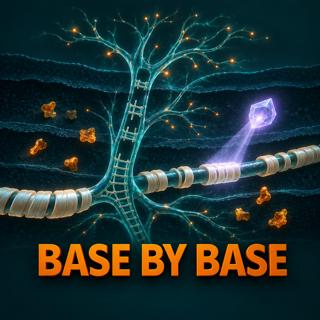
The AntennAlive system uses a magnesium split-ring passive implant antenna coupled with genetically engineered Escherichia coli that accelerate metal degradation to convert molecular detection into an electromagnetic signature. E. coli BL21 engineered to express the CcmA–H cytochrome c maturation pathway degraded the magnesium prototype faster (≈8 h) than non-engineered cells (≈14 h), causing a controlled structural transition from split ring to segmented ring. Numerical and experimental work showed resonant frequencies near 1.16 GHz for the intact antenna and 1.91 GHz after degradation, and an on-body reader antenna covering 0.8–2.3 GHz enabled backscatter monitoring through a muscle phantom. A wireless, chipless link between the cell-based passive implant and an external receiver was demonstrated at 25 mm implant depth, showing potential for molecular-level in-body sensing without batteries or electronics.

Conclusion:
Genetically programmed bacteria can modulate biodegradable antenna properties to produce remotely detectable backscatter signals, enabling battery-free, implantable molecular sensing.

Music:
Enjoy the music based on this article at the end of the episode.

First author:
Bilir A

Journal:
Nature Communications

DOI:
10.1038/s41467-025-65416-5

Reference:
Bilir A., Yavuz M., Safak Seker U. O., Dumanli S. Wireless in-body sensing through genetically engineered bacteria. Nature Communications. 2025;16:10432. https://doi.org/10.1038/s41467-025-65416-5

License:
This episode is based on an open-access article published under the Creative Commons Attribution 4.0 International License (CC BY 4.0) – https://creativecommons.org/licenses/by/4.0/

Support:
Base by Base – Stripe donations: https://donate.stripe.com/7sY4gz71B2sN3RWac5gEg00

Official website https://basebybase.com

On PaperCast Base by Base you’ll discover the latest in genomics, functional genomics, structural genomics, and proteomics.

Episode link: https://basebybase.com/episodes/antennalive-bacterial-implant

️ Episode:
224: AntennAlive — wireless in-body sensing with engineered bacteria

️ Season:
1

Article title:
Wireless in-body sensing through genetically engineered bacteria

QC:
This episode was checked against the original article PDF and publication metadata for the episode release published on 2025-12-10.

QC Scope:
- article metadata and core scientific claims from the narration
- excludes analogies, intro/outro, and music
- transcript coverage: Audited the transcript's coverage of AntennAlive concept, magnesium-based passive implant, engineered E. coli (CcmA–H), degradation-driven resonant-frequency shift, experimental phantom setup, 25 mm depth demonstration, and discussed limitations/future work.
- transcript topics: AntennAlive concept and biohybrid sensing bridge; Magnesium-based passive implant antenna design and degradation; Engineering E. coli for extracellular electron transfer (CcmA–H); Degradation dynamics and resonance shift (1.16 GHz to 1.91 GHz); Experimental setup: muscle phantom, Mg foil, on-body reader, VNA; Phantom-based wireless backscatter demonstration at 25 mm depth

QC Summary:
- factual score: 10/10
- metadata score: 10/10
- supported core claims: 7
- claims flagged for review: 0
- metadata checks passed: 4
- metadata issues found: 0

Metadata Audited:
- article_doi
- article_title
- articl...

Tämä jakso on lisätty Podme-palveluun avoimen RSS-syötteen kautta eikä se ole Podmen omaa tuotantoa. Siksi jakso saattaa sisältää mainontaa.

Jaksot(441)

439: Coembedding Sequence and Structure: CLSS Maps the Protein Universe

439: Coembedding Sequence and Structure: CLSS Maps the Protein Universe

Longo LM et al., PNAS - This episode summarizes a PNAS study introducing CLSS, a contrastive two-tower protein language model that coembeds domain sequences, structures, and subsequences into a shared...

11 Elo 23min

438: Mapping AIRE: a proactive atlas of 9,790 missense variants

438: Mapping AIRE: a proactive atlas of 9,790 missense variants

Axakova A et al., The American Journal of Human Genetics - Axakova et al. generated a variant effect map for AIRE using an insulin‑promoter GFP reporter in HEK293 cells to measure the functional impac...

10 Elo 24min

437: Cell villages and Dirichlet modeling map human cell fitness genetics

437: Cell villages and Dirichlet modeling map human cell fitness genetics

Hanson C et al., The American Journal of Human Genetics - Hanson et al. combine pooled multi-donor human neural progenitor cell "villages" with Townlet, a hierarchical Dirichlet regression model, to e...

9 Elo 28min

436: KIAP4 and the ARND family: building the Leishmania adhesion plaque

436: KIAP4 and the ARND family: building the Leishmania adhesion plaque

Owino BO et al., PNAS - Using TurboID proximity proteomics and microscopy, researchers identify KIAP4 as the canonical member of a conserved Adhesion Related NTPase-like Domain (ARND) family that loca...

8 Elo 24min

435: E. coli TGT binds two tRNAs — cryo-EM reveals dual engagement

435: E. coli TGT binds two tRNAs — cryo-EM reveals dual engagement

Ember M et al., PNAS - This episode examines a cryo-EM study of Escherichia coli tRNA-guanine transglycosylase (TGT) that solves the enzyme structure and its covalent intermediate with tRNATyr. Unexpe...

7 Elo 19min

434: High‑coverage genomes recast Japan's prehistoric demography

434: High‑coverage genomes recast Japan's prehistoric demography

Ishiya K et al., PNAS - This episode examines a PNAS study that reports two high-coverage ancient human genomes from mainland Japan (an Initial Jomon >67× and a Middle Yayoi >46×). The genomes enable ...

6 Elo 27min

433: Lactate, HSP90α and the Mitochondrial Switch

433: Lactate, HSP90α and the Mitochondrial Switch

Wu G et al., Proceedings of the National Academy of Sciences - This episode examines a PNAS study that identifies site-specific lactylation of HSP90α as a metabolic signal linking glycolysis to mitoch...

23 Heinä 23min

432: Echovirus 18: Capsid opening releases the genome

432: Echovirus 18: Capsid opening releases the genome

Mukhamedova L et al., Proceedings of the National Academy of Sciences - Using cryo-electron tomography and single-particle cryo-EM of infected Cos-7 cells, the authors show that echovirus 18 (E18) rel...

23 Heinä 18min

Suosittua kategoriassa Tiede

rss-poliisin-mieli
tiedekulma-podcast
rss-mita-tulisi-tietaa
docemilia
rss-hereilla
rss-bios-podcast
utelias-mieli
hippokrateen-vastaanotolla
rss-metsanomistaja-podcast
rss-lapsuuden-rakentajat-podcast
rss-sosiopodi
filocast-filosofian-perusteet
rss-tiedetta-vai-tarinaa
rss-duodecim-lehti
radio-antro
rss-totuuden-liepeilla