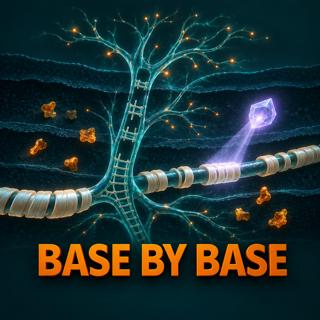
273: CTVT-A acquires 15-Mb N-HT1 dicentric nuclear element via horizontal transfer
Base by Base28 Tammi

273: CTVT-A acquires 15-Mb N-HT1 dicentric nuclear element via horizontal transfer

Gori K et al., Proc. Natl. Acad. Sci. U.S.A. 2025.122:e2424634122 - In canine transmissible venereal tumor (CTVT), deep sequencing and cytogenetics identify a 15‑Mb horizontally transferred nuclear element (N-HT1) acquired ~2,000 years ago that is transcriptionally active. Key terms: CTVT, horizontal gene transfer, N-HT1, PacBio long-read sequencing, centromeric fusion.

Study Highlights:
The authors screened 174 transmissible tumor genomes, focusing on CTVT, DFT1, and DFT2, using deep short-read sequencing, long-read PacBio sequencing, structural variant analysis, and metaphase FISH. In CTVT-A they discovered a 15-Mb dicentric element (N-HT1) assembled from 11 fragments of six chromosomes that forms the short arm of a small submetacentric chromosome after centromeric fusion. Mutation density and CpG-based dating place N-HT1 acquisition about 2,000 years ago, and transcriptome allele deconvolution shows N-HT1 is transcriptionally active and adopts the CTVT expression profile. Functional interrogation found no clear oncogenic drivers on N-HT1, with at least one rescued gene (ARFGEF3) later inactivated, consistent with the element behaving as a likely neutral passenger.

Conclusion:
A single host-to-tumor nuclear horizontal transfer event was detected in sampled transmissible cancers: CTVT-A acquired a 15-Mb N-HT1 element that is transcriptionally active but shows no clear evidence of positive selection.

QC:
This episode was checked against the original article PDF and publication metadata for the episode release published on 2026-01-28.

QC Scope:
- article metadata and core scientific claims from the narration
- excludes analogies, intro/outro, and music
- transcript coverage: Audited the core scientific claims presented about N-HT1: its structure, origin, timing, transcriptional activity, and evolutionary implications, as described in the article.
- transcript topics: CTVT background and transmissible cancers; SNP flipping screen to detect host-to-tumor nuclear transfer; Discovery and structure of N-HT1 (15 Mb, 11 fragments, from 6 chromosomes); Cytogenetics and centromeric fusion of N-HT1 onto a CTVT chromosome; Timing: acquisition ~2000 years ago and donor ancestry; Gene expression and functional impact (ARFGEF3 rescue)

QC Summary:
- factual score: 10/10
- metadata score: 10/10
- supported core claims: 8
- claims flagged for review: 0
- metadata checks passed: 4
- metadata issues found: 0

Metadata Audited:
- article_doi
- article_title
- article_journal
- license

Factual Items Audited:
- N-HT1 is a 15-Mb horizontally transferred nuclear DNA element composed of 11 fragments from six canine chromosomes
- N-HT1 forms the short arm of a small submetacentric chromosome via centromeric fusion onto a CTVT chromosome
- N-HT1 was acquired by CTVT-A approximately 2,000 years ago
- N-HT1 is transcriptionally active and adopts the CTVT expression profile
- There is no clear evidence of positive selection acting on N-HT1 within CTVT-A
- ARFGEF3 was rescued from a null state by N-HT1 but was subsequently inactivated again

QC result: Pass.

Chapters
  • (00:00:00) - Blast by Bass
  • (00:00:29) - Cancer Has Stealing DNA From Your Body
  • (00:02:41) - Horizontal Transfer of nuclear DNA in transmissible cancer
  • (00:07:24) - The ghost of a dog's genome
  • (00:11:55) - Transmissible DNA in human cancer
  • (00:14:08) - Step, Step, Close Hold

Tämä jakso on lisätty Podme-palveluun avoimen RSS-syötteen kautta eikä se ole Podmen omaa tuotantoa. Siksi jakso saattaa sisältää mainontaa.

Jaksot(441)

439: Coembedding Sequence and Structure: CLSS Maps the Protein Universe

439: Coembedding Sequence and Structure: CLSS Maps the Protein Universe

Longo LM et al., PNAS - This episode summarizes a PNAS study introducing CLSS, a contrastive two-tower protein language model that coembeds domain sequences, structures, and subsequences into a shared...

11 Elo 23min

438: Mapping AIRE: a proactive atlas of 9,790 missense variants

438: Mapping AIRE: a proactive atlas of 9,790 missense variants

Axakova A et al., The American Journal of Human Genetics - Axakova et al. generated a variant effect map for AIRE using an insulin‑promoter GFP reporter in HEK293 cells to measure the functional impac...

10 Elo 24min

437: Cell villages and Dirichlet modeling map human cell fitness genetics

437: Cell villages and Dirichlet modeling map human cell fitness genetics

Hanson C et al., The American Journal of Human Genetics - Hanson et al. combine pooled multi-donor human neural progenitor cell "villages" with Townlet, a hierarchical Dirichlet regression model, to e...

9 Elo 28min

436: KIAP4 and the ARND family: building the Leishmania adhesion plaque

436: KIAP4 and the ARND family: building the Leishmania adhesion plaque

Owino BO et al., PNAS - Using TurboID proximity proteomics and microscopy, researchers identify KIAP4 as the canonical member of a conserved Adhesion Related NTPase-like Domain (ARND) family that loca...

8 Elo 24min

435: E. coli TGT binds two tRNAs — cryo-EM reveals dual engagement

435: E. coli TGT binds two tRNAs — cryo-EM reveals dual engagement

Ember M et al., PNAS - This episode examines a cryo-EM study of Escherichia coli tRNA-guanine transglycosylase (TGT) that solves the enzyme structure and its covalent intermediate with tRNATyr. Unexpe...

7 Elo 19min

434: High‑coverage genomes recast Japan's prehistoric demography

434: High‑coverage genomes recast Japan's prehistoric demography

Ishiya K et al., PNAS - This episode examines a PNAS study that reports two high-coverage ancient human genomes from mainland Japan (an Initial Jomon >67× and a Middle Yayoi >46×). The genomes enable ...

6 Elo 27min

433: Lactate, HSP90α and the Mitochondrial Switch

433: Lactate, HSP90α and the Mitochondrial Switch

Wu G et al., Proceedings of the National Academy of Sciences - This episode examines a PNAS study that identifies site-specific lactylation of HSP90α as a metabolic signal linking glycolysis to mitoch...

23 Heinä 23min

432: Echovirus 18: Capsid opening releases the genome

432: Echovirus 18: Capsid opening releases the genome

Mukhamedova L et al., Proceedings of the National Academy of Sciences - Using cryo-electron tomography and single-particle cryo-EM of infected Cos-7 cells, the authors show that echovirus 18 (E18) rel...

23 Heinä 18min

Suosittua kategoriassa Tiede

tiedekulma-podcast
rss-poliisin-mieli
rss-mita-tulisi-tietaa
rss-hereilla
rss-bios-podcast
filocast-filosofian-perusteet
hippokrateen-vastaanotolla
rss-sosiopodi
rss-duodecim-lehti
rss-murremyytin-murtajat
utelias-mieli
rss-astetta-parempi-elama-podcast
rss-totuuden-liepeilla
rss-metsanomistaja-podcast
rss-lapsuuden-rakentajat-podcast