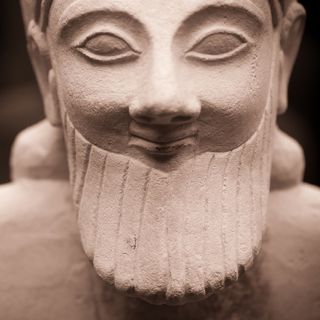
Primary Source XXV: "Enemy Ships Have Been Sighted at Sea," The Final Letters from Ugarit

Primary Source XXV: "Enemy Ships Have Been Sighted at Sea," The Final Letters from Ugarit

The following dramatization are from the correspondences between the kings of Ugarit and Alashiya (ancient Cyprus). These exchanges are preserved in the Ugaritica, the published corpus of cuneiform tablets excavated at the ancient city of Ugarit (modern Ras Shamra, Syria). Discovered beginning in 1928, these archives comprise thousands of administrative, literary, diplomatic, and economic texts dating primarily to the 14th and 13th centuries BCE. Among them are letters exchanged between rulers across the eastern Mediterranean, offering an extraordinarily intimate glimpse into the political world immediately preceding the Bronze Age Collapse. The particular correspondence dramatized here* belongs to the final decades of the 13th century BCE, when the great palace kingdoms of the eastern Mediterranean were under increasing pressure. Trade networks were breaking down, kingdoms were falling, and the groups later known collectively as the "Sea Peoples" were beginning to appear in the historical record. These letters capture that world at the very moment it was beginning to unravel. I chose these exchanges because they reveal something important about the international standing of Alashiya. One of the most striking features is the diplomatic language employed by the king of Ugarit. He repeatedly addresses the king of Alashiya as "my father." This is not merely a polite turn of phrase. In the carefully calibrated language of Late Bronze Age diplomacy, such terms reflected perceived status and hierarchy. Contrast this with the famous correspondence between the kings of Alashiya and the Egyptian pharaohs, in which both rulers consistently address one another as "my brother." That title denoted equality among the so-called "Great Kings" of the Late Bronze Age. The differing forms of address suggest that, at least from Ugarit's perspective, the king of Alashiya occupied a position of exceptional prestige. That prestige was no accident. Cyprus possessed the eastern Mediterranean's richest copper resources, and copper was one of the indispensable commodities of the Bronze Age. Combined with tin, it produced bronze--the metal upon which armies, agriculture, tools, trade, and prestige depended. To command Cyprus was to command one of the ancient world's most strategically important resources, making Alashiya a kingdom whose influence extended far beyond the island itself. A brief note on the production: I've taken a few creative liberties to help bring these ancient letters to life. For example, the scratching sound you'll hear isn't entirely authentic. A more accurate soundscape would have been the impression of a stylus pressed into wet clay rather than the scratching of pen on paper. Unfortunately, convincingly recreating the sound of cuneiform being inscribed proved rather difficult, so I've opted for an approximation that hopefully conveys the spirit of the act, even if not its precise reality. Next episode, I invite Dr. Eric Cline to discuss the Bronze Age Collapse!

Tämä jakso on lisätty Podme-palveluun avoimen RSS-syötteen kautta eikä se ole Podmen omaa tuotantoa. Siksi jakso saattaa sisältää mainontaa.

Jaksot(126)

*SPECIAL!* Learning Greek, the Cypriot Way! Cyprusays® with Effie & Costas Athanassiou

*SPECIAL!* Learning Greek, the Cypriot Way! Cyprusays® with Effie & Costas Athanassiou

If you ever wanted to learn Cypriot Greek, it's never been easier. Cyprusays® is a language learning app designed to help learners speak Cypriot Greek naturally and confidently. In this Special "Prima...

15 Syys 31min

54. From Sufis to Secularists: Identity and Religion amongst Turkish Cypriots with Mete Hatay

54. From Sufis to Secularists: Identity and Religion amongst Turkish Cypriots with Mete Hatay

In this episode, we explore the complex history and contemporary character of Turkish Cypriot Islam, a tradition often described as highly secular, private, or even residual. My guest, Mete Hatay (Sen...

2 Syys 51min

LIV: William Turner's Observations on Turkish Cypriots

LIV: William Turner's Observations on Turkish Cypriots

William Turner, a British traveller in the early 1800s, left one of the more vivid foreign descriptions of Cyprus under Ottoman rule. He claimed that Turkish Cypriots practiced a more relaxed form of ...

15 Elo 1min

53. Fragments of Faience, Glints of Gold: Cyprus and Egypt in Contact with Louise Steel

53. Fragments of Faience, Glints of Gold: Cyprus and Egypt in Contact with Louise Steel

Dr. Louise Steel is an archaeologist whose work focuses on challenging colonial interpretations of Cypriot history by emphasizing the agency of the local population. Through postcolonial theory, she e...

2 Elo 49min

Primary Source LIII: The Misfortunes of Wen-Amun

Primary Source LIII: The Misfortunes of Wen-Amun

In the early 11th century BCE, the Egyptian official Wen-Amun was dispatched on a diplomatic mission to Byblos to acquire timber for the sacred barque of Amun-Ra. His journey quickly unraveled -- purs...

15 Heinä 2min

52. When Kinship Failed: Cyprus & The Black Death with Tassos Papacostas

52. When Kinship Failed: Cyprus & The Black Death with Tassos Papacostas

"Out of necessary cruelty, fathers abandoned their sons, and sons fled from their fathers, as the evident danger overcame all the rules of kinship, love, and nature." - Francesco Loredano AKA Henry G...

2 Heinä 1h

*BONUS!* Building and Living an Archaeological Fieldwork Project with Luca Bombardieri

*BONUS!* Building and Living an Archaeological Fieldwork Project with Luca Bombardieri

Luca Bombardieri, Associate Professor in Aegean and Cypriot Archaeology at the University of Siena in Italy and the scientific director at the Erimi Archaeological Project in Cyprus, explores what it ...

20 Kesä 18min

Primary Source LII: Loredano & The Black Death

Primary Source LII: Loredano & The Black Death

The Black Death swept across Europe in the mid-14th century, killing millions and leaving entire regions devastated. No corner of the continent was spared, and Cyprus too fell victim to the deadly pan...

15 Kesä 2min
Suosittua kategoriassa Historia

olipa-kerran-otsikko
mayday-fi
gogin-ja-janin-maailmanhistoria
mystista
rss-ikiuni
huijarit
totuus-vai-salaliitto
tsunami
rss-historian-salaisuudet
konginkangas
sotaa-ja-historiaa-podi
rss-i-dont-like-mondays-2
rss-subjektiivinen-todistaja
rss-peter-peter
rouva-diktaattori
rss-kirkon-ihmeellisimmat-tarinat
rss-outoja-uutisia-pohjois-suomesta
matakuu