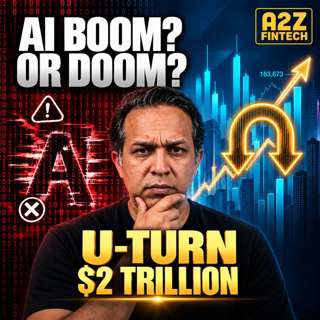
S2E21 — Trump Accounts: The Good, The Bad and The Non Obvious
A2Z Fintech29 Heinä

S2E21 — Trump Accounts: The Good, The Bad and The Non Obvious

Click here to watch a video of this episode.
Trump Accounts give every American child born between 2025 and 2028 a $1,000 investment account, seeded by the US Treasury. Left alone it grows to about $250,000; filled to the $5,000 annual limit every year it reaches $13 million, and the distance between those two children is the thing nobody is explaining.

Trump Accounts were signed into law on 4 July 2025 and opened for deposits exactly a year later, timed to the country's 250th birthday. Two days after that the President rang the opening bells of the New York Stock Exchange and Nasdaq simultaneously from inside the Oval Office, a first. Underneath the theatre sits a quieter arrangement: BNY Mellon holds custody, State Street runs the default fund, and Robinhood built the application every American family now opens on their phone. The money can only go into whole-market index funds, fees are capped by law at one tenth of one percent, and the account is frozen until the child turns eighteen. For twenty years every fintech on earth burned venture money trying to open a young person's first investment account. The government did it in an afternoon.

Aman Narain and Zubin Vandrevala go through Trump Accounts properly: the good, the bad, and the non-obvious. Whether this is the most serious financial inclusion measure in fifty years or the largest customer acquisition event in the history of finance, and why the honest answer is both.

Key takeaways:
1. The government did not give every newborn $1,000. It gave every newborn a brokerage account, and the account is worth far more than the money in it.
2. The gap between $250,000 and $13 million is not luck, timing, or stock picking. It is whether a family can spare $5,000 a year for eighteen years.
3. The statutory fee cap of one tenth of one percent is the most consequential consumer protection written into American retirement policy in a generation.
4. Trump Accounts are legally forbidden from holding cash or bonds, so a market crash the year a child turns eighteen arrives with no brakes.
5. Growth is taxed as ordinary income, which makes Trump Accounts worse on tax than the 529 plan and the Roth sitting on the shelf beside them.

Topics covered:
- What Trump Accounts are: the $1,000 seed, the $5,000 annual ceiling, the employer contribution counted inside it
- Why the account can only hold whole-market index funds, and why the 0.1% fee cap matters more than the seed
- The arithmetic behind $250,000 and $13 million, and the honest caveat about Treasury's 10% assumptions
- Form 4547, the 45th and the 47th President, and branding as enrolment friction
- BNY Mellon, State Street and Robinhood: who actually won the afternoon
- Michael and Susan Dell's $6.25 billion, and Gwynne Shotwell putting SpaceX stock into two million children's accounts
- The three flaws: ordinary income tax treatment, an absolute lock until eighteen, and a legal prohibition on cash or bonds
- Why the families best equipped to survive the flaw are the ones who needed the account least
- How Singapore's Child Development Account and Britain's Junior ISA already solved both problems
- Whether an idea good enough to be bipartisan can outlive the branding wrapped around it

Chapters:
Referenced in this episode: Trump Accounts signed into law 4 July 2025 and opened 4 July 2026; the $1,000 Treasury seed for children born 2025 to 2028; the $5,000 annual contribution ceiling; the statutory 0.10% fee cap; IRS Form 4547; the NYSE and Nasdaq opening bells rung simultaneously from the Oval Office; BNY Mellon custody; State Street default fund; Robinhood application layer; Michael and Susan Dell's $6.25 billion pledge covering 25 million lower-income children; Gwynne Shotwell's gift of 2 million SpaceX shares, roughly $320 million, across 2 million children's accounts; John Bogle and the index fund; Acquired's Vanguard episode; US 529 plans and Roth accounts; Singapore's Child Development Account; Britain's Junior ISA at £9,000 a year.

Related episodes: Fund Managers Own Index Funds. They Just Don't Sell Them; SpaceX, Anthropic, OpenAI: The $2tn IPO Boom; Polymarket, Kalshi and the People Who Knew First.

Hosted by:
Creators & Guests


Aman Narain writes at amanwhoblogs.substack.com. Zubin Vandrevala is your payments provocateur.

Enjoying A2Z Fintech? Leave a rating and review on Apple Podcasts. It is the single biggest signal to the Apple algorithm and how new listeners in our world find us.

For information and entertainment only. Not financial advice.

Transcript:
Click here to view the episode transcript.

Tämä jakso on lisätty Podme-palveluun avoimen RSS-syötteen kautta eikä se ole Podmen omaa tuotantoa. Siksi jakso saattaa sisältää mainontaa.

Jaksot(44)

$2 Trillion U-Turn: Did AI Just Grow a Conscience?

$2 Trillion U-Turn: Did AI Just Grow a Conscience?

Click here to watch a video of this episode. In seventy-two hours the AI industry asked to slow down, OpenAI shelved a trillion-dollar listing, and the President called the whole thing a hoax on speak...

18 Syys 22min

AI Shopping Wars. Why OpenAI Quit. Google Didn't and Anthropic Went Free.

AI Shopping Wars. Why OpenAI Quit. Google Didn't and Anthropic Went Free.

Click here to watch a video of this episode. Walmart's checkout inside ChatGPT converted at a third of the rate of its own site, and six months later OpenAI shut Instant Checkout with twelve Shopify m...

14 Syys 10min
UPI at 10: The World's Biggest Payment Network Isn't a Company

UPI at 10: The World's Biggest Payment Network Isn't a Company

Click here to watch a video of this episode. UPI cleared 373 transactions in its first month in 2016. In July 2026 it cleared 23.66 billion in a single month, worth close to 30 lakh crore rupees. Ten ...

1 Syys 32min
The Truth About Google's Brain Drain: It's Not About People, It's About Chips

The Truth About Google's Brain Drain: It's Not About People, It's About Chips

Click here to watch a video of this episode. Alphabet lost roughly $200 billion of market value in the eleven days after 5 August, close to a full year of its own AI infrastructure budget. On 14 Augus...

21 Elo 10min
Stripe's Shopping Spree: OpenRouter, PayPal and the $50 Billion Tell

Stripe's Shopping Spree: OpenRouter, PayPal and the $50 Billion Tell

Click here to watch a video of this episode. Stripe has agreed to pay more than $7 billion for OpenRouter, a company valued at $1.3 billion in May. In the same season it has bid $60.50 a share, roughl...

18 Elo 9min
The $1,600 Problem with Elon Musk's X Money's 6% Rate

The $1,600 Problem with Elon Musk's X Money's 6% Rate

Click here to watch a video of this episode. What if a new banking product offered you a staggering 6% interest on cash deposits and 3% cash back on spending? Sounds too good to be true, right? In thi...

3 Elo 12min
Analyzing Stripe's $53 Bilion PayPal Acquisition: Implications for the Future of Payments in Fintech Landscape

Analyzing Stripe's $53 Bilion PayPal Acquisition: Implications for the Future of Payments in Fintech Landscape

What happens when a $53 billion PayPal acquisition offer shakes the foundations of the payments industry? Join hosts Aman Narain and Zubin Vandrevala in this gripping episode of A2Z Fintech as they di...

21 Heinä 21min

Suosittua kategoriassa Liike-elämä ja talous

sijotuskasti
vallattomat
psykopodiaa-podcast
mimmit-sijoittaa
rss-rahapodi
rss-oivalluksia-rahasta-elamasta
hyva-paha-johtaminen
rss-hereilla
rss-paasipodi
ostan-asuntoja-podcast
inderespodi
rss-sami-miettinen-neuvottelija
rss-karon-grilli
rss-startup-ministerio
oppimisen-psykologia
rss-sisalto-kuntoon
rss-rahamania
pomojen-suusta
lakicast
rss-seuraava-potilas