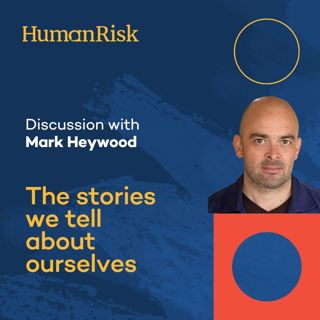
Mark Heywood on The Stories We Tell About Ourselves

Mark Heywood on The Stories We Tell About Ourselves

What parts of yourself have you learned to hide in order to be taken seriously? My guest on this episode is Mark Heywood, a friend of the show, returning guest and someone I've collaborated with on a number of projects.

Episode Summary & Guest Profile
Mark has spent more than twenty years working in crisis management and operational resilience, while simultaneously building a successful career as a bestselling novelist, screenwriter and, more recently, stand-up comedian.

On the morning we recorded this conversation, Mark published an article marking his fifty-first birthday. In it, he reflected on the pressure many of us feel to present only one version of ourselves professionally, arguing that his creative and corporate lives were never really separate.

As he puts it, they were 'not two jobs, but one obsession wearing two different lanyards.' That simple idea becomes the starting point for a much wider discussion about the stories we tell ourselves, and the stories organisations tell themselves.

Along the way we explore:
  • Why "stay in your lane" may say more about other people's expectations than your own potential.
  • Why organisations often encourage people to bring their whole selves to work, while rewarding conformity.
  • What interviews, dress codes and organisational culture reveal about human behaviour.
  • Why stories often influence behaviour more effectively than rules, policies and frameworks.
  • What films can teach us about operational resilience, cybersecurity and crisis management.
  • Why the Titanic remains one of the most powerful lessons in organisational failure.
  • How imagination is a strategic capability rather than a soft skill.
  • Why thinking through "severe but plausible" scenarios requires organisations to become better storytellers.
Links

AI-Generated Timestamped Summary
00:00 – Why do we hide parts of ourselves to be taken seriously?

03:40 – Mark explains why he stopped separating his creative and corporate identities.

08:00 – Which hobbies and outside interests are considered professionally acceptable—and why?

10:30 – Job interviews, authenticity and bringing your whole self to work.

16:00 – Jeremy King on why behaviour matters more than dress codes.

19:00 – Rachel Heyhoe Flint, the MCC and what institutional rules reveal about culture.

23:00 – Why stories influence behaviour more effectively than rules.

24:00 – The Trojan Horse and using films to teach cybersecurity and resilience.

29:00 – The Titanic as a lesson in organisational resilience rather than maritime history.

32:00 – Conduct versus outcomes: why testing matters more than compliance.

36:00 – Using stories and popular culture to make risk real.

38:00 – Noah's Ark, history and the enduring power of storytelling.

40:30 – CrowdStrike, PPE and why organisations keep repeating the same mistakes.

46:00 – Stories aren't predictions—they're a way of exploring possibility.

49:00 – A ransomware exercise and the danger of relying on fixed policies.

52:00 – Returning to the Titanic: preparing for the inquiry before the crisis.

55:00 – Thinking like an attacker and challenging assumptions about cyber risk.

58:00 – Taylor Swift, insurance and why seemingly ordinary data can become highly sensitive.

1:02:00 – The idea of "risk inflation" and why yesterday's rules aren't enough.

1:10:00 – Why memorable stories change behaviour more effectively than realistic scenarios.

1:15:00 – Reverse stress testing and imagining what could really break an organisation.

1:20:00 – RAG ratings, reporting and the danger of looking resilient instead of being resilient.

1:23:00 – Final reflections on creativity, identity and why being more than one thing is a strength.

Tämä jakso on lisätty Podme-palveluun avoimen RSS-syötteen kautta eikä se ole Podmen omaa tuotantoa. Siksi jakso saattaa sisältää mainontaa.

Jaksot(376)

Benji Wilson on why we rate everything

Benji Wilson on why we rate everything

Why do we rate everything and why do we do so on a scale of one to five stars? What happens when systems designed to help us make better choices start influencing our behaviour in ways we don’t necess...

8 Elo 1h 4min

Gill Kernick on Grenfell -  the disaster we still haven't learned from

Gill Kernick on Grenfell - the disaster we still haven't learned from

When something goes badly wrong, we investigate it. Reports are written. Recommendations are made. Lessons are identified. But do we actually learn them?Episode SummaryReturning to the show, Gill Kern...

21 Heinä 57min

Anna Rössler on Finding Your Voice — Online, On Stage and At Work

Anna Rössler on Finding Your Voice — Online, On Stage and At Work

What does jazz singing have to do with LinkedIn? More than you might think. This week's guest, Anna Rössler, has built a career helping senior leaders find their voice online while simultaneously deve...

5 Heinä 1h 1min

David Grosse on The Unconvention

David Grosse on The Unconvention

What happens when two people who spend their careers thinking about human behaviour meet in a London pub and start complaining about conferences? Apparently, they decide to organise one.Episode Summar...

25 Kesä 48min

Freewheeling on Human Risk with Thomas Ableman

Freewheeling on Human Risk with Thomas Ableman

Why is it so hard to stop people playing vides, music or phone calls out loud on public transport — and what does that tell us about changing human behaviour? Show Summary This episode of The Human Ri...

11 Kesä 45min

Jill Wick on The Human Side of Cybersecurity

Jill Wick on The Human Side of Cybersecurity

What if the best way to improve cybersecurity — or any other form of human risk — wasn't another policy, training course, or piece of technology, but a board game?  That's the kind of question my gues...

30 Touko 1h 3min

Tobias Sturesson: from cult to corporate culture

Tobias Sturesson: from cult to corporate culture

What can businesses learn from cults?It might sound like an uncomfortable comparison: one involves strategy meetings, values statements and quarterly targets; the other manipulation, charismatic leade...

23 Touko 1h 8min

Suosittua kategoriassa Tiede

rss-poliisin-mieli
tiedekulma-podcast
rss-mita-tulisi-tietaa
docemilia
rss-hereilla
rss-bios-podcast
utelias-mieli
hippokrateen-vastaanotolla
rss-metsanomistaja-podcast
rss-lapsuuden-rakentajat-podcast
rss-sosiopodi
filocast-filosofian-perusteet
rss-tiedetta-vai-tarinaa
rss-duodecim-lehti
radio-antro
rss-totuuden-liepeilla