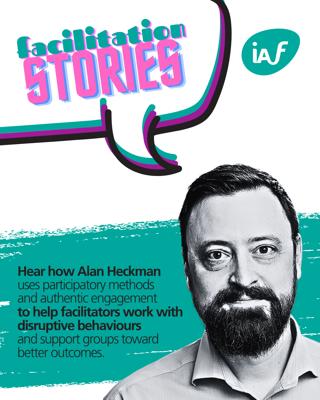
đŸŽ™ïžFS84 - Dealing with disruptive behaviours, with Alan Heckman

đŸŽ™ïžFS84 - Dealing with disruptive behaviours, with Alan Heckman

In today's episode, Umah welcomes facilitator Alan Heckman to share practical ways to handle disruptive behaviours in groups, drawing on his IAF England and Wales conference workshop and his background with ICA training.

They talk about:

  • Common challenges, from subtle withdrawal to over-participation to barbed comments
  • Mango's in facilitation!
  • Setting informal norms and tools for helping people feel heard while keeping the process moving.
  • The facilitator persona
  • Addressing hierarchy by depersonalising ideas
  • Using the group to redirect off-topic derailments.

Quote highlights

  • "The very first thing that I say is, 'Hi, my name is Alan. I'm a group facilitator. This is what I think a group facilitator is.'"
  • "What you need is not for the person to stop talking, usually. What you need is to make them a little bit more of a process-aware participant."
  • "Usually, they're concerned about something important, something that they aren't feeling heard about or that they love or think is really critical... They keep talking because they fear it won't come out in the final result."
  • "If somebody steps up and is being angry or disruptive...you might try asking them...'Can I ask you a question?' followed by 'What is it that would have to take place for you to find this process worth engaging with?'"

Links
Today's guest - Alan Heckman:
Facilitator and Facilitation Trainer
Alan's website: www.alanheckman.co.uk
Alan's Email: alan@alanheckman.co.uk
Alan's Linkedin: www.linkedin.com/in/alanheckman

For more information on the courses Alan runs, and to learn more about ICA:UK: www.ica-uk.org.uk/courses

Today's host: Umah:
Change and Transformation Advisor and Facilitator
https://www.linkedin.com/in/umah

To find out more about Facilitation Stories and the IAF:
🎧 https://facilitationstories.libsyn.com/
📧 podcast@iaf-ew.co.uk
🌐https://www.iaf-world.org/site/chapters/england-wales

To find out more about Facilitation Stories and the IAF England & Wales Chapter:
🎧 https://facilitationstories.libsyn.com/
📧 podcast@iaf-ew.co.uk
🌐https://www.iaf-world.org/site/chapters/england-wales

Transcript

Umah: Hello, and welcome to Facilitation Stories. This podcast is brought to you by the England & Wales Chapter of the International Association of Facilitators, also known as IAF. My name is Umah, and today, we're going to hear about dealing with disruptive behaviours. This year at the IAF England & Wales Conference, I had the privilege of attending Alan Heckman's workshop on dealing with disruptive behaviours.

His insights into managing group dynamics were both enlightening and practical. Alan is a seasoned facilitator with over 20 years of experience in designing participatory processes and events, particularly in the public and charitable sectors. He's known for fostering genuine engagement where every voice contributes effectively towards decisions that everyone commits to.

Today, I'm thrilled to welcome Alan Heckman to our podcast. Welcome, Alan.

Alan: Hello, Umah. Thank you so much for having me.

Umah: Alan, your session at the IAF conference was really insightful. Could you share with our listeners a little bit about the work that you do and what brought you to facilitation as a career?

Alan: So I'm unusual in the field of facilitation in that I was doing it from a relatively young age. I took a year out of university when I was 20 to do a year-long volunteer internship with the ICA in Phoenix, Arizona. Many of your listeners might already know that ICA is a community organization deeply involved in participatory practice, and was helpful, among other things, in founding the IAF, but also in setting facilitation as a field and in taking participatory approaches and running trainings in facilitation as well.

So from that internship in, a long time ago, I had various roles that were related to participation and facilitation. I haven't been a full-time facilitator ever since. But I did move into independent practice as a freelance facilitator in 2015, which is now 11 years ago. So I've been doing this for quite a long time.

Umah: Thank you. That's really interesting to know about the background and the connection with ICA and IAF as well.

Alan: It is interesting. ICA probably doesn't have as good of a profile or as big of a profile as perhaps it should, but it is really interesting.

Umah: At the conference, in your presentation, you spoke about different behaviours

and I just wondered if you could share maybe a few of the common ones that you've encountered and how you handled them.

Alan: Absolutely. So I run these two-day group facilitation methods courses through the ICA here in the UK, and I love running those training courses. And by far, the most common question I get on those training courses is some version of, "what do you do when it all goes wrong?"

What do you do when things go pear-shaped? So that thing that you saw at the IAF was really a development from my set of answers to that question. Often, I've included it within the course. So now, your actual question was some of the behaviours I have seen. I work almost entirely in the public and charitable sectors.

It's often professionals that I'm working with. And so the behaviours that I tend to see, especially here in the UK, are a little bit more subtle. There's rarely threats of violence and relatively rarely shouting or angrily becoming overtly aggressive. It's often subtle, more shutting down because they don't like something that's happening, or irritation or barbed comments.

So various kinds of non-participation. And then the other one that everybody talks about, because it is so common, is over-participation, and I wanna emphasise that this is not over-participation in the sense of being dominant on purpose. Usually, it's being dominant, I have to say it, if we can call it innocently, in that the person hasn't thought about their effect on the group and the process.

It's usually they're concerned about . something, that they aren't feeling heard about, something important, something that they are worried about or that they love or that they think is really critical, and that they don't think that the group is going to successfully take into account somehow, or that it won't come out in the thing, so they keep talking.

Umah: Mm-hmm.

Alan: And that's so common. You know, it happens. You don't want to assume, but there's one in nearly every group of 20 or 30 people, somebody who hasn't really thought about their impact on the group. And to be fair, I've invited them not to worry about that. I'm claiming that role for myself as the facilitator.

I'm the one in charge of process. I'm inviting them to just worry about what their content is. So I regard these people as innocent in the sense that they're almost always not trying to wreck stuff on purpose.

Umah: One of your tips where, which I think a few of us use quite often, is the car park, but do you have any guidelines that you set beforehand?

Alan: It's really interesting. I would imagine most of the listeners to this podcast will be in the habit of setting some kind of ground rules or norms at the beginning of a session. And I do that, but I do it very informally, probably less formally than anybody else. They don't get flip charted. So I tend to say, "You wouldn't mind turning off your phones," et cetera.

Umah: Right.

Alan: So I don't set the car park up ahead of time. I tend to not use it until it's needed. In fact, it tends to not even be a thing that I pull out 90% of the time. I have another way of thinking about the car park. Should I tell you about that now?

Umah: Yeah, go for it.

Alan: What is the car park? Now, I would imagine your facilitation-aware audience knows already, but just in case, let's say what the car park is.

You might do it a different way. You might call it the bicycle stand or whatever, but the key thing there is that you are taking participants' concern of their issue, their thing they're worried about, and inviting them to not talk about it, because you need to carry on. And in order to reassure them that it won't get lost, you can put it in the car park.

The idea is that you're reassuring them that we will come back to it, and giving yourself permission to not talk about it right now. Now, that can be very helpful indeed. Of course, what it does mean is that you have to come back to it if you're gonna be an honest and fair facilitator. But you might be able to come back to it at the end of your day, or you might be able to invite them to set a new meeting, depending of course on what the group is in relation to that.

If you come back to it under any other business at the end, 50% of the time it's like, "Nah, it's fine." But you do need to check. The car park is a way of managing an impossible problem that we face all the time as facilitators, which is how do we help somebody feel heard when they're not feeling heard, and also move on when we need to move on?

And of course, if they're oversharing or talking too much or whatever you might call it, in a way that's disruptive to the process, I need to help that person be reassured that whatever they're concerned about will be adequately considered, and I also need to get them to stop talking about it. So those two things are in contradiction to each other.

So a car park is a way of doing that. It's acknowledging them and moving on at the same time, right? You've said it's important, and also in doing so, you're setting out the boundary or the standard that we're not talking about it right now. That's not what we're doing.

Umah: Yeah.

Alan: So there's other ways that you can solve that impossible problem of both helping somebody feel acknowledged and also moving on, and it is hard, right?

One way that I really love is, is mangoes. Now, this is silly. I ask my participants this sometimes, "What's a mango?" And they look at me like I'm an idiot.

Umah: Juicy fruit!

Alan: Yeah, right. It's a juicy, delicious fruit, and of course, for many of us, a mango might be really exciting and really sweet and juicy and delicious.

And I make up a silly story. I tell them, "Look, if you could imagine for a moment that we're all walking down a forest path on a journey to somewhere in, you know, some kind of fantasy land, and we see there across the valley a mango tree full of ripe, juicy, delicious mangoes. You know that we would all love nothing more than to go and sit under the mango tree for the afternoon eating delicious mangoes, but we still can't.

We can't do it." 'Cause we have to carry on our path to carry on and make it to our destination. Now, that's obviously a pretty contrived story that's a little bit silly. But what you've done there is you've said, "I think maybe that topic that you've raised is a bit of a mango. I think it's exciting and juicy- Yeah

but we still can't talk about it right now." So by telling that little micro story, you've found a new way to solve the problem of helping them feel acknowledged, feel heard, but also moving on. You like specifically said, "Boy, that's a juicy one. That's interesting. I'm sure we would love to talk about that all afternoon, but we still can't."

It's just a verbal trick in the end, but I've had it become an inside joke for my participants. I've come back six months later and had them say, "Isn't that a bit of a mango?" It's a thing that I find myself using more often than the car park, and of course it does depend on being willing to tell a slightly contrived, silly story to the group.

Umah: It's good if it brings them together and they're on page there, doesn't it? I have in my notes a little question for you on it. You mentioned about turning up and turning down the facilitator persona.

Alan: Yeah, sure. Yeah.

Umah: What does that look like? How would I do that?

Alan: I'll tell you what my approach is, right?

Umah: Yeah

Alan: So we're facilitators, and what that means is we're in front of the room. It means I'm being essentially a neutral... It sounds a little bit over-egged, but a neutral sort of guardian of process, right? I'm leading the group through a process, but I'm relaxing into not being a participant in their content.

And so as a facilitator, I'm the one in front of the room. If there's 100 people in the room, I might have to be a really big character sometimes to hold the whole room together. But ultimately, it needs to not be about me. Like, it's not the Alan Show. I need them at the end to feel like they've accomplished something, not me, right?

And my job is to support them to do that by providing the process, and sometimes that means getting out of the way. So as facilitators, we all find ourselves on this scale. How big of a person, how big of a presence, how big of a character do I need to be in the room right now? And I imagine that most of us do this, thinking about it or not thinking about it.

You know, where do I need to be right now? Is it helping the group if I'm standing in the middle and waving my arms about, or is it actually hindering the group, and what I need to do is sit down, move back, and get out of the way and use a quieter tone of voice? Now, in dealing with difficult behaviours, of course, you might need to adjust it one way or the other depending on what's going on.

You might need to be a much bigger character, of course, when you're drawing all the group together, or if you're working with a much larger group. And of course, you might decide in response to some behaviour to turn the dial down. I would imagine for you and for any of us who are facilitators, when we are in front of the room, physical room or maybe a Zoom room or whatever, when we're the one in front of the room, we are a certain version of ourselves, right?

We're not, I hope, inauthentic, but nonetheless, we're a different version than we are on the couch at home or out with our friends or whatever. We're a version of ourselves. And thinking about what that version of yourselves- self is in order to best support the group is a valuable exercise that I would recommend anybody to.

And it's not a static point. That version of yourself, you might call it the dial or the turning up or down your facilitator persona. And when it's up, you know, you're wearing loud clothes, you're waving your arms about, you're a big presence in the room. You need to do that to hold the group together, not because it's about you or your ego, I hope.

And when it's down, the group is having their conversation and they might forget you're there. So you need to manage time or something, of course.

Umah: So say you've got someone who is maybe naturally an extrovert and talking quite a bit, which you touched on earlier, and then you've got an- another few who are introverts, or say it's something like hierarchy going on where the senior person's talking and everyone else is maybe in agreement, something like that. What would turning up and down the dial look like then, or what else would you do?

Alan: Sure. So if you've got a character who's dominating because of the force of their personality, you might dial up to meet that character in order to, I wouldn't say push back against them, but to hold the space, right?

Now, what I would say, though, is that the other situation you've described, and we've perhaps all run into it, the chief executive in the room is being a bit too chief executive-y or whatever, right? What I would tend to, I would tend to use different methods than that one to try to approach that situation.

Certainly, I would probably end up breaking into groups, which I imagine many of us would do, but we'd use some kind of leveling process, and also some kind of process that aims to detach the idea or the opinion or the conclusion from the person whenever we can. So you may be familiar with ICS Consensus Workshop Process, and one of the things I love most about that process is that the ideas that come into the process are not anonymous, but they are sort of depersonalised.

They're no longer connected to the individual in the space, and that's a nice way to start, begin to deal with issues of hierarchy in a space.

Umah: And something else I've noted down is ' using peer pressure'. That's a bit shocking to read just by itself!

Alan: So before I tell you about this one, it's probably worth providing that caveat, right? As facilitators, we're standing in the front of the room, and I'd invite all of us to think about this as a position of power. I myself am a tall, bearded, white male, so people can pay attention to me, and I could be claiming a kind of power that wouldn't necessarily be helpful to the group.

So I particularly, and I imagine all of us, have to be exceedingly careful that the power that I'm claiming at any given point in my role as a facilitator is for the sake of the group. It's helpful. It's helping them accomplish their aims. It's helping them be heard. It's helping them be engaged. It's helping them genuinely participate in the decisions that affect their lives.

So I just have to keep this, if not at the forefront of my mind, at least in the back of my mind at all the time. I'm trying not to claim power over their final product or their content, but I am claiming a lot of power over what we do. Do we break into groups next? Who speaks next? What question are we addressing next?

That's my role, and that's a pretty powerful role. So why have I brought that up? Because as we are talking about some of the items on these lists, you could abuse that role, right? If you were not values-based or if you were not aware of what you are doing as a facilitator, if you've got the social awareness and some experience, you could manipulate a group, and we're seeking to not do that.

That's our job as a facilitator is to not manipulate the group. So some of these As we move on to this, might be, I think they're edging onto considering how you use them and why and when, because you wouldn't want to shut down somebody because- Yeah ... they've irritated you, right? Okay. Now let's talk about using peer pressure.

So as a facilitator, in general, what I want to do is avoid the dynamic where I'm the stern teacher telling off the naughty student, right? And probably everybody's familiar with that dynamic 'cause they saw it during their school days, and probably a lot of people have bad feelings about that dynamic.

But eventually you get to the point where you have to openly address something, of course. But fundamentally, I like to go as far as I can with making the problem go away before it's me as an authoritarian controlling their behaviour. So how could I do that? I've got a variety of verbal tricks, and I'm sure everybody has their own, that I might use in a moment to just phrase something in a different way.

And one of the, one of the things you could do is that instead of you being the person shutting down a behaviour, is you could invite the group to do it for you. There were a couple occasions when I was running public meetings for a local authority. Sometimes people show up to public meetings 'cause they're mad about something.

The classic examples are something about the bins or something about dog poo or something about youths congregating at the end of the street. Maybe it was libraries shutting down in your neighborhood. That's not a nice thing, and people are probably mad about that anyway. It might or might not have anything to do with the already tough subject that you're there to discuss.

But if they start talking about bins, but you could imagine saying, "Well, sounds like this is really valuable and important," and then say to the whole group, "We came here to talk about libraries, but it seems like it might be really useful to talk about bins and bin pickups. Should we switch to that instead?"

Umah: Yeah.

Alan: And of course, the whole group goes "No! We came here to talk about libraries." Now, what have you achieved if you've done that? You've got the group to be the authoritarian telling the person off rather than you. What you've done, if it works, is you have, you've gotten the person to moderate their behaviour without you being the one who's told them off.

I would prefer not to be the one seeking to control somebody's behaviour overtly, because if they rebel and they're mad at you, it turns off their participation. And of course, that's the opposite of what we're trying to achieve. I don't want their participation turned off. Sometimes I might need it turned down a little bit, but if I've turned it off, then I've failed, right?

I haven't achieved what I've set out to do as a facilitator with a participatory process.

Umah: And you mentioned addressing things more directly. So-

Alan: Yeah.

Umah: Tell me about that. What are good phrases that aren't too standoffish?

Alan: So, okay, well let's talk about this. The world is messy, so eventually you maybe get to the point where you have to openly address it, even if it's uncomfortable. Now, this'll show me in the podcast light, but one thing that I do is I'll take the person behind two ferns during the break or whatever, rather than addressing it publicly. It depends on the circumstances, but if you can, during the break is better, isn't it? And I would try first by saying, "I'm worried about everybody else's ability to participate. Could you help me make sure they participate?"

Umah: Mm.

Alan: But if you're worried that even that won't be direct enough, you might need to be a little bit more direct. Now, this is gonna show me because I won't be able to actually tell you the rigid words or the process, but there's something called non-violent communication. Fundamentally what it is, it's a very short set of processes that would say, "Here's what I'm seeing. This is how it's affecting me," and in my case, I would probably talk about how it's affecting what I need to achieve with the group, "and here's the change I need."

I've done a poor job of representing non-violent communication there, but that sort of careful and thoughtful approach to trying not to blame them, trying not to raise their hackles to the extent that you can.

Umah: Yeah.

Alan: And also being clear about what the situation is as a result of that, and making a request about what you need.

Now, what you need is not for the person to stop talking usually. What you need is to make them a little bit more of a processor when they're a participant. So we don't want their concerns to go away. We don't want them to be brushed under a rug. We don't want them to leave feeling like they've been bamboozled.

We want them to be heard, and also we need everybody else to be heard as well. And then we need to work on something to being moving forward with that. So if the behaviour is such that other people can't be heard, that's when it becomes a problem.

Umah: So it's clear obviously that you're very well-equipped to deal with different things. Do you still have a moment where it's, "Oh, what do I do?" Or is it a little bit more, "Oh, I pretty much know how to deal with everything now"?

Alan: There's no guarantee that every single one of my sessions is perfect. Sometimes stuff happens, right? That's often the situation.

Umah: Yeah.

Alan: And I will usually have an idea at least of what might be done, and I think it's not that I'm so perfect that I always feel confident or comfortable.

Sometimes I do, but I, I don't necessarily always feel confident or comfortable that I know exactly what to do. But what I do feel good about, and I would recommend this to anyone, is I'm maintaining the framework in my mind about what's happening now, what's the situation, what might I try first? What might I try next? What might it get to? If we need to give this person five extra minutes, can I adjust it so they can? Will that do it? It's that meta level that I imagine many of us are running in our heads, as we're facilitating is really valuable, and that does come with experience. So it's not so much that I'm always sure.

Umah: Mm-hmm.

Alan: But a, a lot of times it's whether or not I'm sure, I've got a framework for trying to do something.

Umah: Sometimes a participant is trying to get a rise out of you to see how you react. So then in those situations, do you detach a bit? What would you suggest for someone who is new into facilitation, how they handle it so that their confidence isn't wrecked for the next time.

Alan: If you get somebody who's really challenging, what we're usually talking about is a couple of situations. One is somebody who's angrily doubting the utility of participating in the process at all.

Umah: Hmm.

Alan: Or who I suppose a very closely related but slightly different role is angrily doubting or denying your right to be in the role of the facilitator with that being in charge of process. You know, who are you to tell us what to do? Why do you get to be...? Now some of that's because these are professional people who have their jobs rely on being professional in a room full of professionals, right?

So certain behaviours are expected. They're not all nice, these behaviours, but certain things are fairly normal. Usually, the very first thing that I say is, "Hi, my name is Alan Heckman. I'm a group facilitator. This is what I think a group facilitator is." 'Cause if you Google group facilitator, it could be an awful lot of things.

People are doing stuff, much of which I respect deeply, but it's also not the same thing that I am doing. The second sentence out of my mouth after introducing myself is to tell them what I think my role is, and I always say that my role is to be in charge of process so that you all can relax into providing the ideas, hearing each other, coming to consensus where possible, finding themes and threads, making decisions, making plans. That's your job. My job is not to do that.

And I think just that reassurance right at the beginning before we've done anything else, I think that's part of contracting with the group, right? I'm making a promise to them implicitly or sometimes explicitly that they're gonna get a chance to be heard, that their input is valued, and just that alone will deflect a huge amount of that kind of challenge before it arises. I'm explicitly declaiming that I have any right to have a say about the content of what they're talking about. Yeah.

Umah: Yeah.

Alan: I think that goes an awfully long way.

Umah: Hmm.

Alan: However, if you get to the point where somebody is saying, "Who the heck are you to tell us what to do?" Or, "Why should we be here? What are we doing?" I mean, one option is that they go, right? It's not nice, but if they're not in the right room and they don't wanna be there, well, who's making them? Not you. Maybe somebody is. Maybe we can sort it out so they don't have to be there.

The other thing is that a lot of times you'll get people where somebody's angrily doubting whether or not this-- we should even be doing this thing that we're doing, either because they think it's a whitewash or they think they're being manipulated sometimes, and maybe they've had an experience of participation, you can't see, but I'm doing air quotes, that wasn't real, that was manipulative. So that's what they're expecting from you as a facilitator. One thing you can do is essentially ask what would make it worthwhile for them. Many facilitators will be familiar with a facilitator called Ingrid Bens. She's written some books, and I met her years and years ago. Gosh, I think it was at the IAF conference in Helsinki, whatever year that was.

I really liked one thing that she said at that conference, and she called it the long question. Now, sorry to Ingrid Bens if I misrepresent the long question 'cause it's been a lot of years since I heard you say it. But what I recall as her insight is that if you've got somebody, especially somebody who's angry, one thing you can do is ask them a detailed and long question because they have to calm down enough to hear your long question.

Now, Ingrid Bens recommends actually splitting it into two questions, if I recall correctly, and the first one is, "Can I ask you a question?" Which I think is great, because if they say no, they've exposed themselves as being unwilling to be reasonable. The second question then is some version of what is it that would have to take place for you to find this process worth engaging with? You could craft your own version of that question. You're also saying, "What are your ransom demands," right? Like, what do you actually need to do? What needs to happen for this to be worthwhile for you? That could be, if asked in the wrong way, it could be kinda forthright as a challenge there. I mean, you would already be in an uncomfortable situation if you got to that point, I think.

Umah: Yeah.

Alan: But if somebody steps up and is being angry or disruptive, in that kind of situation, you might try it because they might tell you their answer. And if they do, of course, it doesn't make the problem necessarily go away, but it is a start.

On one particular occasion, somebody said some version of, "If I thought the Board was gonna actually listen to what we had to say, then I'd say fine." And it's like, wow, okay. Actually, that's a totally reasonable request. If you think that you're in this room and that you are being asked for your opinions for the board to do strategy, but the board isn't gonna listen to what you say, of course you're angry. And I can't make that anger go away necessarily, but what I could do in that specific situation was essentially rely on two things. One of them was I could say, "Well, the board's not in the room, so I can't tell you what they're gonna do. But what I can tell you is the process that I've planned to carry out strategy with the board and how I'm gonna bring your content in, and that this is your opinion to share."

And I can also essentially make a little argument from my values. But I can say, "Look, if this was fake participation, I wouldn't participate in it. That's not what I do." In my early career when I was desperate for work, I turned down very little. But probably what I did turn down, even then, was situations where I thought they didn't really want real, genuine participation. So it worked. I asked him this long question. He said what it would take, and I kinda persuaded him that my values wouldn't let me to participate in a process if it wasn't genuine, and that was enough in that case.

Umah: We had a question from one of our previous guests, which I'd like to ask you. It was, "how do you measure or know when your facilitation has made an impact?"

Alan: So this was a theme at the conference as well, wasn't it? We had a few conversations that were talking about impact. What does impact really mean in facilitation? How can you tell you're having an impact? And I will give you two answers, and one is satisfying, and the other one is probably not satisfying.

I'll be aware as I say this that we're talking about a specific kind of impact. I will say That the thing that really drives me as a facilitator is when at the end of the day, somebody comes up to me and says, "We never could have gotten this much done. I can't believe we got through this. We've gotten so far on our strategic plan in one day."

And variations of this, I imagine many facilitators have heard, and I love that, right? So is that impact, at the end of the day, they feel really good about what we did. That's exciting. And then of course, the question is, do they then go out and do it? Has it made their lives better? Has it made their work better? Do they implement the strategic plans?

I think they do, at least most of the time, but it's hard to tell, right? It's hard to really tell. I don't have any formal way of going back and checking with my clients six months later and saying, "How did it go?" I do hear from my clients again, usually because they tend to say, "Can you come back again?" Which is really, it's a lovely way to measure impact, is to say, well, they must have at least thought it was really good, 'cause they want me to come back and run something else. Or they recommend me for stuff. I'm barely active on LinkedIn, and my website is there. It's a brochure site. Yeah. It's not super active. It doesn't change very often. My marketing plan as a facilitator is entirely reliant on other people recommending me for what I do. They had a good experience, right? And so I need them to do that if I'm gonna stay in business, so it's, it's also very rewarding, and I guess also it's a measure of impact.

And every once in a while, I have come across someone who says, "Do you remember that strategy day that you ran with a bunch of stakeholders?" "Oh, yeah, sure. I remember that." It's like, "We've been running based on that ever since then." And now somebody created a new area of outstanding natural beauty as a result of that strategy day, which is a big impact, right? That's a major thing that happened years and years ago that now somebody's come back and they specifically approached me at an event where they didn't have to tell me.

Umah: Very nice. That's a good feeling.

Alan: I will say, though, that to some extent, and this is the unsatisfying answer, I don't know.

Umah: That's an honest answer!

Alan: I hope they go forth and do the things they said they were gonna do, because that's what impact would really be. They're out there meeting their aims in a better way than they would have because I was in the room for that day or that half day or whatever. And I think they do, but I don't really check, so I don't really deeply know.

Umah: I was in your IAF workshop, and that was one hour, and I'd say for me, that definitely did make an impact, so I could tell you that.

Alan: Wow. Oh, thank you.

Umah: And you have been brought on to the podcast to go through it in a bit more detail with me, so thank you so much. Just before we wrap up, I wondered if you could leave a question for our next guest.

Alan: Now, to be fair, you warned me ahead of time that I would do this, and I was thinking about it, and I think I would love to ask a question in keeping with our theme today. I don't know who the next facilitator or person is, so my question for them is, "can you tell us about a time when it all went wrong? And what did you do? What did you do? What happened?" And I'm happy if it's a great example, or if you're comfortable sharing one that didn't turn out well, we'll, we might all learn from it, so that's my question.

Umah: I hope you listen in and hear the answers to it next time.

Alan: I will, for sure. Absolutely, I will.

Umah: Thank you, Alan, especially on joining me on this heatwave day right in the peak of it.

Alan: It's a warm day.

Umah: We are sweating.

Alan: Thank you- so much for having me. It's been a joy. I'd love to talk to anybody who wants to talk. It's a joy.

Umah: Brilliant. Thank you. We'll put your contact details in the show notes, so-

Alan: Oh, thank you.

Umah: So everyone can have a look there.

Alan: Wonderful, thank you.

Umah: We have reached the end of today's episode of Facilitation Stories, the community podcast of the IAF England and Wales. If you'd like to hear more about the IAF and how to get involved, please head over to our website, www.facilitationstories.libsyn.com, to make sure you never miss an episode.

We are always on the lookout for new topics to discuss, so if you think there's a facilitator that we should talk to, or you would like to share what's emerging in your world of facilitation, send us an email at podcast@iaf.ew.co.uk.

We hope you join us for more facilitation stories again soon. Until then, thank you for listening.

TÀmÀ jakso on lisÀtty Podme-palveluun avoimen RSS-syötteen kautta eikÀ se ole Podmen omaa tuotantoa. Siksi jakso saattaa sisÀltÀÀ mainontaa.

Jaksot(86)

FS83 - Facilitation as a super skill with Robert Cserti

FS83 - Facilitation as a super skill with Robert Cserti

In todays episode Sam is joined by Robert Cserti, who traces his path from a single transformative team building workshop nearly 20 years ago to co-founding SessionLab in 2013 as a side project (built...

17 HeinÀ 25min

đŸŽ™ïžFS82 - Facilitating in communities with Jeffrey Marr

đŸŽ™ïžFS82 - Facilitating in communities with Jeffrey Marr

In today's episode, Umah is joined by Jeff Marr, founder of The Practical Philosophy Club, to unpack the unique art of community facilitation and what it takes to design unstructured, safe spaces for ...

7 KesÀ 23min

đŸŽ™ïž FS81 - Abimbola Olajide - Tactile, hands on practice

đŸŽ™ïž FS81 - Abimbola Olajide - Tactile, hands on practice

In today's episode, Olivia is joined by Abimbola Olajide, serial social entrepreneur and Chief of Play, to explore tactile, hands-on facilitation and what it means to work with the whole person in the...

15 Touko 32min
đŸŽ™ïž FS 80 From Facilitation to Hosting: Creating Transformative Spaces with Peter Pula

đŸŽ™ïž FS 80 From Facilitation to Hosting: Creating Transformative Spaces with Peter Pula

Todays episode explores the evolving relationship between facilitation and hosting, highlighting how both practices can create transformative spaces for individuals and communities. Peter Pula shares ...

19 Tammi 27min

đŸŽ™ïž FS79_Julia Slay & Ending Sessions Well

đŸŽ™ïž FS79_Julia Slay & Ending Sessions Well

In today's episode, Olivia is joined by Julia Slay, founder of Facilitation 101, to explore an often-overlooked part of facilitation: how we end sessions well. With 15+ years' experience across social...

5 Joulu 202534min

đŸŽ™ïž FS 78 – Relaunch Episode: Meet the New Hosts; Umah, Sam, Olivia

đŸŽ™ïž FS 78 – Relaunch Episode: Meet the New Hosts; Umah, Sam, Olivia

In today's episode, the Facilitation Stories podcast returns with a brand-new hosting team — Olivia, Sam, and Umah — who share their stories, inspirations, and hopes for the next chapter of the podcas...

21 Marras 202528min

FS 77 Facilitation in the Agile Space with Farah Egby and Çiğdem Saka Jackson

FS 77 Facilitation in the Agile Space with Farah Egby and Çiğdem Saka Jackson

In today's episode Helene speaks to Farah Egby and Cigdem Saka-Jackson about Agile. They talk about: Agile as a set of working practices that prioritises people over processes and tools; Farah a...

20 Touko 202541min

Suosittua kategoriassa Liike-elÀmÀ ja talous

sijotuskasti
mimmit-sijoittaa
psykopodiaa-podcast
rss-rahapodi
ostan-asuntoja-podcast
rss-inderes
rahapuhetta
rss-sami-miettinen-neuvottelija
hyva-paha-johtaminen
sijoituspodi
rss-porssipuhetta
rss-ammattipodcast
rss-startup-ministerio
asuntoasiaa-paivakirjat
rss-karon-grilli
rss-porssipodi
oppimisen-psykologia
rss-hilden-kaira-podcast
rss-johtajatabut-aiheita-joista-ei-ole-tapana-puhua
juristipodi