The Incredible Engineering Behind Driving on the Moon

The Incredible Engineering Behind Driving on the Moon

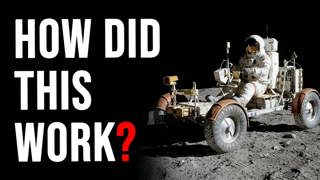
Long before the Apollo Program was officially announced in 1961, engineers and science fiction writers recognized the value of giving future moon explorers some kind of wheeled vehicle to increase their mobility. Most early concepts for such vehicles were large truck-like contraptions with pressurized cabins, allowing the astronauts to operate in so-called “shirt-sleeve” conditions, not unlike in the phenomenal film, The Martian. Such vehicles appear in Polish science fiction writer Jersz Zulawski’s 1901 novel On a Silvery Globe and Belgian cartoonist Hergé’s 1952 comic book On a Marché Sur La Lune AKA Explorers on the Moon, in which intrepid globetrotting journalist Tintin becomes the first person to set foot on earth’s satellite. That same year, Wernher von Braun, the former Nazi rocket engineer who developed the V2 ballistic missile and was brought to the United States after the Second World War as part of Project Paperclip, wrote a series of articles for Collier’s Weekly magazine with the delightfully gung-ho 1950s title of Man Will Conquer Space Soon! in which he speculated on what future space missions might look like. In these articles, he described a hypothetical six-week expedition to the moon equipped with specially-designed ten-ton tractor-trailer vehicles for hauling supplies. These articles were later adapted into three episodes of the Disney anthology TV series Disneyland - Man in Space, Man and the Moon, and Mars and Beyond - in which von Braun was prominently featured. Once the Apollo Program officially got underway, von Braun - by now the director of the newly-formed Marshall Spaceflight Centre in Huntsville, Alabama - commissioned a series of studies in cooperation with various corporations including Lockheed, Bendix, Boeing, General Motors, Brown Engineering, Grumman, and Bell Aerospace to evaluate the feasibility of building a wheeled vehicle for lunar surface exploration. Directed by MSC engineer Saverio Morea, these studies came up with a number of theoretical concepts including the Lunar Logistics System or LLS; the Lunar Scientific Survey Module or LSSM; the Mobility Test Article or MTA, the Lunar-Traversing Vehicle or LTV and the Mobility Laboratory or MOLAB - all of which followed the same general form factor of a large, truck-like vehicle with a pressurized cabin and four or more large wheels driven by electric motors. At first, the primary challenge in designing such vehicles was the nature of the lunar surface, which in the late 1950s and early 1960s was largely unknown. Some astronomers speculated that millions of years of bombardment by meteorites might have buried the surface under a blanket of dust several feet deep that would instantly swallow up any lander, rover, or astronaut that touched down on it. Author: Gilles Messier Host/Editor: Daven Hiskey Producer: Samuel Avila Learn more about your ad choices. Visit megaphone.fm/adchoices

Tämä jakso on lisätty Podme-palveluun avoimen RSS-syötteen kautta eikä se ole Podmen omaa tuotantoa. Siksi jakso saattaa sisältää mainontaa.

Jaksot(305)

Why Don't Vultures Get Sick?

Why Don't Vultures Get Sick?

⁠⁠In this episode of The Brain Food Show, we start by looking at the mind blowing things caterpillars get up to while in the chrysalis. Next up we begin by looking at the fascinating way in which hon...

22 Elo 54min

WTF is Up with the Tea Bag?

WTF is Up with the Tea Bag?

Legend says that brewing tea dates back to around 2737 BC, when tea leaves fell into water being boiled for Emperor Shennong of China. There does not appear to be any hard evidence of tea being discov...

20 Elo 12min

Why the Heck Did Goose Die Ejecting in Top Gun, but Maverick Didn't at Mach 10 in Top Gun: Maverick?

Why the Heck Did Goose Die Ejecting in Top Gun, but Maverick Didn't at Mach 10 in Top Gun: Maverick?

During the 1986 beach volleyball film Top Gun, U.S. Navy aviators and ultimate bros Lt. Pete “Maverick” Mitchell and Nick “Goose” Bradshaw are flying dogfight exercises in a Grumman F-14 Tomcat when t...

19 Elo 50min

How Did Edgar Allan Poe Die?

How Did Edgar Allan Poe Die?

Edgar Allan Poe is probably best known for his raven that squawks “Nevermore,” but he’s also one of the first American short story writers and is often credited with being the “inventor” of detective ...

18 Elo 19min

NASA’s Most Hilarious Failure

NASA’s Most Hilarious Failure

On April 11, 2026, the Orion spacecraft Integrity splashed down in the Pacific Ocean, bringing astronauts Victor Glover, Reid Wiseman, Jeremy Hansen, and Christina Koch (cook) safely back to earth aft...

17 Elo 32min

Can You Actually Tip a Cow?

Can You Actually Tip a Cow?

⁠⁠In this episode of The Brain Food Show, we start by looking at a rather fascinating fact about dogs and cats that you probably didn’t know. Next up we begin by debunking a variety of common whale ...

15 Elo 54min

The U.S.'s Biological Warfare Against Its Own Citizens, the Nazi Breeding Program and Much More

The U.S.'s Biological Warfare Against Its Own Citizens, the Nazi Breeding Program and Much More

In the "Forgotten History" compilation video today, we're looking at the United States' biological warfare program tested on its own citizens, the women who were used for breeding by the Nazis, the am...

14 Elo 2h 55min

The Forgotten American Civil War Death Camp

The Forgotten American Civil War Death Camp

On November 10, 1865, Henry Wirz, the commander of Andersonville prison in Georgia (a.k.a. Camp Sumter), was executed for his actions during the Civil War. A Swiss immigrant, Wirz was the only Confede...

13 Elo 14min

Suosittua kategoriassa Koulutus

rss-murhan-anatomia
psykopodiaa-podcast
voi-hyvin-meditaatiot-2
adhd-podi
rss-liian-kuuma-peruna
rss-vapaudu-voimaasi
psykologia
rss-niinku-asia-on
kesken
leikitaanko-laakaria
rss-narsisti
koulu-podcast-2
puhutaan-koiraa
rss-eron-alkemiaa
solu-ja-molekyylibiologian-perusteet
rss-koira-haudattuna
rss-duodecim-lehti
rss-hereilla
ilona-rauhala
jari-sarasvuo-podcast