Beyond Surveillance: How Behavioral Analytics Became a Trust Problem

Beyond Surveillance: How Behavioral Analytics Became a Trust Problem

Behavioral Analytics in 2026: How Companies Are Moving From Surveillance to Trust Architecture

The paradox nobody talks about:

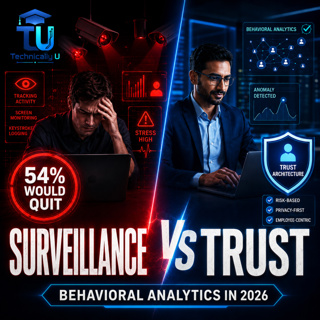
76% of companies see efficiency gains from monitoring. But 60% of employees report feeling MORE stressed. 54% would quit if surveillance increased.

This is how leading organizations are reframing behavioral analytics from "surveillance" to "security."

🎯 THE REAL COST OF INSIDER THREATS:

$19.5 MILLION: Average annual cost of insider threat incidents per organization (2026)

22-24 MILLION: North America average (doubling from 2018

INSIDER THREAT BREAKDOWN:

- 53% from negligent employees (mistakes, errors, accidents)

- 27% from malicious insiders (intentional data theft)

- 20% from stolen credentials (external attackers using legitimate access)

- 68% of organizations experience 21-40+ insider incidents per YEAR

- Average organization: 13.5 incidents annually

- Each incident costs $676,517 (negligent) to $715,366 (malicious)

SPEED MATTERS:

- Caught in 31 days: $10.6M total cost

- Caught in 30-90 days: $14.2M average

- Caught in 90 days: $18.7M+ total cost

- Containment alone costs $211,021 per incident

INCIDENT TYPES:

- Credential theft: $779,707 per incident (most expensive)

- Malicious insider: $4.7M average total impact

- Negligent employee: $4.5M average total impact

- Data breach via insider: $4.92M (costliest initial vector)---

🚨 THE SURVEILLANCE PARADOX:

THE SHORT-TERM GAIN:

✅ 76% of companies report increased efficiency after monitoring deployment

✅ 86% of large organizations already use some form of monitoring (Gartner 2026)

✅ 94% of companies with remote/hybrid work now deploy monitoring tools

THE LONG-TERM COST:

❌ 60% of employees report feeling MORE stressed under surveillance

❌ 54% say they would consider quitting if surveillance increased

❌ 30% report decreased job satisfaction

❌ Companies using invasive monitoring see 22% LOWER productivity long-term than transparent monitoring

THE TRUST GAP:

- 68% of managers believe monitoring improves work

- 54% of employees say they would quit if surveillance increased

- 44% of employees receive NO information about what data is collected about them

-77% would accept monitoring IF transparent about it

THE HUMAN COST:

Companies optimizing for "looks busy" instead of "actually productive."

Invasive monitoring creates short-term activity increases but long-term engagement collapse.---

🔒 BEHAVIORAL ANALYTICS VS. SURVEILLANCE:

BEHAVIORAL ANALYTICS (Security Tool):

✅ Establishes behavioral baselines for each user

✅ Flags deviations from normal patterns

✅ Uses machine learning to detect anomalies

✅ Targeted and efficient

✅ 70% faster insider threat detection than traditional monitoring

✅ Transparent about what's tracked

✅ Involves human review of alerts

SURVEILLANCE (Control Tool):

❌ Constant recording and monitoring

❌ Keystroke logging, screenshots, video surveillance

❌ Exhaustive data collection

❌ Invasive and stress-inducing

❌ Creates compliance and legal risks

❌ Often hidden from employees

❌ Generates alert fatigue

WHICH WORKS BETTER?

Organizations using transparent behavioral analytics see 22% higher productivity gains than those using invasive surveillance (Gartner 2026 data).---

📊 THE BUSINESS CASE:

REASON 1: INSIDER THREAT DETECTION- UEBA-equipped organizations catch insider threats 70% faster- Organizations with UEBA save average of $5.1M annually on insider costs- Every day faster containment = hundreds of thousands in savings

REASON 2: COMPLIANCE & REGULATORY- EU AI Act (August 2, 2026): AI monitoring tools classified as "high-risk"- Emotion recognition AI banned in EU workplaces (February 2025)- 20 US states have enacted privacy laws affecting workplace monitoring- Regulators expect organizations to have behavioral monitoring controls- Lack of controls = audit red flags---

Tämä jakso on lisätty Podme-palveluun avoimen RSS-syötteen kautta eikä se ole Podmen omaa tuotantoa. Siksi jakso saattaa sisältää mainontaa.

Jaksot(266)

The Confidence Gap: Why Executives Think AI Agents Are Secure (And Why They're Wrong)

The Confidence Gap: Why Executives Think AI Agents Are Secure (And Why They're Wrong)

The Confidence Gap: AI Agents and the Security Crisis Nobody Is Talking AboutEighty-two percent of executives feel confident that their existing AI agent policies are enough to keep their organization...

8 Elo 18min

Seeing Is No Longer Believing: How Deepfake Fraud Targets Businesses and Families

Seeing Is No Longer Believing: How Deepfake Fraud Targets Businesses and Families

What if the voice on the phone sounds exactly like your boss, your bank, or someone in your family — but it isn’t them?In this episode of Technically U, we break down Deepfake Fraud and why it has bec...

31 Heinä 23min

The AI Criminal Playbook: How Cybercrime Changed Forever in 2026

The AI Criminal Playbook: How Cybercrime Changed Forever in 2026

The next generation of cybercrime may not come from a hacker typing code in a dark room.It may come from someone using AI to generate phishing emails, clone voices, create fake identities, manipulate ...

24 Heinä 16min

RiskRecon Explained: The Cybersecurity Credit Score Companies Use to Judge You

RiskRecon Explained: The Cybersecurity Credit Score Companies Use to Judge You

What if a company you've never heard of is already influencing whether customers do business with you?In this episode of Technically U, we break down RiskRecon, the cybersecurity risk-rating platform ...

19 Heinä 9min

Vulnerability Management Explained: Find, Prioritize & Patch Before Hackers Strike

Vulnerability Management Explained: Find, Prioritize & Patch Before Hackers Strike

Right now, there may be vulnerabilities sitting inside your organization’s systems — and attackers may already be looking for them.In this episode of Technically U, we break down Vulnerability Managem...

12 Heinä 19min

HSTS: The Invisible Security Header Protecting Billions

HSTS: The Invisible Security Header Protecting Billions

Every time you visit your bank, check your email, log into a shopping site, or open a secure web app, there’s an invisible browser protection working behind the scenes: HSTS — HTTP Strict Transport Se...

3 Heinä 10min

The DNS Encryption War: Why Privacy Tools and Security Teams Are Fighting Over DoH

The DNS Encryption War: Why Privacy Tools and Security Teams Are Fighting Over DoH

DNS over HTTPS (DoH) encrypts the internet's phonebook—and it's breaking traditional network security. Here's what IT professionals need to know about DoH in 2026, why enterprises are concerned, and h...

20 Kesä 28min