
The Rise & Fall of the Hot Girl Service Economy (E215)
El Podcast25 Elo

The Rise & Fall of the Hot Girl Service Economy (E215)

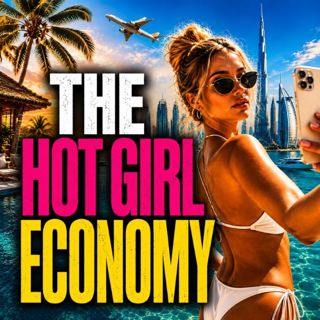
Swedish demographer and political candidate David Lorentzon explains his controversial theory of the “Hot Girl Service Economy”—how social media, global travel, gender-segregated careers and migration created female-centered economic ecosystems in places like Bali, Phuket, Dubai and Miami, and why he believes AI and economic disruption could bring them down.

Guest bio

David Lorentzon is a Swedish demographer, researcher and political candidate who studies migration, gender ratios, dating markets and demographic change. His research has focused particularly on separating migration statistics by gender, which led him to theories about mass female migration and what he calls the Hot Girl Service Economy. He is running for Sweden's parliament as a candidate for Alternative for Sweden (AfS), with personal policy interests including dating-app regulation and a modern debt jubilee. Lorentzon also holds U.S. citizenship through his American mother.

Topics discussed
  • The Hot Girl Service Economy and how it works
  • Bali, Phuket, Dubai and Miami as female-centered economic hubs
  • Instagram, OnlyFans, modeling and the influencer economy
  • Why social media accelerated this economy after roughly 2010
  • Gender segregation in careers and geography
  • Women moving toward cities and service-sector employment
  • Men clustering in rural, industrial and blue-collar regions
  • College education, student debt and career choices
  • Dating, marriage, fertility and family formation
  • AI-generated influencers and models replacing human creators
  • Whether the Hot Girl Service Economy could collapse
  • Marriage migration and “passport bros”
  • Female migration from Southeast Asia, Latin America and Eastern Europe
  • Male-heavy versus female-heavy societies
  • Dating apps and proposed regulation
  • Debt and the case for a modern debt jubilee
  • Sweden's political system and culture
  • Sweden's changing immigration policies
  • Swedish repatriation policies
  • Sweden versus the United States
  • Political polarization and national identity
Main points

1. The Hot Girl Service Economy is bigger than influencers. Lorentzon describes an ecosystem where models and online creators bring money into places such as Bali and Dubai, then spend that money on businesses and services—fitness, beauty, wellness and other lifestyle industries—that often employ other women.

2. Social media provided the catalyst. He traces early versions of the phenomenon to international tourism in the 1980s and 1990s, but says it reached critical mass around 2010 and became much more established around 2016–17.

3. The broader thesis is about a gender-segregated economy. Lorentzon argues that young men and women increasingly work in different industries and therefore live in different places: men disproportionately gravitate toward industrial, agricultural and blue-collar work, while women concentrate in cities and service-oriented industries.

4. He believes this has demographic consequences. In his view, these geographic and occupational differences make dating, marriage and family formation harder because compatible men and women increasingly don't live and work in the same places.

5. AI could threaten the economic model. Lorentzon predicts businesses will increasingly substitute inexpensive AI-generated models and influencers for human ones, potentially removing some of the high-income jobs that feed money into the wider ecosystem. This is presented in the episode as his forecast, rather than an established outcome.

6. Marriage migration acts as another demographic balancing mechanism. His research argues that migration from Southeast Asia, Eastern Europe and parts of Latin America into Western countries is disproportionately female in some flows, partly because of international marriage.

7. Gender imbalance can hurt men as well. Lorentzon rejects the idea that simply having many more men necessarily produces a stronger economy, arguing that extreme male surpluses can eventually produce disengagement, lower productivity and social instability.

8. His political platform goes beyond demographics. As an AfS parliamentary candidate, Lorentzon discusses leaving NATO and the EU and supporting re-migration, while his personal priorities include restructuring dating-app incentives and implementing a modern debt jubilee.

9. He challenges the conventional American image of Sweden. Lorentzon argues that modern Sweden combines a large welfare state with socially restrictive policies and a highly entrepreneurial economy, making the country's politics harder to categorize on a simple American left-right spectrum.

10. Sweden becomes the episode's second major case study. The latter portion moves from gender and dating into immigration, national identity, political polarization and differences between Sweden and the United States.

Top 3 quotes

“We have basically created a gender-segregated economy, not just in the US, but on a global scale.” — David Lorentzon

“The money is just circulating amongst each other. And that's the ecosystem.” — David Lorentzon

“People don't like dating apps anymore. Kind of have to change that.” — David Lorentzon

🎙 The Pod is hosted by Jesse Wright
💬 For guest suggestions, questions, or media inquiries, reach out at https://elpodcast.media/
📬 Never miss an episode – subscribe and follow wherever you get your podcasts.
⭐️ If you enjoyed this episode, please rate and review the show. It helps others find us.

Thanks for listening!

Tämä jakso on lisätty Podme-palveluun avoimen RSS-syötteen kautta eikä se ole Podmen omaa tuotantoa. Siksi jakso saattaa sisältää mainontaa.

Jaksot(213)

What Europeans Get Wrong About America (E214)

What Europeans Get Wrong About America (E214)

A German travel YouTuber shares how visiting America challenged nearly every stereotype she had about the United States—from friendliness and safety to healthcare, food, and quality of life—while comp...

18 Elo 1h 18min

What Happened to Australia? A Warning for the Entire West (E213)

What Happened to Australia? A Warning for the Entire West (E213)

Australian law professor Dr. Augusto Zimmermann argues that Western civilization is in rapid decline due to the erosion of free speech, the rule of law, mass migration, and the growing power of politi...

11 Elo 1h 20min

The Biggest Lies About American History (E212)

The Biggest Lies About American History (E212)

Professor Jeff Fynn-Paul argues that many popular narratives about European colonialism are historically inaccurate, tracing their origins to ideological reinterpretations of history rather than the h...

4 Elo 1h 9min

Everything You Know About Sleep Is Wrong (E211)

Everything You Know About Sleep Is Wrong (E211)

Humans aren't suffering from a sleep epidemic—we're suffering from a circadian rhythm epidemic, and understanding the difference could transform how we think about sleep, health, and human evolution. ...

21 Heinä 1h 9min

I Asked a Mexico Real Estate Expert About Retiring in Mexico (E210)

I Asked a Mexico Real Estate Expert About Retiring in Mexico (E210)

Guest Bio Greg Gunter is the Founder and Broker/Owner of Berkshire Hathaway HomeServices Mexico. A 17-year resident of San Miguel de Allende, he specializes in helping Americans and Canadians relocate...

15 Heinä 1h

Britain's Collapse Is Happening Faster Than You Think (E209)

Britain's Collapse Is Happening Faster Than You Think (E209)

Dr. Ben Jones explains how mass migration, multiculturalism, and declining free speech are reshaping Britain—and why he believes the country's future is at a turning point. Guest Bio Dr. Ben Jones is...

7 Heinä 59min

The Education System Is Still Trapped in 1893 (E208)

The Education System Is Still Trapped in 1893 (E208)

Former venture capitalist and education reformer Ted Dintersmith explains why America's 19th-century education system is failing students in the AI era—and how schools can better prepare young people ...

30 Kesä 1h 16min

Why Pickleball Is Growing Faster Than Any Other Sport (E207)

Why Pickleball Is Growing Faster Than Any Other Sport (E207)

Former world No. 1 pickleball player Zane Navratil explains why pickleball is exploding globally, how pro players actually make money, and what the future of the sport looks like. Guest Bio Zane Navra...

23 Kesä 54min

Suosittua kategoriassa Liike-elämä ja talous

sijotuskasti
mimmit-sijoittaa
psykopodiaa-podcast
rss-rahapodi
ostan-asuntoja-podcast
rss-sami-miettinen-neuvottelija
hyva-paha-johtaminen
rahapuhetta
rss-ammattipodcast
rss-rahamania
rss-hikipaja
asuntoasiaa-paivakirjat
rss-inderes
rss-oivalluksia-rahasta-elamasta
pomojen-suusta
rss-startup-ministerio
lakicast
rss-karon-grilli
pari-sanaa-lastensuojelusta
rss-vaikuttavan-opettajan-vierella