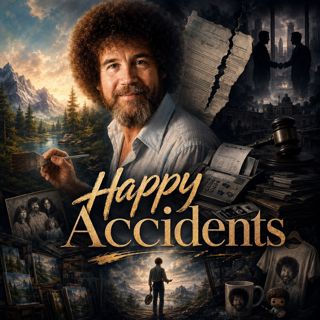

Happy Accidents

Happy Accidents

Everyone knows the voice, the perm, and the happy little trees. Far fewer people know what happened to Bob Ross’s name after the cameras stopped rolling.

In this episode, we trace the remarkable and deeply complicated story of Bob Ross, from his years as an Air Force first sergeant in Alaska, where he painted souvenir gold pans to earn extra money, to the television phenomenon that made him one of the most recognizable artists in American popular culture.

Along the way, we look at the mentor who taught him the wet-on-wet technique he would eventually make famous, the relationship that fractured as Ross’s career took off, and the Virginia couple who recognized that Bob Ross could become something much larger than a television painter. At the center of the story is a corporate agreement signed in 1985.

Four equal partners formed Bob Ross Inc., but a survivorship provision meant that when one partner died, ownership of that person’s shares passed to the surviving partners. What looked like a routine piece of corporate paperwork would eventually determine who controlled Bob Ross’s business, his likeness, and ultimately the commercial future of his name.

Then Bob Ross got sick. Within days of his cancer diagnosis, a six-page fax arrived addressing the future of the company and the rights surrounding his name. During the final year of his life, Ross began recording telephone conversations. Five weeks before his death on July 4, 1995, he signed a trust stating that he wanted the rights to his name and likeness divided between his son, Steve, and his half-brother, Jimmie Cox.

What followed was a legal battle that continued long after Bob Ross was gone.We examine the litigation that followed his death, including reimbursement claims calculated down to the dime for expenses incurred while Ross was traveling for cancer treatment, a dispute involving the children’s television project that became some of his final work, and a settlement that resulted in recorded tapes being destroyed. For years afterward, much of the conflict surrounding his estate remained largely outside public view.T hen, decades later, the fight resurfaced.

Bob Ross’s son, Steve, discovered in his fifties that his father’s trust purported to leave him 49% of the rights associated with his name and likeness. That discovery eventually led to a federal courtroom in Virginia, where a judge reached a devastating conclusion: when Bob signed the trust, the intellectual property he attempted to leave behind was not actually his to give.

From there, the story enters an afterlife Bob Ross could never have imagined. His television episodes became streaming marathons. His face appeared on waffle makers, lottery tickets, clothing, toys, and countless other products.

A Bob Ross bobblehead entered the Smithsonian’s collection, while original paintings that had spent years stacked inside cardboard boxes became extraordinarily valuable pieces of American pop-culture history, with works eventually reaching prices above $1 million as part of efforts benefiting public television.

This is not simply the story of Bob Ross the painter. It is the story of what happens when a person becomes a brand, what a famous name is actually worth, who gets to control it after its owner is gone, and how one of television’s gentlest personalities became the center of a decades-long battle over his own legacy.


Email Brian

Join Our FREE Newsletter

Get Brian's Books

Leave Us A Voicemail

Visit Our Website


Have a forgotten historical mystery, disturbing event, unsolved crime, or hidden conspiracy you think deserves investigation?

Send your suggestions to brian@paranormalworldproductions.com.

Disturbing History is a dark history podcast exploring unsolved mysteries, secret societies, historical conspiracies, lost civilizations, and the shadowy stories buried beneath the surface of the past.

Follow the show and enable automatic downloads so you never miss a deep dive into history’s most unsettling secrets.

Because sometimes the truth is darker than fiction.

Tämä jakso on lisätty Podme-palveluun avoimen RSS-syötteen kautta eikä se ole Podmen omaa tuotantoa. Siksi jakso saattaa sisältää mainontaa.

Jaksot(154)

The 1990's

The 1990's

On July 16, 1990, Time magazine put a group of young adults on its cover beneath the word “twentysomething” and asked whether they were laid back, late blooming, or simply lost. The story said they st...

30 Syys 1h 12min

The Siege At Ruby Ridge

The Siege At Ruby Ridge

Listener discretion is advised. This episode contains descriptions of real-life violence and death, including the shooting deaths of a fourteen-year-old boy, his mother, and a federal law enforcement ...

27 Syys 1h 18min

The 1980's

The 1980's

The 1980s began with 52 Americans still being held hostage in Tehran and ended with crowds tearing open the Berlin Wall. Between those two moments came one of the most turbulent, contradictory decades...

25 Syys 1h 9min
Halley's Comet

Halley's Comet

On the night of May 18, 1910, people across the world waited for Halley’s Comet to kill them.Hotels in New York opened their rooftops. Miners in Pennsylvania refused to go underground. A religious sec...

23 Syys 1h 1min
The Freeway Killer

The Freeway Killer

This episode discusses sexual violence against children and teenagers, torture, and murder and is not suitable for younger audiences. Listener discretion is strongly advised. On the night of June 11, ...

21 Syys 1h 19min

The 1970's

The 1970's

The 1970s opened in conflict.On April 30, 1970, President Richard Nixon announced the expansion of U.S. military operations into Cambodia.Days later, four students were killed by the Ohio National Gua...

18 Syys 1h 2min
The Bystander Effect

The Bystander Effect

On March 27, 1964, The New York Times published a story that would become one of the most famous examples of human indifference ever told. According to the report, 38 people in Queens watched as 28-ye...

16 Syys 1h
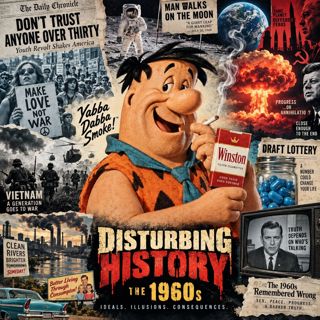
The 1960's

The 1960's

Everybody knows the line: “Don’t trust anyone over thirty.” It became shorthand for an entire generation, even though the man who said it was a 24-year-old Berkeley graduate student who would turn thi...

13 Syys 1h 2min

Suosittua kategoriassa Yhteiskunta

olipa-kerran-otsikko
i-dont-like-mondays
seitseman
sita
siita-on-vaikea-puhua
hupiklubi
uutiscast
download
poks
antin-palautepalvelu
mamma-mia
kaksi-aitia
kolme-kaannekohtaa
yopuolen-tarinoita-2
rss-murhan-anatomia
aikalisa
rss-palmujen-varjoissa
gogin-ja-janin-maailmanhistoria
vallattomat
kummitusjuttuja