422 | The Leadership Operating System - Scale Faster With Trust | Jurgen Dauk

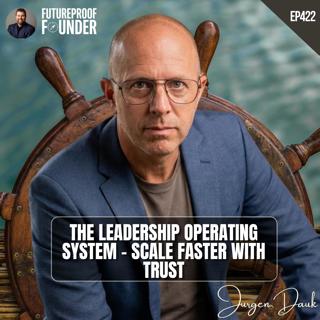
422 | The Leadership Operating System - Scale Faster With Trust | Jurgen Dauk

Jeff Mains sits down with Jurgen Dauk to unpack why the org chart that got a company to its first 50 people is often the exact thing choking it at 500. Jurgen argues that most companies are still built and run like machines — predictable, controllable, command-and-control — when what actually thrives in fast-moving, crisis-prone markets is an organization that behaves more like an organism: adaptive, self-healing, and built around trust in people rather than rigid processes. The conversation covers why rolling AI into a broken structure just accelerates the dysfunction, how to diagnose silos and misaligned KPIs, why a real vision and mission (not a wall plaque) is the glue that holds cross-functional teams together, and concrete stories — from a car manufacturer losing the innovation race to China, to Ritz-Carlton's radical front-line trust — showing what happens when decision power moves closer to the action.

Key Takeaways

2:31 — The structure that got you here might be the exact thing slowing you down now.

6:19 — Think of your company as an organism, not a machine — it puts people at the center, not the org chart.

9:09 — Why command-and-control kills AI ROI: strategic top-down rollouts vs. empowered cross-functional teams choosing their own AI use cases.

12:04 — The "garbage in, garbage out" AI story: a regional marketing team fed AI a stale document instead of training it on their ideal customer.

15:19 — Command-and-control is really about fear — fear of losing control, fear it won't work out.

17:07 — The fastest diagnostic for a broken org: ask 10 people the company's vision/mission and see how many different answers you get.

18:19 — Gallup data: nearly 80% of employees are completely checked out.

23:52 — What a "Leadership Operating System" actually is — not a machine principle bolted onto your org, but a guide to co-create your own unique structure.

26:03 — How to find your silos fast: look at how decisions flow, how information moves, and whether your teams' KPIs actually conflict with each other.

34:23 — The German auto industry story: a legacy manufacturer builds one generation of a car in the time a Chinese competitor builds three.

37:26 — The #1 structural move before spending another dollar on AI: just ask your people what they need.

42:49 — The Amazon Web Services story — building backwards from what the customer needs, not from existing tools/processes.

45:36 — The Ritz-Carlton story: an employee flies to Hawaii to hand-deliver a guest's forgotten laptop, funded by a no-questions-asked discretionary budget.

Tweetable Quotes"Your structure is either your engine or your anchor." — Jeff Mains"AI amplifies what is there. If your foundation isn't set up well, it will amplify exactly that." — Jurgen Dauk"Organizations are made up of people, not machines." — Jurgen Dauk"The reality is different — our issue is the time it takes us to build one generation of our flagship product, while our competition is developing three." — Jurgen Dauk"Instead of investing into AI, ask your people. Talking to people is not very expensive." — Jurgen Dauk"What people almost never ask is: In what way would I need to change?" — Jurgen Dauk"Organizational transformation really is personal transformation just at scale." — Jeff MainsSaaS Leadership Lessons
  1. Trust decision power to where the knowledge lives. Cross-functional teams closer to the action decide faster and better because they understand the problem firsthand.
  2. A rigid structure will sabotage your AI investment. Rolling out AI on top of command-and-control doesn't fix dysfunction — it accelerates it.
  3. Vision and mission are operational tools, not marketing copy. A vision that unites people (not "20% YoY growth") is what aligns fragmented teams and keeps talent engaged.
  4. Diagnose silos through decisions, information flow, and KPIs. Conflicting metrics between departments (e.g., sales vs. marketing) are a reliable early warning sign.
  5. Letting go of control is the hardest and highest-leverage move. It requires training people on communication, clear guardrails, and a safe space for mistakes — not just "here's the plan, good luck."
  6. Build backwards from the customer, not from existing tools or processes. Amazon Web Services and Ritz-Carlton both succeeded by empowering people to act in service of the customer outcome, not internal process compliance.

Guest Resources

j.dauk@theleadership-os.com

https://theleadership-os.com/

https://www.linkedin.com/in/juergendauk/

Episode Sponsor

The Futureproof Series - https://www.youtube.com/playlist?list=PLfkXKUPZ5xuOqMPR7_gzGybncTtavyR1N

The Captain's Keys

Small Fish, Big Pond – https://smallfishbigpond.com/ Use the promo code ‘SaaSFuel’

Champion Leadership Group – https://championleadership.com/

https://jeffmains.com/books/

SaaS Fuel Resources

Website - https://championleadership.com/

Jeff Mains on LinkedIn - https://www.linkedin.com/in/jeffkmains/

Twitter - https://twitter.com/jeffkmains

Facebook - https://www.facebook.com/thesaasguy/

Instagram - https://instagram.com/jeffkmains

Tämä jakso on lisätty Podme-palveluun avoimen RSS-syötteen kautta eikä se ole Podmen omaa tuotantoa. Siksi jakso saattaa sisältää mainontaa.

Jaksot(433)

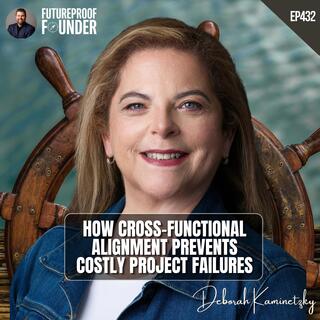
432 | How Cross-Functional Alignment Prevents Costly Project Failures | Deborah Kaminetzky

432 | How Cross-Functional Alignment Prevents Costly Project Failures | Deborah Kaminetzky

A software implementation can be delivered on time and on budget, then fail the moment people refuse to use it.In this episode, Jeff Mains talks with Deborah Kaminetzky, founder of De Facto Project Ma...

15 Loka 47min

431 | The Hidden Work Behind Cross-Border Supply Chains | Daman Grewal

431 | The Hidden Work Behind Cross-Border Supply Chains | Daman Grewal

Daman Grewal grew a logistics company from $1 million to $24 million in four years, working across dispatch, safety, accounts receivable, and sales before he fully recognized the skills he was buildin...

13 Loka 53min
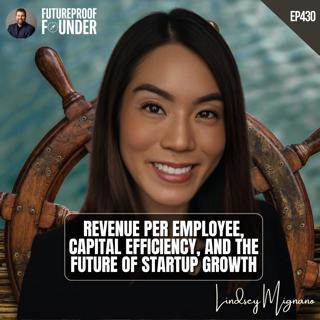
430 | Revenue Per Employee, Capital Efficiency, and the Future of Startup Growth | Lindsey Mignano

430 | Revenue Per Employee, Capital Efficiency, and the Future of Startup Growth | Lindsey Mignano

Are you raising venture capital because your business needs it—or because getting funded feels like proof you’ve made it?In this episode of Futureproof Founder, Jeff Mains sits down with Lindsey Migna...

8 Loka 54min

429 | AI, Education, and the Decline of Independent Thinking | Jonathan Schaeffer

429 | AI, Education, and the Decline of Independent Thinking | Jonathan Schaeffer

Are you using AI to make better decisions—or letting a confident answer do your thinking for you?In this episode of Futureproof Founder, Jeff Mains sits down with AI researcher and entrepreneur Jonath...

6 Loka 57min
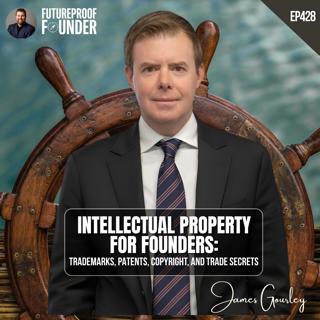
428 | Intellectual Property for Founders: Trademarks, Patents, Copyright, and Trade Secrets | James Gourley

428 | Intellectual Property for Founders: Trademarks, Patents, Copyright, and Trade Secrets | James Gourley

Jeff Mains sits down with James Gourley, a patent attorney and IP litigator who has spent 20 years on both sides of intellectual property disputes — from filing patents and trademarks to defending com...

1 Loka 42min
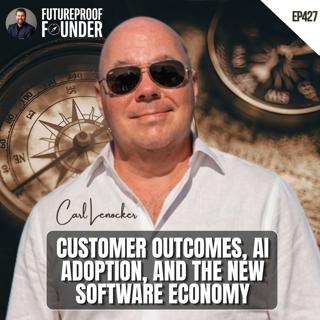
427 | Customer Outcomes, AI Adoption, and the New Software Economy | Carl Lenocker

427 | Customer Outcomes, AI Adoption, and the New Software Economy | Carl Lenocker

Jeff Mains sits down with Carl Lenocker, a 30-year enterprise software veteran who started in Silicon Valley in the '80s, survived the dot-com bust, and now consults founders on what actually creates ...

29 Syys 45min
426 | How Founders Can Turn AI Whiplash Into Strategic Focus | David Fung

426 | How Founders Can Turn AI Whiplash Into Strategic Focus | David Fung

David Fung spent 15 years at Salesforce as a Senior Director before walking away from unvested RSUs to launch Coachful Coaching. He now coaches CTOs and tech leaders on the pattern he calls "AI whipla...

24 Syys 46min
425 | Product-Market Fit Starts with Understanding the User | Erin Rollenhagen

425 | Product-Market Fit Starts with Understanding the User | Erin Rollenhagen

Erin Rollenhagen learned the most expensive lesson in product development the hard way: she spent years building software without ever talking to a single end user—and people took early retirement to ...

22 Syys 46min

Suosittua kategoriassa Liike-elämä ja talous

sijotuskasti
vallattomat
psykopodiaa-podcast
mimmit-sijoittaa
rss-rahapodi
rss-oivalluksia-rahasta-elamasta
ostan-asuntoja-podcast
rss-rahamania
rss-hereilla
rss-laakispodi
rss-karon-grilli
hyva-paha-johtaminen
pomojen-suusta
rahapuhetta
rss-startup-ministerio
rss-sami-miettinen-neuvottelija
rss-paasipodi
rss-alanvaihtajat
rss-ammattipodcast
rss-deloitten-podcastit