
Revising our founding myths in face of violence against women - Susana Muszkat

Revising our founding myths in face of violence against women - Susana Muszkat

What if God had created Eve not at Adam’s service, but acknowledging his human condition of helplessness and absolute dependence on another human being? What may be the influence of this Western myth of the creation of civilization upon our subjectivity, especially regarding gender differences? These and other interesting questions are posed by Susana Muszkat in this paper about male violence and its naturalization in society.

According to her, gender-biased behaviors associated with masculinity (and femininity) are sustained by fixed cultural codes and repeated unconsciously across generations, in the absence of interventions aimed at deconstructing them. Is it God’s fault, or is it the way we read the myth?

Susana Muszkat is a psychologist and psychoanalyst, a full member and faculty member of the Brazilian Psychoanalytical Society of São Paulo. She sees adults, couples, and families in private practice and in institutions. Susana has a master’s degree in Social Psychology, which led her to studies on masculinity, violence, and gender, and to coordinating talk groups for men convicted of domestic violence for 15 years, where she had the opportunity to reflect on the “social construction of masculinity.”

She noted that men get trapped in static roles and cultural demands—as they are always expected to be strong, have courage, and engage in risky behaviors—differently from what is expected of women. According to her, this ends up affecting their mental health, generating violence as a product of having to maintain this Ideal Ego. In an attempt to get rid of feelings of insecurity, they react with violence. Susana coined the term “violence from identity distress” for this emotional condition.

Susana is a former IPSO President and has served on several IPA committees. She currently chairs the Institutional Issues Committee and was recently awarded first prize by the Community and the World Committee on Health and Psychoanalysis at the 2025 Lisbon Congress for her joint paper on the SOS Brazil project. She has published articles, book chapters, and books in several languages on this and other subjects.

This episode is presented in English and Portuguese.

portuguese

You can download a copy of the paper here.

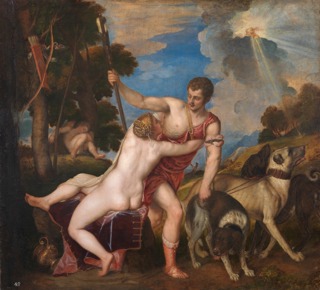
This podcast series is produced by the International Psychoanalytical Association as part of the activities of the IPA Outreach Subcommittee. Chair: Gaetano Pellegrini Podcast Coordinator: Florencia Biotti This episode produced by: Sylvia Pupo Editing and Post-Production: Massimiliano Guerrieri Cover Image: Titian, Venus and Adonis, 1554. Museo del Prado, Madrid. Public domain.

Tämä jakso on lisätty Podme-palveluun avoimen RSS-syötteen kautta eikä se ole Podmen omaa tuotantoa. Siksi jakso saattaa sisältää mainontaa.

Jaksot(100)

Why I Write: From the Dot to the Line – Drawing a Thread Out and Writing it Through · Jennifer Davids

Why I Write: From the Dot to the Line – Drawing a Thread Out and Writing it Through · Jennifer Davids

Why does the analyst write? And further why might the analyst write different kinds of pieces such as clinical writing, scientific papers, narratives, or poetry? There are always the considerations of...

28 Heinä 17min

The Body as a Pulsing Frontier - Ema Ponce de León

The Body as a Pulsing Frontier - Ema Ponce de León

Are the limits of what can be said – the field of the non-verbal, the texture of affects, everything that resists symbolic capture – the true challenge facing psychoanalysis today? In her thought-prov...

30 Kesä 22min

Psychic Change and Enactment: some reflections - Ariel Liberman

Psychic Change and Enactment: some reflections - Ariel Liberman

"Psychic Change and Enactment: Some Reflections" is the work that Ariel Liberman offers us, to examine psychic change from a relational perspective, placing enactment as a central moment in the analyt...

4 Touko 26min
Vicissitudes of Transience - Jhuma Basak

Vicissitudes of Transience - Jhuma Basak

"How does the psyche navigate the interplay of impermanence and resilience? In 'Vicissitudes of Transience', Jhuma Basak explores the concept of transience through psychoanalytic, cultural, and philos...

23 Maalis 23min

Transience and the prohibition of “Don’t Look” - Osamu Kitayama

Transience and the prohibition of “Don’t Look” - Osamu Kitayama

"What happens when we accept that impermanence is not a loss, but the very essence of life? In psychoanalysis, transience is often associated with mourning and the capacity to renew oneself. Inspired ...

3 Maalis 23min
The Body and Compulsion in Childhood - Christine Anzieu-Premmereur

The Body and Compulsion in Childhood - Christine Anzieu-Premmereur

In this article, Christine Anzieu-Premmereur explores the relationship between compulsion and the body in childhood and adolescence. Using psychoanalytic theory, she analyzes how the compulsive repeti...

14 Tammi 24min

The Mystery, Again - Mariano Horenstein

The Mystery, Again - Mariano Horenstein

"X". Calle Alcalá, Madrid. Photograph by Ana M. Martín Solar. With the evocative title “Once Again, the Mystery”, the Argentine psychoanalyst Mariano Horenstein poses the equally enigmatic question: H...

14 Loka 202535min

Suosittua kategoriassa Tiede

rss-mita-tulisi-tietaa
rss-poliisin-mieli
tiedekulma-podcast
utelias-mieli
rss-duodecim-lehti
rss-totuuden-liepeilla
rss-luontopodi-samuel-glassar-tutkii-luonnon-ihmeita
filocast-filosofian-perusteet
rss-ja-ihminen-loi-alyn-aalto-yliopiston-tekoalypodcast
rss-vaasan-yliopiston-podcastit
rss-bios-podcast
rss-sosiopodi
rss-tiedetta-vai-tarinaa
hippokrateen-vastaanotolla
rss-ruoka-murroksessa
rss-hereilla