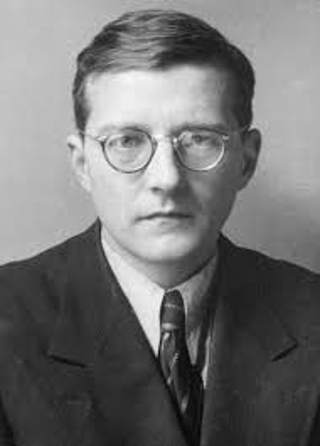
Shostakovich Symphony No. 6

Shostakovich Symphony No. 6

Dmitri Shostakovich: "I have set myself a task fraught with tremendous responsibility, to express in sound the immortal image of Lenin as a great son of the Russian people and as a leader of the masses. I have received numerous letters from all over the Soviet Union with regard to my future symphony. The most important advice contained therein was to make considerable use of musical folklore."

In the massively consequential year of 1939, Shostakovich used these words to launch his Sixth Symphony. The piece was meant to have soloists and a chorus alongside the orchestra — perhaps a nod to his Second and Third Symphonies, which were essentially propaganda pieces. Shostakovich even promised to use the poem "Vladimir Ilyich Lenin" by Vladimir Mayakovsky as the basis for his choral text.

The Soviet public eagerly awaited this new symphony, which was inevitably going to be compared with his Fifth Symphony — the piece that had brought Shostakovich back into the Soviet government's good graces, and which remains one of his most popular works even as it's also one of his most complex and nuanced pieces beneath its relatively conservative surface.

But whether Shostakovich ever actually planned to write this gigantic "Lenin" symphony is highly doubtful, since no sketches of it have ever turned up. Instead, Shostakovich pivoted publicly to describing his new symphony this way:

"The musical character of the Sixth Symphony will differ from the mood and emotional tone of the Fifth Symphony, in which moments of tragedy and tension were characteristic. In my latest symphony, music of a contemplative and lyrical order predominates. I wanted to convey in it the moods of spring, joy, youth."[6]

As you can see, Shostakovich wasn't actually saying much about the content of the symphony — if anything at all. He was leaving things deliberately ambiguous, and, fittingly, ambiguous is a pretty good description of this highly enigmatic symphony.

Everything about this symphony is slightly off. It's in three movements, not the typical four, and it opens with a massive slow movement; the two remaining movements are fast and significantly shorter, together lasting less than the first movement alone. It was written in 1939 — supposedly a year of military triumph for the Soviet Union, given the Stalin pact with Hitler that allowed Hitler to invade Poland and launch World War II — and yet there is not a hint of military triumphalism in it.

In short, this symphony confused a lot of people and has always received mixed reviews, whether from musicologists trying to fit it into the traditional "everything in Shostakovich is about Stalin" narrative, or from Soviet critics of the time trying to fit it into Socialist Realist aesthetics. In the end, descriptions of Shostakovich always attempt to put him into a box — silent dissident, Soviet stooge, hero, coward, etc. The truth, of course, is complicated, and this symphony is a great example of the eternal enigma that is Dmitri Shostakovich.

Today, on this Patreon-sponsored episode, I'll take you through this wonderful symphony from a musical perspective, trying to parse its unusual form, its unusually lyrical first movement, and the wild, madcap dash of the final two movements. Join us!

Tämä jakso on lisätty Podme-palveluun avoimen RSS-syötteen kautta eikä se ole Podmen omaa tuotantoa. Siksi jakso saattaa sisältää mainontaa.

Jaksot(297)

Grieg: Peer Gynt

Grieg: Peer Gynt

Grieg's Peer Gynt suites are among the best-known and best-loved works of classical music in the world. They are practically embedded into popular culture, being used in a dizzying number of cartoons,...

3 Syys 1h 7min
Mozart Clarinet Concerto

Mozart Clarinet Concerto

When it comes to a piece like the Mozart Clarinet Concerto, a few words or phrases regularly come up: the concerto is described as "mellow" or Mozart's "swan song," but most often it is described as "...

20 Elo 51min
Bohuslav Martinu Symphony No. 1

Bohuslav Martinu Symphony No. 1

It took a lot to make the composer and critic Virgil Thomson happy. He was famous for savaging new works he didn't like, and the truth is, he didn't like very many new works at all. One exception was ...

6 Elo 1h 1min
Scriabin Poem of Ecstasy

Scriabin Poem of Ecstasy

Thence the universe resounds
 With a joyful cry  I AM. These are the final lines of Alexander Scriabin's epic Poem of Ecstasy, a 300-line poem that takes nearly 10 minutes to read aloud and is one of ...

23 Heinä 51min
Sibelius Tapiola

Sibelius Tapiola

Ancient, mysterious, brooding savage dreams; Within them dwells the Forest's mighty God, And wood-sprites in the gloom weave magic secrets. These lines are affixed to the first page of Sibelius' tone...

10 Heinä 47min
Arthur Honneger, Symphony No. 3, "Liturgique"

Arthur Honneger, Symphony No. 3, "Liturgique"

In the aftermath of World War II, the Swiss composer Arthur Honegger, who had been living in occupied Paris throughout the war, wrote a new symphony entitled "Liturgical." He wrote an extended comment...

25 Kesä 53min
Dvorak Piano Quintet, Op. 81

Dvorak Piano Quintet, Op. 81

In 1872, at the age of 31, Dvořák wrote a Piano Quintet designated as Opus 5. Dvořák was not a prodigy like some other famous composers; instead, his development as a composer was slow and steady. Lat...

11 Kesä 49min

Suosittua kategoriassa Viihde

aamuvuoro
anni-jaajo
tuplakaak
grekovit
hei-baby-3
terveisia-perheesta
hupiklubi
antin-palautepalvelu
dear-shirly
seitseman
bella-table
ellen-jari-tamakin-viela
everypodi
the-harlin-show
antin-elokuvakerho
dear-shirly-ja-arttu
nonsensepodi
tahtitehdas
trippileiri
get-jassud