Rosa Luxemburg
Melvyn Bragg discusses the life and times of Rosa Luxemburg (1871-1919), 'Red Rosa', who was born in Poland under the Russian Empire and became one of the leading revolutionaries in an age of revolution. She was jailed for agitation and for her campaign against the Great War which, she argued, pitted workers against each other for the sake of capitalism. With Karl Liebknecht and other radicals, she founded the Spartacus League in the hope of ending the war through revolution. She founded the German Communist Party with Liebknecht; with the violence that followed the German Revolution of 1918, her opponents condemned her as Bloody Rosa. She and Liebknecht were seen as ringleaders in the Spartacus Revolt of 1919 and, on 15th January 1919, the Freikorps militia arrested and murdered them. While Luxemburg has faced opposition for her actions and ideas from many quarters, she went on to become an iconic figure in East Germany under the Cold War and a focal point for opposition to the Soviet-backed leadership.With Jacqueline Rose Co-Director of the Birkbeck Institute for the Humanities, Birkbeck, University of LondonMark Jones Irish Research Council fellow at the Centre for War Studies, University College Dublinand Nadine Rossol Senior lecturer in Modern European History at the University of EssexProducer: Simon Tillotson.
13 Huhti 201750min

Pauli's Exclusion Principle
After 27 years, Melvyn Bragg has decided to step down from the In Our Time presenter’s chair. With over a thousand episodes to choose from, he has selected just six that capture the huge range and depth of the subjects he and his experts have tackled. In this fifth of his choices, we hear Melvyn Bragg and his guests discuss a key figure from quantum mechanics.Their topic is the life and ideas of Wolfgang Pauli (1900-1958), whose Exclusion Principle is one of the key ideas in quantum mechanics. A brilliant physicist, at 21 Pauli wrote a review of Einstein's theory of general relativity and that review is still a standard work of reference today. The Pauli Exclusion Principle proposes that no two electrons in an atom can be at the same time in the same state or configuration, and it helps explain a wide range of phenomena such as the electron shell structure of atoms. Pauli went on to postulate the existence of the neutrino, which was confirmed in his lifetime. Following further development of his exclusion principle, Pauli was awarded the Nobel Prize in Physics in 1945 for his 'decisive contribution through his discovery of a new law of Nature'. He also had a long correspondence with Jung, and a reputation for accidentally breaking experimental equipment which was dubbed The Pauli Effect.With Frank Close Fellow Emeritus at Exeter College, University of OxfordMichela Massimi Professor of Philosophy of Science at the University of EdinburghandGraham Farmelo Bye-Fellow of Churchill College, University of CambridgeProducer: Simon TillotsonSpanning history, religion, culture, science and philosophy, In Our Time from BBC Radio 4 is essential listening for the intellectually curious. In each episode, host Melvyn Bragg and expert guests explore the characters, events and discoveries that have shaped our world
6 Huhti 201748min
Hokusai
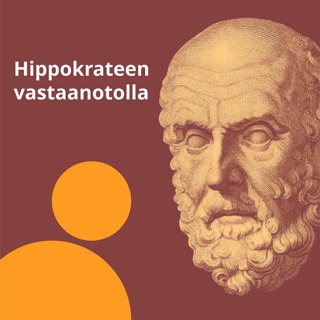
Melvyn Bragg and guests discuss Katsushika Hokusai (1760-1849), the Japanese artist whose views of Mt Fuji such as The Great Wave off Kanagawa (pictured) are some of the most iconic in world art. He worked as Japan was slowly moving towards greater contact with the outside world, trading with China and allowing two Dutch ships to dock each year. From these ships he picked up new synthetic colours and illustrations with Western compositions, which he incorporated in his traditional wood block prints. The quality of his images helped drive demand for prints among the highly literate Japanese public, particularly those required to travel to Edo under feudal obligations and who wanted to collect all his prints. As well as the quality of his work, Hokusai's success stems partly from his long life and career. He completed some of his most memorable works in his 70s and 80s and claimed he would not reach his best until he was 110.With Angus Lockyer Lecturer in Japanese History at SOAS University of LondonRosina Buckland Senior Curator of Japanese Collections at the National Museum of ScotlandAnd Ellis Tinios Honorary Lecturer in the School of History, University of LeedsProducer: Simon Tillotson.
30 Maalis 201748min

The Battle of Salamis
Melvyn Bragg and guests discuss what is often called one of the most significant battles in history. In 480BC in the Saronic Gulf near Athens, between the mainland and the island of Salamis, a fleet of Greek allies decisively defeated a larger Persian-led fleet. This halted the further Persian conquest of Greece and, at Plataea and Mycale the next year, further Greek victories brought Persian withdrawal and the immediate threat of conquest to an end. To the Greeks, this enabled a flourishing of a culture that went on to influence the development of civilisation in Rome and, later, Europe and beyond. To the Persians, it was a reverse at the fringes of their vast empire but not a threat to their existence, as it was for the Greek states, and attention turned to quelling unrest elsewhere.With Lloyd Llewellyn-Jones Professor in Ancient History at Cardiff UniversityLindsay Allen Lecturer in Greek and Near Eastern History, King's College LondonandPaul Cartledge Emeritus Professor of Greek Culture and AG Leventis Senior Research Fellow at Clare College, University of CambridgeProducer: Simon Tillotson.
23 Maalis 201750min

The Paleocene-Eocene Thermal Maximum
Melvyn Bragg and guests discuss the high temperatures that marked the end of the Paleocene and start of the Eocene periods, about 50m years ago. Over c1000 years, global temperatures rose more than 5 C on average and stayed that way for c100,000 years more, with the surface of seas in the Arctic being as warm as those in the subtropics. There were widespread extinctions, changes in ocean currents, and there was much less oxygen in the sea depths. The rise has been attributed to an increase of carbon dioxide and methane in the atmosphere, though it is not yet known conclusively what the source of those gases was. One theory is that a rise in carbon dioxide, perhaps from volcanoes, warmed up the globe enough for warm water to reach the bottom of the oceans and so release methane from frozen crystals in the sea bed. The higher the temperature rose and the longer the water was warm, the more methane was released. Scientists have been studying a range of sources from this long period, from ice samples to fossils, to try to understand more about possible causes. With Dame Jane Francis Professor of Palaeoclimatology at the British Antarctic SurveyMark Maslin Professor of Palaeoclimatology at University College LondonAndTracy Aze Lecturer in Marine Micropaleontology at the University of LeedsProducer: Simon Tillotson.
16 Maalis 201749min

North and South
Melvyn Bragg and guests discuss Elizabeth Gaskell's novel North and South, published in 1855 after serialisation in Dickens' Household Words magazine. It is the story of Margaret Hale, who was raised in the South in the New Forest and London's Harley Street, and then moves North to a smokey mill town, Milton, in Darkshire. As well as Margaret's emotional life and her growing sense of independence, the novel explores the new ways of living thrown up by industrialisation, and the relationships between 'masters and men'. Many of Margaret Hale's experiences echo Gaskell's own life, as she was born in Chelsea and later moved to Manchester, and the novel has become valued for its insights into social conflicts and the changing world in which Gaskell lived.With Sally Shuttleworth Professor of English Literature at the University of OxfordDinah Birch Pro-vice Chancellor for Research and Professor of English Literature at the University of LiverpoolAndJenny Uglow Biographer of Elizabeth GaskellProducer: Simon Tillotson.
9 Maalis 201748min

The Kuiper Belt
Melvyn Bragg and guests discuss the Kuiper Belt, a vast region of icy objects at the fringes of our Solar System, beyond Neptune, in which we find the dwarf planet Pluto and countless objects left over from the origins of the solar system, some of which we observe as comets. It extends from where Neptune is, which is 30 times further out than the Earth is from the Sun, to about 500 times the Earth-Sun distance. It covers an immense region of space and it is the part of the Solar System that we know the least about, because it is so remote from us and has been barely detectable by Earth-based telescopes until recent decades. Its existence was predicted before it was known, and study of the Kuiper Belt, and how objects move within it, has led to a theory that there may be a 9th planet far beyond Neptune.WithCarolin Crawford Public Astronomer at the Institute of Astronomy and Fellow of Emmanuel College, University of CambridgeMonica Grady Professor of Planetary and Space Sciences at the Open UniversityAndStephen Lowry Reader in Planetary and Space Sciences, University of KentProducer: Simon Tillotson.
2 Maalis 201748min

Seneca the Younger
Melvyn Bragg and guests discuss Seneca the Younger, who was one of the first great writers to live his entire life in the world of the new Roman empire, after the fall of the Republic. He was a Stoic philosopher, he wrote blood-soaked tragedies, he was an orator, and he navigated his way through the reigns of Caligula, Claudius and Nero, sometimes exercising power at the highest level and at others spending years in exile. Agrippina the Younger was the one who called for him to tutor Nero, and it is thought Seneca helped curb some of Nero's excesses. He was later revered within the Christian church, partly for what he did and partly for what he was said to have done in forged letters to St Paul. His tragedies, with their ghosts and high body count, influenced Shakespeare's Titus Andronicus and Hamlet, and Kyd's Spanish Tragedy. The image above is the so-called bust of Seneca, a detail from Four Philosophers by Peter Paul Rubens.WithMary Beard Professor of Classics at the University of CambridgeCatharine Edwards Professor of Classics and Ancient History at Birkbeck, University of LondonandAlessandro Schiesaro Professor of Classics at the University of ManchesterProducer: Simon Tillotson.
23 Helmi 201751min