
Episode #109: Are We Building the Dark Fiber of AI?

Episode #109: Are We Building the Dark Fiber of AI?

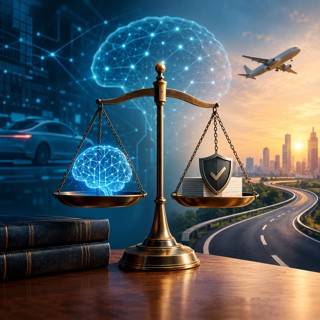
In this episode of the Stewart Squared podcast, host Stewart Alsop sits down with his son, Stewart Alsop II, to unpack Anthropic's anticipated IPO and the seismic shifts happening in AI right now. The two dive into whether Anthropic will actually go public despite the existential risk narrative Dario Amodei has been pushing, exploring the real reasons these companies need to IPO (hint: it's about the cash burn). They discuss California's new AI regulations under Gavin Newsom, the emerging threat of JEV—a new AI architecture from a company called Hyde that could upend the entire foundation model business—and why Anthropic might be positioning itself around biotech IP rather than AI patents. The conversation weaves through regulatory capture, the impossibility of patenting a black box, NVIDIA's vulnerabilities, and why comparing AI to cars or airplanes misses the mark entirely. For more on the Verge interview with former FTC Commissioner Jonathan Cantor that Stewart Alsop references, check out The Verge's podcast feed, and if you want to explore JEV further, search for their "build prod, not god" positioning at their company site. Key Insights
1. The Anthropic IPO is expected to proceed despite concerns about existential AI risk because the company and its banks have assessed liability issues and determined they can move forward with the offering. Both Anthropic and OpenAI need to go public to access capital, as they are consuming cash at rates that will eventually push private investors to demand public markets access. The companies can raise additional private rounds, but going public provides access to much larger pools of capital through both initial offerings and secondary offerings that would be necessary to sustain their operations over time. 2. Product liability is emerging as the critical regulatory framework for AI companies, comparable to how Boeing is responsible for making safe aircraft. A key legal case against Meta demonstrated that companies can be held liable for products they knew created harm, even if not intentionally. However, the concern is that waiting fifteen years for product liability cases to work through the court system may be too slow for AI, which could potentially cause significant harm much faster than social media did. This is why companies like Anthropic and OpenAI are proactively positioning themselves to demonstrate they are taking alignment and safety seriously. 3. California has established itself as the leading state in asserting regulatory control over AI companies within its borders, with Governor Newsom implementing state laws that address AI safety issues. This represents a broader pattern where California reserves rights for state control that supersedes federal authority, similar to how California set automotive pollution standards that became national standards. Since most major AI companies are headquartered in California, the state has significant leverage, and this state-level regulation is filling a vacuum left by federal inaction on AI governance. 4. Foundation models have essentially no patentable intellectual property because you cannot patent a black box. Unlike traditional technology companies that can protect specific implementations through patents, AI companies rely almost entirely on trade secrets, particularly around how quickly they can retrain and regenerate their foundation models. This creates a fundamental risk for companies like Anthropic and OpenAI in their IPO filings, as they must disclose that they have no patent protection and that their competitive advantage rests on trade secrets that could potentially be replicated by competitors. 5. Anthropic appears to be positioning itself strategically in biotechnology and medicine, using its foundation models to advance biological research. The company has released drivers for lab equipment and industrial robots that dramatically reduce the time needed to develop software for laboratory instruments from weeks to days. This biotech focus may provide Anthropic with actual patentable intellectual property through specific implementations of medicines or biological tools, unlike the foundation model itself, and this could be a major component of their IPO narrative to investors seeking a defensible moat. 6. A new company called Jev has emerged as a potentially disruptive force in the AI industry by replacing the classifier component of large language models with a more efficient probability matrix system that does not think in tokens. Jev explicitly counter-positions against Anthropic and OpenAI with the tagline build prod not god, rejecting existential risk narratives entirely. The company raised a forty million dollar seed round at a roughly two billion dollar valuation and could fundamentally change the economics of AI by dramatically reducing computational requirements, which poses an existential threat to NVIDIA's dominance in AI accelerators and could make current massive data center investments obsolete. 7. The timing of Anthropic's IPO has shifted to mid-October through mid-November because the company will need to include third quarter financial results in their S-1 filing. Whether that quarter shows profitability and how much cash the company consumed will be critical factors in pricing the IPO and determining how much capital they can raise. Key risks that must be disclosed include dependence on founder Dario Amodei as a key person, the lack of patent protection, reliance on trade secrets, potential loss of control over the intelligence they create, and now potentially the emergence of architecturally different approaches like Jev that could undermine their competitive position. Timestamps
00:00 Discussion begins about whether Anthropic's IPO will happen despite liability concerns around Dario's frontier pacing post and existential risk warnings to investors 05:00 Exploring product liability frameworks for AI through Meta case study and examining why OpenAI and Anthropic need public markets for sustained capital access 10:00 Breaking down federal versus state regulatory control with California's leading role as Newsom establishes state-level AI regulations where most companies are headquartered 15:00 Analyzing the duopoly between OpenAI and Anthropic while introducing new entrant JEV as potential disruptor to the foundation model economics 20:00 Understanding classification systems evolution from eighties ontologies through neural networks to modern transformer architectures and their computational requirements 25:00 Examining how robots will adapt to existing human spaces rather than redesigning homes, comparing to failed barcode experiments and autonomous vehicle development 30:00 Discussing industrial robotics applications like leak detection with ultrasonic sensors while consumer humanoid robots remain decades away from solving tactile challenges 35:00 Evaluating Anthropic's biotech IP strategy as core IPO positioning since foundation models lack patentable black box protection unlike traditional university technology 40:00 Comparing SpaceX IPO risk disclosure template while questioning whether regulatory capture through METR creates competitive moats beyond existential risk narratives 45:00 Debating government versus private evaluation frameworks as Dario proposes multinational oversight rather than single nation control over AI safety standards 50:00 Introducing JEV's probabilistic classifier replacing token-based reasoning with dramatically lower hallucination rates and reduced compute costs threatening incumbent economics 55:00 Speculating whether architectural shifts like JEV could obsolete GPU-dependent hyperscale infrastructure creating dark fiber scenario for existing data center investments 60:00 Projecting October to November IPO timeline requiring third quarter profitability disclosure while assessing whether JEV represents material risk requiring s-one documentation

Tämä jakso on lisätty Podme-palveluun avoimen RSS-syötteen kautta eikä se ole Podmen omaa tuotantoa. Siksi jakso saattaa sisältää mainontaa.

Jaksot(110)

Episode #110: Trust, Debt, and Foundation Models: The New Global Competition

Episode #110: Trust, Debt, and Foundation Models: The New Global Competition

In this episode of the Stewart Squared podcast, host Stewart Alsop sits down with his father Stewart Alsop II to explore the rapidly evolving landscape of AI and foundation models, with a particular f...

8 Loka 51min
Episode #108: Cybersecurity vs. Existential Risk: What Anthropic Won't Tell You in Their IPO

Episode #108: Cybersecurity vs. Existential Risk: What Anthropic Won't Tell You in Their IPO

In this episode of the Stewart Squared podcast, host Stewart Alsop and his father Stewart Alsop II tackle the pressing issue of cybersecurity in AI development, moving beyond what Stewart calls the "a...

24 Syys 1h 2min
Episode #107: $2 Trillion, No Debt: Anthropic's Answer to SpaceX's Risk Factors

Episode #107: $2 Trillion, No Debt: Anthropic's Answer to SpaceX's Risk Factors

In this episode of the Stewart Squared podcast, host Stewart Alsop and guest Stewart Alsop II dig into Anthropic's upcoming IPO and the rapidly shifting AI landscape following the recent releases of O...

17 Syys 1h 10min
Episode #106: The $30 Trillion Question: Inside Anthropic's Audacious IPO Play

Episode #106: The $30 Trillion Question: Inside Anthropic's Audacious IPO Play

In this episode of the Stewart Squared podcast, host Stewart Alsop and guest Stewart Alsop II tackle Anthropic's upcoming IPO and what it means for the broader tech landscape. They compare it to Space...

10 Syys 1h 5min
Episode #105: Beating OpenAI at Their Own Game: Our Case, and the Filing That Settles It

Episode #105: Beating OpenAI at Their Own Game: Our Case, and the Filing That Settles It

In this episode of the Stewart Squared podcast, host Stewart Alsop III and his father Stewart Alsop II dig into the unprecedented AI infrastructure buildout happening across big tech, with Google rais...

3 Syys 1h 1min
Episode #104: 36,000 Companies, One Metric: What DPI Did to Private Equity

Episode #104: 36,000 Companies, One Metric: What DPI Did to Private Equity

In this episode of the Stewart Squared podcast, host Stewart Alsop sits down with his father Stewart Alsop II to unpack how private equity, venture capital, and growth equity have evolved—and possibly...

27 Elo 1h 8min

Episode #103: Scarce to Itself: NVIDIA, Apple, a Driverless Zoox, and the Real Fight Over the Future of Cars

Episode #103: Scarce to Itself: NVIDIA, Apple, a Driverless Zoox, and the Real Fight Over the Future of Cars

In this episode of Stewart Squared, Stewart Alsop III and Stewart Alsop II dig into the fast-moving world of self-driving cars — from Cruise's rocky history and Waymo's expansion to Zoox's driverless ...

20 Elo 1h 1min

Suosittua kategoriassa Liike-elämä ja talous

sijotuskasti
vallattomat
mimmit-sijoittaa
psykopodiaa-podcast
rss-rahapodi
rss-oivalluksia-rahasta-elamasta
rss-rahamania
ostan-asuntoja-podcast
oppimisen-psykologia
rss-startup-ministerio
rss-hereilla
sijoituspodi
rss-karon-grilli
rss-paasipodi
rss-elama-jota-rakastat
rss-porssipodi
rss-kaupan-tila
rss-sopivasti-hyvan-arjen-reseptit
sijoitusovi-podcast
asuntoasiaa-paivakirjat