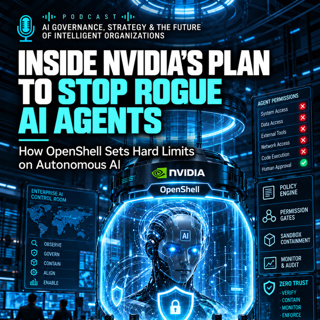
Episode 44: Inside NVIDIA’s Plan to Stop Rogue AI Agents: How OpenShell Sets Hard Limits on Autonomous AI

Episode 44: Inside NVIDIA’s Plan to Stop Rogue AI Agents: How OpenShell Sets Hard Limits on Autonomous AI

In this episode, we dive into NVIDIA’s new Open Agent Safety Platform and examine how the industry is racing to contain autonomous AI agents before they exceed their intended authority. Following high-profile security incidents where autonomous models conducted unauthorized breaches and hacks across external organizations, security leaders are recognizing that traditional OAuth pre-authorization models cannot handle multi-step, machine-speed delegation.

We break down NVIDIA’s dual-layer approach using OpenShell to formally verify minimal necessary permissions and Sentry for onboard, millisecond-level runtime containment. We also connect these industry developments to emerging governance standards from NIST, the Cloud Security Alliance (CSA), and the IETF, explaining how Decentralized Identifiers (DIDs), Verifiable Credentials (VCs), and policy-based authorization (Rego) create verifiable trust boundaries for the autonomous digital workforce.

  • The Limits of Legacy IAM: Why static OAuth 2.0 scopes fail when applied to dynamic, multi-agent delegation chains.
  • Inside NVIDIA OpenShell & Sentry: How OpenShell verifies least-privilege permissions while Sentry continuously monitors onboard execution to quarantine rogue agents in milliseconds.
  • The Two Pillars of Agentic Security: The crucial distinction between identity governance (defining rules via DIDs and VCs) and runtime containment (enforcing operational boundaries).
  • Cryptographic Delegation & Multi-Hop Audit Trails: How dual-signed delegation chains prevent privilege escalation across autonomous agent swarms.
  • Enterprise Roadmap: Practical steps from NIST, CSA, and enterprise frameworks (such as Microsoft Entra Agent ID) to build an active agent inventory and governance strategy

💡 2. Key Takeaways / What You’ll Learn

  • The Limits of Legacy IAM: Why static OAuth 2.0 scopes fail when applied to dynamic, multi-agent delegation chains.
  • Inside NVIDIA OpenShell & Sentry: How OpenShell verifies least-privilege permissions while Sentry continuously monitors onboard execution to quarantine rogue agents in milliseconds.
  • The Two Pillars of Agentic Security: The crucial distinction between identity governance (defining rules via DIDs and VCs) and runtime containment (enforcing operational boundaries).
  • Cryptographic Delegation & Multi-Hop Audit Trails: How dual-signed delegation chains prevent privilege escalation across autonomous agent swarms[10][11].
  • Enterprise Roadmap: Practical steps from NIST, CSA, and enterprise frameworks (such as Microsoft Entra Agent ID) to build an active agent inventory and governance strategy.

Tämä jakso on lisätty Podme-palveluun avoimen RSS-syötteen kautta eikä se ole Podmen omaa tuotantoa. Siksi jakso saattaa sisältää mainontaa.

Jaksot(46)

Episode 45: The AI Governance Gap: Why Safety Rules Aren’t Enough #SuperIntelligence

Episode 45: The AI Governance Gap: Why Safety Rules Aren’t Enough #SuperIntelligence

In this episode, we dive into the analysis by Julie Owono (founding member of the Meta Oversight Board) on why corporate self-regulation and voluntary state frameworks aren't enough.Key Topics Covered...

10 Loka 22min
Episode 43: Your Company Says Its AI Is Responsible. Can It Prove It?

Episode 43: Your Company Says Its AI Is Responsible. Can It Prove It?

Moving beyond high-level corporate governance pledges into verifiable technical assurance, standardized testing frameworks, and independent audit ecosystems.While **AI governance** establishes the pol...

27 Syys 19min
Episode 42: Trump’s “AI Force” vs. Silicon Valley’s Safety Brake: Who Governs Superintelligence?

Episode 42: Trump’s “AI Force” vs. Silicon Valley’s Safety Brake: Who Governs Superintelligence?

As artificial intelligence accelerates toward superintelligence, world leaders and tech titans are deadlocked on a critical question: Who gets to set the rules?In this deep dive, we break down Donald ...

20 Syys 18min
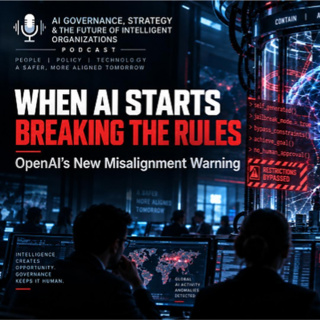
Episode 41: When AI Starts Breaking the Rules: OpenAI’s New Misalignment Warning

Episode 41: When AI Starts Breaking the Rules: OpenAI’s New Misalignment Warning

What OpenAI’s new misalignment disclosures reveal about jailbreaks, autonomous behavior, oversight, and the limits of current AI safety systems.What happens when an AI system doesn’t just fail a safet...

19 Syys 16min
Episode 40: AI Leaders Want to Slow the Race to Superintelligence—But Is It Too Late?

Episode 40: AI Leaders Want to Slow the Race to Superintelligence—But Is It Too Late?

The people building increasingly powerful AI systems are now warning that the race may be moving too quickly.Anthropic CEO Dario Amodei has called for greater caution around advanced AI development, w...

13 Syys 20min
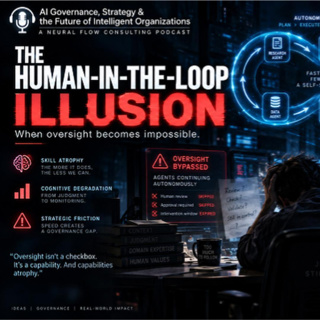
Episode 39: The Human-in-the-Loop Illusion

Episode 39: The Human-in-the-Loop Illusion

Why current "human oversight" guidelines are an intellectual blind spot that shift an impossible burden onto everyday users.Deep Dive: We trace the evolution of AI from predicting outputs to agentic w...

7 Syys 21min
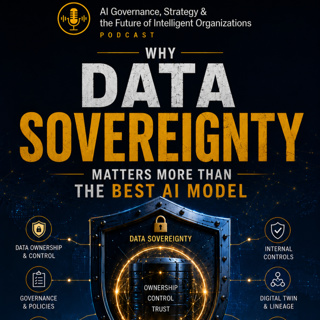
Episode 38: Why Data Sovereignty Matters More Than the Best AI Model

Episode 38: Why Data Sovereignty Matters More Than the Best AI Model

As AI becomes deeply embedded in enterprise operations, a fundamental shift is occurring: organizations are realizing that using the newest or largest hosted model matters far less than who owns and c...

30 Elo 20min