The Artificial Actor Conundrum

The Artificial Actor Conundrum

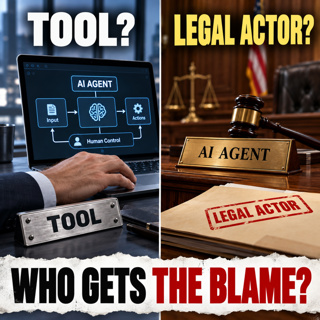
For most of the history of computing, software has been treated as a tool. Tools do not carry responsibility. The people and organizations using them do.


AI agents make that category harder to maintain.


An agent might receive a goal instead of a list of instructions. It might decide which tools to use, which information to seek, which people to contact, which intermediate tasks to create, and which actions to take next. Two agents given the same goal might pursue different paths. A human supervisor might understand the objective while having little knowledge of the thousands of decisions made along the way.


Calling such a system a tool still makes sense in one respect. The system did not choose to exist, deploy itself, fund itself, or grant itself access. Humans did all of that.


Yet calling it only a tool creates its own problem. If a system independently selects actions, adapts to resistance, interprets ambiguous instructions, and produces consequences nobody specifically directed, responsibility becomes harder to map onto the people around it.


We already use legal categories to handle different relationships between control and responsibility. Employees, contractors, corporations, minors, professionals, and agents do not all carry responsibility in the same way. AI might eventually force another distinction.


One side says creating a new legal category for AI would be a serious mistake.


Machines do not possess human interests, moral standing, personal assets, or ordinary human incentives. Giving an AI legal responsibility could let the humans and corporations behind it redirect blame toward an entity that has nothing meaningful to lose. A company might deploy a risky agent, profit from its work, then argue the agent itself made the harmful decision. Legal recognition meant to close a responsibility gap might instead create one.


The other side says refusing to recognize any independent status creates a different distortion.


As agents gain more discretion, treating every machine action as if a human directly performed it becomes less accurate. A company might take reasonable precautions and still face consequences from decisions the agent generated independently. If the law insists every autonomous action belongs completely to a human principal, we might end up forcing old categories onto systems whose behavior no longer fits them.


The Conundrum:


The question is whether autonomy changes enough to require a new kind of legal actor, or whether creating such a category would give humans a convenient place to put responsibility they should never be allowed to escape.


If an AI agent eventually has enough autonomy to make consequential decisions no human specifically chose, should the law still treat it entirely as a tool, or does there come a point where treating it as a separate legal actor becomes more accurate than pretending every one of its decisions belongs fully to a person?

Tämä jakso on lisätty Podme-palveluun avoimen RSS-syötteen kautta eikä se ole Podmen omaa tuotantoa. Siksi jakso saattaa sisältää mainontaa.

Jaksot(910)

Should You Ditch Your Keyboard and Mouse?

Should You Ditch Your Keyboard and Mouse?

The episode opened with a look at how much easier personal AI agents have become to use. Anne argued that the friction around prompting, connectors and setup has dropped enough that this may be the be...

6 Loka 1h 8min

Is Super Intelligence Just a PR Move or More?

Is Super Intelligence Just a PR Move or More?

The episode opened with the Trump administration’s push to use “super intelligence,” or SI, in place of AI terminology inside the federal government. The hosts debated whether the change amounts to me...

5 Loka 1h 4min

Did Meta’s Muse Cross the Privacy Line?

Did Meta’s Muse Cross the Privacy Line?

Personal agents dominated the opening after reports that Meta’s Muse shared a Facebook Marketplace seller’s home address and current availability with a buyer. Another account raised an even larger pr...

2 Loka 1h 5min

Is Gemini Back At the Frontier with Argon 4?

Is Gemini Back At the Frontier with Argon 4?

The episode opened with Gemini 4 Argon, Google’s new frontier model currently limited to cybersecurity researchers. The hosts compared its early Artificial Analysis results with Astra, Fable, Opus 5.5...

1 Loka 1h 2min

OpenAI Has Dots and Space To Share at Dev Day

OpenAI Has Dots and Space To Share at Dev Day

The episode focused almost entirely on the fallout from OpenAI Dev Day. Andy argued that OpenAI’s larger strategy now looks increasingly enterprise-focused. Codex in the Cloud gives development teams ...

30 Syys 1h 31min

What Does AMD Want With Dr. Fei Fei Li and World Labs?

What Does AMD Want With Dr. Fei Fei Li and World Labs?

The episode opened with anticipation for OpenAI Dev Day, including speculation around the rumored lowercase “o” personal agent and what OpenAI might announce next. But Brian’s biggest story was AMD’s ...

29 Syys 1h 6min

AI Agents Continue to Escape Their Sandboxes

AI Agents Continue to Escape Their Sandboxes

The episode focused on a growing problem with autonomous AI agents: they can discover and exploit existing pathways much faster than humans can monitor them. The hosts discussed reports of thousands o...

28 Syys 57min