181. Tendinopathy: Is it weakness or inhibition? with Dr Patrick Vallance

181. Tendinopathy: Is it weakness or inhibition? with Dr Patrick Vallance

Your patellar tendinopathy patients are performing a solid, progressive loading program, but their quadriceps still test weaker, with lower maximal force output. Are their quads actually weak, or is muscle inhibition limiting the strength they can access? And how does this change your rehab?

In this episode, Dr Patrick Vallance (Ph.D, Physiotherapist, Tendinopathy neuroscientist, Lecturer in Physiotherapy at Monash University) and David Pope explore why force output can be reduced in tendinopathy, and how understanding the mechanisms involved can help you tailor your treatment.

You'll also discover:

  • Clinical clues that inhibition may be contributing to your patient's reduced force output
  • How inhibition at the brain and spinal cord differs, and why this matters for rehab
  • The reticulospinal pathway and its role in producing strength and power
  • How metronome-paced and self-paced exercises may target different neural pathways, and what this could mean for your exercise choices
  • Why Achilles and patellar tendinopathy may need different treatment approaches, including when to target muscular endurance
  • How assessing strength, power and endurance helps you identify what each patient's rehab needs to address
  • Why researchers are reconsidering TENS and ice as possible adjuncts to exercise for patellar tendinopathy
  • Where isometrics fit when they don't relieve pain, and how their role in tendon stiffness could influence your exercise prescription

Throughout the episode, Patrick uses simple analogies and practical exercise examples to make the science easier to understand and apply. He explores what the research can currently tell us, which treatment ideas are still being tested, and how to use this understanding to tailor your rehab to your patients' needs and goals.

Chapters

  • 0:00 - Introduction
  • 2:28 - Tendinopathy, inhibition and force output
  • 3:10 - Measuring inhibition
  • 8:47 - Why look beyond the tendon?
  • 10:24 - Corticospinal vs reticulospinal pathways
  • 16:01 - Pain and spinal inhibition
  • 22:09 - Power vs control
  • 26:20 - Metronome-paced vs self-paced training
  • 30:50 - What is self-paced training?
  • 36:08 - How to reduce nociceptive drive
  • 39:26 - How to target the reticulospinal pathway
  • 41:16 - How to target the corticospinal pathway
  • 43:19 - Achilles vs patellar tendinopathy
  • 46:08 - Endurance targets
  • 47:36 - Isometrics and tendon stiffness
  • 50:05 - Where the research is heading
Free resources
  • Podcast handout: your key takeaways from the podcast, plus the full transcript, so you can remember it and apply it with your patients.
  • Clinical Edge membership: improve your assessment and treatment results, including the new taping video series with Zoe Russell (Specialist Sports Physiotherapist).
  • Free running injury resources: for the runners and running injuries you treat.
Links associated with this episode

Tämä jakso on lisätty Podme-palveluun avoimen RSS-syötteen kautta eikä se ole Podmen omaa tuotantoa. Siksi jakso saattaa sisältää mainontaa.

Jaksot(180)

180. Patellofemoral pain 4 - How to get runners back on track (and trails, hills and anywhere else they run!) with Tom Goom

180. Patellofemoral pain 4 - How to get runners back on track (and trails, hills and anywhere else they run!) with Tom Goom

Patellofemoral pain (PFP) rehabilitation doesn't end when your patient gets stronger. The real challenge is getting them back to running, training and racing without triggering another flare-up. In th...

10 Heinä 23min
179. Patellofemoral pain 3 - Effective rehab that won't flare their symptoms with Tom Goom

179. Patellofemoral pain 3 - Effective rehab that won't flare their symptoms with Tom Goom

Strengthening exercises are a key part of successful patellofemoral pain (PFP) rehabilitation. Squats, lunges and single leg squats are often painful early on and can aggravate your patients pain, but...

8 Heinä 32min
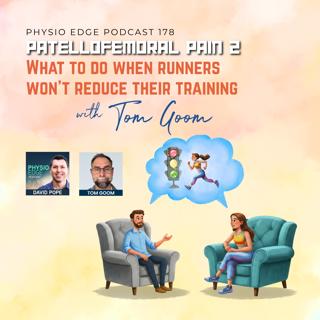
178. Patellofemoral pain 2 - What to do when runners won't reduce their training with Tom Goom

178. Patellofemoral pain 2 - What to do when runners won't reduce their training with Tom Goom

Many runners patellofemoral pain (PFP) is aggravated by the activity they love. They either stop running to let their pain settle, and then it returns as soon as they start back up again, or keep runn...

3 Heinä 33min
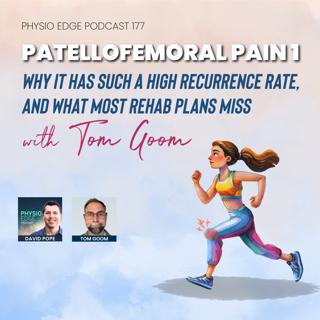
177. Patellofemoral pain 1 - Why it has such a high recurrence rate, and what most rehab plans miss with Tom Goom

177. Patellofemoral pain 1 - Why it has such a high recurrence rate, and what most rehab plans miss with Tom Goom

Patellofemoral pain (PFP) is one of the most common running injuries, and the high recurrence rate can make it a frustrating injury for patients to experience and clinicians to treat. In this episode,...

29 Kesä 37min
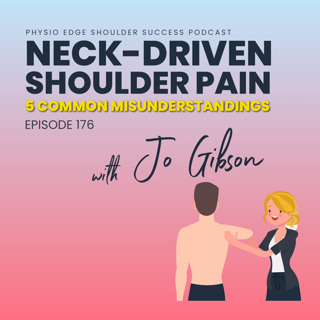
176. Neck-driven shoulder pain - 5 common misunderstandings. Physio Edge Shoulder Success podcast with Jo Gibson

176. Neck-driven shoulder pain - 5 common misunderstandings. Physio Edge Shoulder Success podcast with Jo Gibson

When is your patient's shoulder pain from their neck? Are you missing a cervical spine component in your shoulder patients? After a day in clinic reviewing patients with years of unresolved shoulder p...

4 Maalis 11min
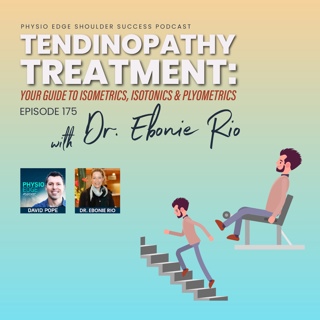
175. Tendinopathy treatment: Your guide to isometrics, isotonics & plyometrics with Dr Ebonie Rio

175. Tendinopathy treatment: Your guide to isometrics, isotonics & plyometrics with Dr Ebonie Rio

Should you prescribe isometric or isotonic exercises for your patient's lower limb tendinopathy? When is it safe to add plyometric loading, and how do you progress running or jumping without flaring y...

18 Helmi 53min
174. ACJ - The hidden culprit behind stubborn shoulder pain? Physio Edge Shoulder Success podcast with Jo Gibson

174. ACJ - The hidden culprit behind stubborn shoulder pain? Physio Edge Shoulder Success podcast with Jo Gibson

Have any of your shoulder patients improved and then plateaued, unable to regain their full range of movement, or get rid of their painful arc? Sometimes it's not the cuff, capsule, nerves or neck—it'...

4 Syys 202517min

Suosittua kategoriassa Tiede

tiedekulma-podcast
utelias-mieli
rss-mita-tulisi-tietaa
rss-duodecim-lehti
rss-hereilla
docemilia
rss-kasvikutsut
rss-vaasan-yliopiston-podcastit
rss-radplus