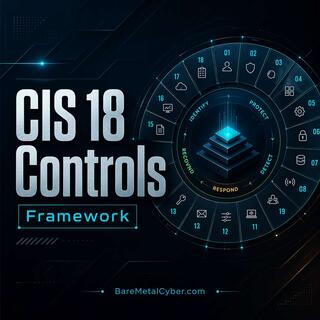
Episode 1 — What are the CIS Critical Security Controls?

Episode 1 — What are the CIS Critical Security Controls?

The CIS Critical Security Controls, often referred to as the CIS 18, represent a prioritized and prescriptive set of cybersecurity best practices designed to help organizations defend against the most pervasive and dangerous cyberattacks. Developed and maintained by the Center for Internet Security (CIS), these controls are informed by real-world threat data and expert consensus across government, academia, and industry. The framework distills complex cybersecurity guidance into actionable steps that focus resources where they matter most—on preventing, detecting, and responding to the most common types of attacks. Unlike theoretical frameworks, the CIS Controls are practical, measurable, and adaptable to enterprises of all sizes. They serve as a foundation for building or strengthening a security program by addressing core areas such as asset management, access control, data protection, incident response, and penetration testing. Together, the 18 Controls form a roadmap toward a defensible security posture that aligns with major frameworks like NIST CSF, ISO 27001, and SOC 2 while remaining accessible to smaller organizations.

Each Control is composed of multiple safeguards—specific technical and procedural measures designed to achieve the desired security outcome. These safeguards are organized into Implementation Groups (IG1, IG2, and IG3), which allow organizations to adopt controls according to their size, resources, and risk tolerance. IG1 represents essential cyber hygiene applicable to nearly every organization, while IG3 applies to enterprises facing sophisticated threats. This scalable design helps teams implement security systematically rather than reactively, ensuring that even limited budgets can produce meaningful risk reduction. The CIS Controls also form the basis for numerous companion guides—covering cloud, IoT, mobile, and industrial environments—that help translate best practices into sector-specific contexts. As cyber threats evolve, the CIS community continually refines these Controls, ensuring that every recommendation remains data-driven, transparent, and aligned with real-world attacker behavior.
Produced by BareMetalCyber.com, where you’ll find more cyber audio courses, books, and information to strengthen your educational path. Also, if you want to stay up to date with the latest news, visit DailyCyber.News for a newsletter you can use, and a daily podcast you can commute with.

Tämä jakso on lisätty Podme-palveluun avoimen RSS-syötteen kautta eikä se ole Podmen omaa tuotantoa. Siksi jakso saattaa sisältää mainontaa.

Jaksot(83)

Welcome to the CIS 18 Control Framework

Welcome to the CIS 18 Control Framework

18 Loka 20251min

Episode 82 — Safeguard 18.2 – Internal and red team exercises

Episode 82 — Safeguard 18.2 – Internal and red team exercises

Safeguard 18.2 extends penetration testing to include internal assessments and red team exercises that emulate an attacker with initial access. Internal testing evaluates how far a threat could move l...

18 Loka 202512min

Episode 81 — Safeguard 18.1 – External testing programs

Episode 81 — Safeguard 18.1 – External testing programs

Safeguard 18.1 requires organizations to establish and maintain a formal penetration testing program that includes recurring external assessments. External tests simulate real-world attackers operatin...

18 Loka 202510min

Episode 80 — Overview – Why penetration testing validates defenses

Episode 80 — Overview – Why penetration testing validates defenses

Control 18—Penetration Testing—closes the CIS framework by validating how well all other controls perform under real-world conditions. While vulnerability scanning identifies potential weaknesses, pen...

18 Loka 202510min

Episode 79 — Remaining safeguards summary (Control 17)

Episode 79 — Remaining safeguards summary (Control 17)

The remaining safeguards in Control 17 reinforce the full lifecycle of incident response—spanning preparation, communication, testing, and continuous improvement. These include assigning key response ...

18 Loka 20259min

Episode 78 — Safeguard 17.2 – Tabletop exercises

Episode 78 — Safeguard 17.2 – Tabletop exercises

Safeguard 17.2 emphasizes the importance of testing the incident response plan through structured tabletop exercises. These simulations bring together key personnel—from technical teams to executives—...

18 Loka 202510min

Episode 77 — Safeguard 17.1 – IR plan and playbooks

Episode 77 — Safeguard 17.1 – IR plan and playbooks

Safeguard 17.1 requires organizations to establish and maintain a comprehensive incident response process that defines scope, roles, responsibilities, and communication procedures. This process must i...

18 Loka 202510min

Episode 76 — Overview – Incident response principles

Episode 76 — Overview – Incident response principles

Control 17—Incident Response Management—defines how an organization prepares for, detects, responds to, and learns from security incidents. Even the most robust defenses can be breached, and when that...

18 Loka 202511min

Suosittua kategoriassa Koulutus

rss-murhan-anatomia
aamukahvilla
psykopodiaa-podcast
voi-hyvin-meditaatiot-2
rss-arkea-ja-aurinkoa-podcast-espanjasta
rss-hereilla
rss-suomen-aa-podcast
kesken
aloita-meditaatio
adhd-podi
rss-niinku-asia-on
rss-taysi-voima
koulu-podcast-2
rss-liian-kuuma-peruna
rahapuhetta
rss-duodecim-lehti
psykologia
rss-luonnollinen-synnytys-podcast
rss-spessu
rss-vapaudu-voimaasi