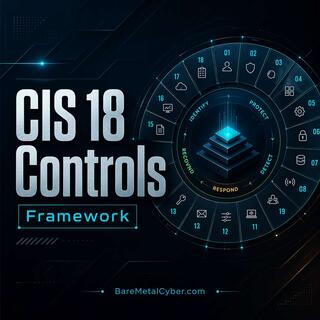
Episode 27 — Remaining safeguards summary (Control 5)

Episode 27 — Remaining safeguards summary (Control 5)

The remaining safeguards in Control 5 complete the account management lifecycle by focusing on administrative segregation, service account oversight, and centralized control. Safeguard 5.4 mandates that administrative privileges be restricted to dedicated administrator accounts separate from normal user profiles. This prevents the compromise of personal credentials from granting excessive access. Safeguard 5.5 requires maintaining an inventory of service accounts—non-human identities used by applications or automated processes—to ensure that each has a documented owner and validated purpose. These accounts often carry elevated privileges and are rarely reviewed, making them prime targets for exploitation. Finally, Safeguard 5.6 reinforces centralized management, ensuring that account creation, modification, and termination occur through standardized identity services rather than ad hoc system-level administration. Together, these safeguards create a complete identity ecosystem that emphasizes accountability, traceability, and least privilege.

Implementing these measures requires combining technical enforcement with clear procedural discipline. Administrators should use Privileged Access Management (PAM) solutions to handle elevated accounts securely, logging every privileged action for review. Service accounts must be registered, assigned expiration dates, and reviewed quarterly to confirm necessity. Where possible, machine identities should employ key-based or tokenized authentication rather than static passwords. Centralized directories provide visibility across all systems, enabling consistent enforcement of password policies, multi-factor authentication, and deactivation workflows. Audit logs from IAM and PAM tools verify compliance and support forensic investigations. Ultimately, these safeguards transform account management from a fragmented administrative task into a continuous governance process. By ensuring that every identity—human or machine—is documented, validated, and controlled, organizations establish a trusted access foundation that supports the more advanced principles of privilege and authorization found in the next control.
Produced by BareMetalCyber.com, where you’ll find more cyber audio courses, books, and information to strengthen your educational path. Also, if you want to stay up to date with the latest news, visit DailyCyber.News for a newsletter you can use, and a daily podcast you can commute with.

Tämä jakso on lisätty Podme-palveluun avoimen RSS-syötteen kautta eikä se ole Podmen omaa tuotantoa. Siksi jakso saattaa sisältää mainontaa.

Jaksot(83)

Welcome to the CIS 18 Control Framework

Welcome to the CIS 18 Control Framework

18 Loka 20251min

Episode 82 — Safeguard 18.2 – Internal and red team exercises

Episode 82 — Safeguard 18.2 – Internal and red team exercises

Safeguard 18.2 extends penetration testing to include internal assessments and red team exercises that emulate an attacker with initial access. Internal testing evaluates how far a threat could move l...

18 Loka 202512min

Episode 81 — Safeguard 18.1 – External testing programs

Episode 81 — Safeguard 18.1 – External testing programs

Safeguard 18.1 requires organizations to establish and maintain a formal penetration testing program that includes recurring external assessments. External tests simulate real-world attackers operatin...

18 Loka 202510min

Episode 80 — Overview – Why penetration testing validates defenses

Episode 80 — Overview – Why penetration testing validates defenses

Control 18—Penetration Testing—closes the CIS framework by validating how well all other controls perform under real-world conditions. While vulnerability scanning identifies potential weaknesses, pen...

18 Loka 202510min

Episode 79 — Remaining safeguards summary (Control 17)

Episode 79 — Remaining safeguards summary (Control 17)

The remaining safeguards in Control 17 reinforce the full lifecycle of incident response—spanning preparation, communication, testing, and continuous improvement. These include assigning key response ...

18 Loka 20259min

Episode 78 — Safeguard 17.2 – Tabletop exercises

Episode 78 — Safeguard 17.2 – Tabletop exercises

Safeguard 17.2 emphasizes the importance of testing the incident response plan through structured tabletop exercises. These simulations bring together key personnel—from technical teams to executives—...

18 Loka 202510min

Episode 77 — Safeguard 17.1 – IR plan and playbooks

Episode 77 — Safeguard 17.1 – IR plan and playbooks

Safeguard 17.1 requires organizations to establish and maintain a comprehensive incident response process that defines scope, roles, responsibilities, and communication procedures. This process must i...

18 Loka 202510min

Episode 76 — Overview – Incident response principles

Episode 76 — Overview – Incident response principles

Control 17—Incident Response Management—defines how an organization prepares for, detects, responds to, and learns from security incidents. Even the most robust defenses can be breached, and when that...

18 Loka 202511min

Suosittua kategoriassa Koulutus

rss-murhan-anatomia
aamukahvilla
psykopodiaa-podcast
voi-hyvin-meditaatiot-2
rss-arkea-ja-aurinkoa-podcast-espanjasta
rss-hereilla
rss-suomen-aa-podcast
kesken
aloita-meditaatio
adhd-podi
rss-niinku-asia-on
rss-taysi-voima
koulu-podcast-2
rss-liian-kuuma-peruna
rahapuhetta
rss-duodecim-lehti
psykologia
rss-luonnollinen-synnytys-podcast
rss-spessu
rss-vapaudu-voimaasi