
Werner Bohleber: Trauma - Catastrophic Reality and the Overwhelmed Psyche.

Werner Bohleber: Trauma - Catastrophic Reality and the Overwhelmed Psyche.

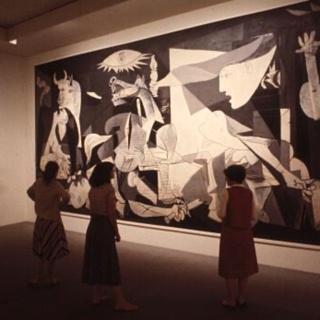
"Guernica" by Picasso at MOMA, NYC. Gotfryd, Bernard, photographer. Courtesy Library of Congress.

What happens when our basic trust in the world is challenged, and the social dimension of reality is disrupted as a consequence of collective trauma? In this episode, Werner Bohleber addresses the theme of traumatic experiences and does so starting from the two main models around which psychoanalytic thought has sought to understand trauma: the freudian psycho-economic model and the object-relational model. Reflecting on what he so effectively defines as "the symbolic web that carries us", Bohleber considers the implications of man-made disasters, and those that befall our individual and collective memory.

Werner Bohleber, Dr. phil, is a psychoanalyst in private practice in Frankfurt am Main. He is training analyst and former President of the German Psychoanalytical Association. He has long served on committees of the IPA, the last from 2009-2013 as Chair of the IPA Committee on Conceptual Integration. From 1997 to 2017 he was main editor of the journal PSYCHE. His research subjects and main publication themes are: late adolescence and young adulthood; psychoanalytic theory; transgenerational consequences of the Nazi period and the war on the second and third generation; nationalism, terrorism, anti-Semitism; trauma research. In 2007, he was awarded the Mary S. Sigourney Award for his diverse contributions, especially those relating to the traumatic aftermath of the Holocaust, National Socialism, and World War II.

link to the paper https://docs.google.com/document/d/18yMyiZ6darmN6ouxVoQmUwlci44UCnCQ/edit?usp=sharing&ouid=112457875385152358388&rtpof=true&sd=true

this episode is available also in German

Bibliography

Allen, J. (2013). Mentalizing in the development and treatment of attachment trauma. London: Karnac.

Amery J. (1996): Die Tortur. Merkur, 50, 502-515.

Balint M (1969). Trauma and object relationship. Int. J. Psycho-Anal. 50: 429-36.

Baranger M, Baranger W, Mom JM (1988). The infantile psychic trauma from us to Freud: Pure trauma, retroactivity and reconstruction. Int. J. Psycho-Anal. 69: 113-28.

Bohleber, W (2010). Destructiveness, Intersubjectivity, and Trauma. The Identity Crisis of Modern Psychoanalysis. London: Karnac.

Cooper, A. (1986), Toward a limited definition of psychic trauma. In: The Reconstruction of Trauma. Its Significance in Clinical Work, ed. A. Rothstein. Madison, CT: International Universities Press, pp. 41-56.

Erikson E.H. (1968): Identity. Youth and crisis. Nem York: Norton.

Ferenczi S (1949). Confusion of the tongues between the adults and the child [1933]. Int. J. Psycho-Anal. 30: 225-30.

Freud S (1920). Beyond the pleasure principle. Standard Edition 18, p. 7-64

Freud S (1926). Inhibitions, symptoms and anxiety. Standard Edition 20, p. 77-174.

Freud S. (1939). Moses and Monotheistism. SE 23: 1-138. (GW 16: 103–246)

Garland, C. (1998). Thinking about trauma. In: Garland, C. (Hg.). Understanding trauma. A psychoanalytic approach. London (Karnac).

Krystal, H. (1988). Integration and Self-Healing. Affect, Trauma, Alexithymia. Hillsdale: Analytic Press.

Langer L.L. (1995): Memory’s time: Chronology and duration in Holocaust testimonies. In: Langer, L.L.: Admitting the Holocaust: Collected essays. New York/Oxford: John Hopkins University Press, pp.13-23.

Leys R. (2000). Trauma: A genealogy. Chicago, Ill.: University of Chicago Press.

Morris D. J. (2015): The evil hours. A biography of post-traumatic stress disorder. Boston/New York: Houghton Mifflin Harcourt.

Oliner M. (2012): Psychic reality in context. Perspectives on psychoanalysis, personal history, and trauma. London: Karnac

Shalev A.Y. (1996), Stress Versus Traumatic stress. From Acute Homeostatic Reactions to Chronic Psychopathology. In: Traumatic Stress. The Effects of Overwhelming Experience on Mind, Body and Society, ed. B. van der Kolk, A., Mc Farlane & L.Weisaeth. New York NY: Guilford Press, pp. 77-101.

Steele BF (1994). Psychoanalysis and the maltreatment of children. J. Amer. Psychoanal. Assn. 42: 1001-25.

Van der Kolk B. (1996). Trauma and memory. In: B. van der Kolk, B., A. McFarlane & L. Weisath (Eds.) Traumatic stress. The effects of overwhelming experience on mind, body and society. New York: Guilford Press, pp. 279-302.

van der Kolk B. (2014): The body keeps the score. Mind, brain, and the body in the healing of trauma London: Penguin Books.

CREDITS Editing: Agustín Ruiz Brussain

Jaksot(100)

Relentlessness Of Life Instinct As The Source Of Inconsolability And Greed - Salman Akhtar

Relentlessness Of Life Instinct As The Source Of Inconsolability And Greed - Salman Akhtar

Still Life with Fruit and Wineglasses on a Silver Plate, c. 1659-1660, Willem Kalf. Courtesy Mauritshuis, The Hague.   Why do some people seem unable to achieve full satisfaction in things? What keeps...

3 Marras 202324min

Bernard Golse - A plea for a third topicality.

Bernard Golse - A plea for a third topicality.

A plea for a third topicality. An intrapsychic representation of the intersubjective bond, even before the discovery of the object.   Can psychoanalysis be useful with infants? How can we think throug...

12 Loka 202331min

The distorted Oedipus complex - François Richard

The distorted Oedipus complex - François Richard

How can we think about the Oedipus complex today in a contemporary society beset by a crisis of ideals and the emergence of new forms of sexuality? Neurosis has not disappeared, but borderline states ...

12 Kesä 202337min

Time matters - the self and its continuity. Georg Northoff.

Time matters - the self and its continuity. Georg Northoff.

Our self is always there and present throughout our whole life. Despite the many social, environmental and ecological changes as well as the major bodily changes, our self remains one and the same thr...

20 Huhti 202321min

The Self and its continuity: Out of body experience - Rosa Spagnolo.

The Self and its continuity: Out of body experience - Rosa Spagnolo.

What is the relationship between the mind and the body, and how does it shape our understanding of the self? In this episode, Rosa Spagnolo presents her reflections on the topic, published in her rece...

21 Maalis 202317min

Notes on the aptitude for happiness - Marion Minerbo

Notes on the aptitude for happiness - Marion Minerbo

Happiness is humans' undeniable desire, but why does it seem so within reach for some, and so rare and difficult for others? What makes it possible from the psychic perspective? In this episode, Dr. M...

6 Maalis 202335min

Hidden unconscious, buried unconscious, implicit unconscious - Stefano Bolognini.

Hidden unconscious, buried unconscious, implicit unconscious - Stefano Bolognini.

This paper was published in The Italian Psychoanalytic Annual issue 16, in 2022. The full text can be found on the publisher Raffaello Cortina's website: https://riviste.raffaellocortina.it/scheda-art...

11 Tammi 202319min

Why and what is gender for? - Juan Francisco Artaloytia.

Why and what is gender for? - Juan Francisco Artaloytia.

For those interested in the extensive written version on which this short talk is based, please contact the author at jfartaloytia@gmail.com .   From the Freudian conception of psychic bisexuality to ...

16 Joulu 202219min

Suosittua kategoriassa Tiede

rss-mita-tulisi-tietaa
tiedekulma-podcast
rss-poliisin-mieli
rss-duodecim-lehti
filocast-filosofian-perusteet
radio-antro
rss-kasvatuspsykologiaa-kaikille
rss-kasvikutsut
utelias-mieli
docemilia
vinkista-vihia
rss-tiedetta-vai-tarinaa
rss-lapsuuden-rakentajat-podcast
rss-lihavuudesta-podcast