
176: The Ancient Egyptian Book of Gates (Part 2)
From hours 6-12, Ra continues his journey. The great serpent Apep returns, bringing an army of his followers. The sun god deals with those who have died in horrible ways. The journey reaches its climax, and the dawn approaches... Date: c. 1305 BCE (first appearance). Website: www.egyptianhistorypodcast.com. Support the show via Patreon www.patreon.com/egyptpodcast. Make a one-time donation via PayPal payments. Music intro and interludes: Luke Chaos. Sistrum: Tahya Hathor Systrum. TRANSLATIONS of the Book of Gates by Erik Hornung (2014) and John Darnell & Colleen Manassa Darnell (2018) Select Bibliography: C. Carrier, Grands Livres Funéraires de l’Égypte Pharaonique (Paris, 2009). J. C. Darnell and C. Manassa Darnell, The Ancient Egyptian Netherworld Books (Writings from the Ancient World 39; Atlanta, 2018). N. J. Dominy, ‘Mysteries of Ancient Egypt’s Sacred Baboons Revealed’, Scientific American, accessed 3.21.2023 (2021). N. J. Dominy, ‘Secrets of the Sacred Baboons’, Scientific American 325 (2021), 46–53. E. Hornung, Das Grab des Haremhab im Tal der Könige (Bern, 1971). E. Hornung, Das Buch von den Pforten des Jenseits, I (Geneva, 1979). E. Hornung, Das Buch von den Pforten des Jenseits, II (Geneva, 1984). E. Hornung, The Ancient Egyptian Books of the Afterlife (Ithaca, 1999). E. Hornung, The Egyptian Book of Gates, trans. T. Abt (Zurich, 2014). J. Roberson, ‘The Royal Funerary Books: The Subject Matter of Scenes and Texts’, in R. H. Wilkinson and K. R. Weeks (eds), The Oxford Handbook of the Valley of the Kings (New York, 2016), 316–332. M. Smith, Following Osiris: Perspectives on the Osirian Afterlife from Four Millenia (Oxford, 2017). Theban Mapping Project, ‘KV 57 The Tomb of Horemheb’. J. Zandee, ‘The Book of Gates’, Liber Amicorum: Studies in Honor of Professor Dr. C.J. Bleeker (Leiden, 1969), 282–324. Learn more about your ad choices. Visit megaphone.fm/adchoices
28 Maalis 20231h 5min
175: The Ancient Egyptian Book of Gates (Part 1)
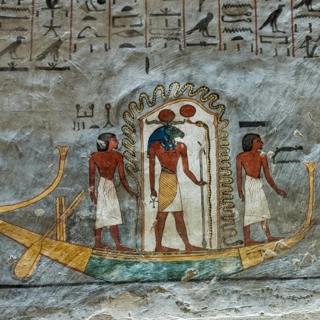
In the dark of the night, Ra took a journey through the Duat (underworld). His voyage was fraught with danger, but he also made many friends along the way. In the Book of Gates, the sun god takes a mysterious but meaningful journey... Details: Date: c.1305 BCE (first recorded appearance). Source: KV57, the tomb of Horemheb, and others. Website: www.egyptianhistorypodcast.com. Support the show via Patreon www.patreon.com/egyptpodcast. Make a one-time donation via PayPal payments. Music intro: Jeffrey Goodman. Music interludes: Cover versions by Luke Chaos. Music outro: Ancient Lyric. Logo image: Ra on his solar barque, from the tomb of Ramesses I (Photo by Dominic Perry, 2022). TRANSLATIONS of the Book of Gates by Erik Hornung (2014) and John Darnell & Colleen Manassa Darnell (2018). Select Bibliography: J. Assmann, Egyptian Solar Religion in the New Kingdom: Re, Amun and the Crisis of Polytheism (1995). C. Carrier, Grands Livres Funéraires de l’Égypte Pharaonique (2009). J. C. Darnell and C. Manassa Darnell, The Ancient Egyptian Netherworld Books (2018). E. Hornung, Das Grab des Haremhab im Tal der Könige (1971). E. Hornung, Das Buch von den Pforten des Jenseits, I (1979). E. Hornung, Das Buch von den Pforten des Jenseits, II (1984). E. Hornung, The Ancient Egyptian Books of the Afterlife (1999). E. Hornung, The Egyptian Book of Gates, trans. T. Abt (2014). C. Manassa, ‘The Judgement Hall of Osiris in the Book of Gates’, Revue d’Égyptologie 57 (2006), 109—150. J. Roberson, ‘The Royal Funerary Books: The Subject Matter of Scenes and Texts’, in R. H. Wilkinson and K. R. Weeks (eds), The Oxford Handbook of the Valley of the Kings (2016), 316–332. M. Smith, Following Osiris: Perspectives on the Osirian Afterlife from Four Millenia (2017). Theban Mapping Project, ‘KV 57 The Tomb of Horemheb’. Y. Volokhine, Le porc en Égypte ancienne (2014). J. Zandee, ‘The Book of Gates’, Liber Amicorum: Studies in Honor of Professor Dr. C.J. Bleeker (1969), 282–324. Learn more about your ad choices. Visit megaphone.fm/adchoices
21 Maalis 202356min
174b: Horemheb, Unfinished Business
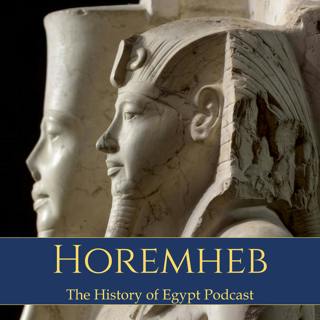
Horemheb's Lesser-known works and monuments. A selection of "off-cuts" from the Horemheb narrative including the Luxor Cachette, Horemheb's burial(s) of the Apis Bulls, and the rock-cut temple at Gebel Silsila. Website: www.egyptianhistorypodcast.com. Support the show via Patreon www.patreon.com/egyptpodcast. Make a one-time donation via PayPal payments. Music and Interludes: Luke Chaos. Additional music interludes: Keith Zizza. See statues from the Luxor Cachette in Luxor Museum, Wikimedia. Learn more about your ad choices. Visit megaphone.fm/adchoices
18 Maalis 202325min
174: Horemheb, Death and Legacy
The Death and Legacy of Horemheb (c.1305 BCE). Horemheb's reign ended after some 27-years of rule, though this is debated fiercely among historians. His latter-day achievements include an unorthodox approach to building his Memorial Temple, as well as an innovative and spectacular royal tomb. Ultimately, the King reached the end of his reign, leaving a legacy that deserves greater attention... Date: c.1305 BCE. Website: www.egyptianhistorypodcast.com. Support the show via Patreon www.patreon.com/egyptpodcast. Make a one-time donation via PayPal payments. Intro music and interludes: Luke Chaos. Additional interludes: Keith Zizza. Outro music: Ancient Lyric. Read the excavation report for Horemheb/Ay's Memorial Temple at The University of Chicago. Select Bibliography: N. Brown, ‘Coffin of Ramesses II’, American Research Center in Egypt. K. M. Bryson, ‘Some Year Dates of Horemheb in Context’, Journal of the American Research Center in Egypt 51 (2015), 285–302. K. M. Bryson, ‘The Reign of Horemheb: History, Historiography, and the Dawn of the Ramesside Era’, Unpublished PhD. Thesis, Johns Hopkins University (2018). A. Dodson, Amarna Sunset: Nefertiti, Tutankhamun, Ay, Horemheb, and the Egyptian Counter-Reformation (2nd edn, 2017). U. Hölscher, The Excavation of Medinet Habu II: The Temples of the Eighteenth Dynasty (1939). Available free online. E. Hornung, Das Grab des Haremhab im Tal der Könige (1971). M. Nilsson and P. Martinez, ‘In the Footsteps of Ricardo Caminos: Rediscovering the “Speos of Gebel el Silsila”’, in G. Rosati and M. C. Guidotti (eds), Proceedings of the XI International Congress of Egyptologists (2017), 445—449. N. Reeves, ‘The Coffin of Ramesses II’, Proceedings of the First Vatican Coffin Conference 19–22 June 2013, I (2013), 425—438. Theban Mapping Project, ‘KV 57 The Tomb of Horemheb’. A.-C. Thiem, Speos von Gebel es-Silsileh: Analyse der architektonischen und ikonographischen Konzeption im Rahmen des politischen und legitimatorischen Programmes der Nachamarnazeit (2000). J. Van Dijk, ‘New Evidence on the Length of the Reign of Horemheb’, Journal of the American Research Center in Egypt 44 (2008), 193—200. Learn more about your ad choices. Visit megaphone.fm/adchoices
14 Maalis 202357min
The Tomb of Tutankhamun (100 Year Anniversary)
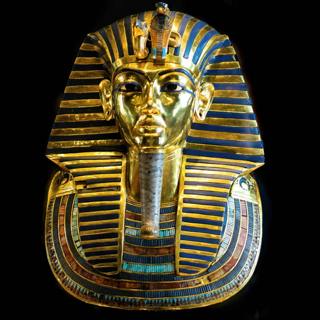
Hardcore Edition. In a special presentation, I compile my “Tomb of Tutankhamun” miniseries into a single mega episode. With updated information, and some new revelations, this 7-hour special is the full story, as best I can tell it. Reference materials: For the full archive of Harry Burton’s photographs, showing the tomb of Tutankhamun in its original state, at the Griffith Institute. See other images, including the treasures, at Wikimedia. The Tomb of Tutankhamun at The Theban Mapping Project. The life and reign of Tutankhamun at The History of Egypt Podcast. The Tomb of Tutankhamun episodes (with references and pictures): Part 1 (Chapters 1 to 5). Part 2 (Chapters 6 and 7). Part 3 (Chapters 8 and 9). Part 4 (Chapters 10 to 12). Part 5 (Chapters 13 and 14). Part 6 (Chapters 15 and 16). The “DNA Study” (Episode 128). The Tomb of Nefertiti (Episode 137b). Episode Details Date: 1340 BCE and 1922 - 1932 CE. Website: www.egyptianhistorypodcast.com. Support the show via Patreon www.patreon.com/egyptpodcast. Make a one-time donation via PayPal payments. Logo image: The gold mummy mask of Tutankhamun via Wikimedia. Music by Keith Zizza https://www.keithzizza.net/ Music by Michael Levy http://www.ancientlyre.com/ Music by Ancient Lyric http://www.bettinajoydeguzman.com/ Sound interludes by Luke Chaos https://twitter.com/Luke_Chaos Learn more about your ad choices. Visit megaphone.fm/adchoices
4 Marras 20227h 12min
173: A Forgotten Campaign
To Vile Carchemish. In Year 16, King Horemheb may have led a "campaign of victory" to the far north. An artefact identified in the 1970s, but lost for decades, testifies to these events... but what do they mean? Episode details: Date: c.1316 BCE. Website: www.egyptianhistorypodcast.com. Support the show via Patreon www.patreon.com/egyptpodcast. Make a one-time donation via PayPal payments. Music intro: Keith Zizza. Music interludes and outro: Luke Chaos. Select Bibliography: A. Ahrens, ‘New Light on the Amarna Period from the Northern Levant: A Clay Sealing with the Throne Name of Akhenaten/Amenhotep IV from the Royal Palace at Tall Mišrife/Qatna, in: Zeitschrift für Orient-Archäologie 5 (2012): 232-248’, Zeitschrift für Orient-Archäologie 5 (2012), 232—248. A. Ahrens, ‘Pharao Haremhab und die nördliche Levante. Bemerkungen zu einem Skarabäenabdruck aus Tell Mišrife/Qatna, in: Ugarit-Forschungen 45, In memoriam Oswald Loretz (2014): 1-9’, Ugarit-Forschungen 45 (2014), 1—9. E. Devecchi and J. L. Miller, ‘Hittite-Egyptian Synchronisms and their Consequences for Ancient Near Eastern Chronology’, in J. Mynářová (ed.), Egypt and the Near East – The Crossroads (Prague, 2011), 139—176. H. Gauthier, Dictionnaire des noms géographiques contenus dans les textes hiéroglyphiques (Paris, 1925). R. Gautschy, ‘A Reassessment of the Absolute Chronology of the Egyptian New Kingdom and its “Brotherly” Countries’, Egypt and the Levant 24 (2014), 141—158. N. Grimal, ‘L’offrande d’un vétéran de l’an 16 d’Ḥoremḥeb’, Comptes rendus de l’Académie des Inscriptions et Belles-lettres (Paris) (2018), 319—338. B. Lagarce-Othman, ‘Un nouveau vase inédit d’Horemheb’, in V. Matoïan and M. al-Maqdissi (eds), Études Ougaritiques III, Ras Shamra–Ougarit XXI (Leuven, 2013), 347—364. V. Matoïan, ‘Ugarit et l’Égypte: essai d’interprétation de la documentation archéologique et perspectives de la recherche’, in B. Eder and R. Pruzsinszky (eds), Policies of Exchange Political Systems and Modes of Interaction in the Aegean and the Near East in the 2nd Millenium B.C.E, Proceedings of the International Symposium at the University of Freiburg Institute for Archaeological Studies, 30th May – 2nd June 2012, 2 (Vienna, 2015), 35—84. J. L. Miller, ‘Amarna Age Chronology and the Identity of Nibḫururiya In the Light of a Newly Reconstructed Hittite Text’, Altorientalische Forschungen 34 (2007), 252—293. D. B. Redford, ‘New Light on the Asiatic Campaigning of Ḥoremheb’, Bulletin of the American Schools of Oriental Research 211 (1973), 36—49. D. B. Redford, ‘A Head-Smiting Scene from the 10th Pylon’, in M. Görg (ed.), Fontes Atque Pontes. Eine Festgrabe für Hellmut Brunner (Wiesbaden, 1983), 362—373. Z. Simon, ‘Kann Armā mit Haremhab gleichgesetzt werden?’, Altorientalische Forschungen 36 (2009), 340—348. G. Wilhelm, ‘Muršilis II. Konflikt mit Ägypten und Haremhabs Thronbesteigung’, Die Welt des Orients 39 (2009), 108—116. J. A. Wilson, ‘Egyptian Historical Texts’, in J. B. Pritchard (ed.), Ancient Near Eastern Texts Relating to the Old Testament with Supplement (1978), 227–64. W. Wreszinski, Atlas zur altaegyptischen Kulturgeschichte (Geneva, 1988). Learn more about your ad choices. Visit megaphone.fm/adchoices
2 Marras 202235min
172: Horemheb, Wise Like Thoth
Horemheb's favourite god. Throughout his life, Horemheb commissioned monuments and artefacts that honoured Djehuty (Thoth). As a courtier, then a King, Horemheb showed a certain favour towards this god. Why did he like this god, in particular, and what do these artefacts tell us about Horemheb as a person? Website: www.egyptianhistorypodcast.com. Support the show via Patreon www.patreon.com/egyptpodcast. Make a one-time donation via PayPal payments. Logo image: Horemheb as a Scribe, statue in the Metropolitan Museum of Art, New York. Read the Hymn to Thoth at the Metropolitan Museum of Art website. Music interludes by Luke Chaos, Hathor Systrum, and Keith Zizza. Select Bibliography: N. Allon, Writing, Violence, and the Military: Images of Literacy in Eighteenth dynasty Egypt (1550-1295 BCE). (2019). B. G. Davies, Egyptian Historical Records of the Later Eighteenth Dynasty, VI (1995). M. Lichtheim, Ancient Egyptian Literature Volume II: The New Kingdom (1976). W. J. Murnane, Texts from the Amarna Period in Egypt (1995). K. Sowada, ‘A Late Eighteenth Dynasty Statue in the Nicholson Museum, Sydney’, The Journal of Egyptian Archaeology 80 (1994), 137–43. H. E. Winlock, ‘A Statue of Horemhab before His Accession’, The Journal of Egyptian Archaeology 10 (1924), 1–5. Learn more about your ad choices. Visit megaphone.fm/adchoices
1 Marras 202229min
171: Law & Order (Special Ma'at Unit)
Horemheb's Great Decree. Sometime during his reign, King Horemheb proclaimed a new set of laws. Taking aim at corruption and abuses-of-power (allegedly happening throughout Egypt), the pharaoh went hard on corrective measures. Punishments could range from beatings to disfigurement, exile, and death. Horemheb was not messing around. But what was he really trying to achieve? Episode details, pictures and references at www.egyptianhistorypodcast.com Support the show via Patreon www.patreon.com/egyptpodcast. Make a one-time donation via PayPal payments. Intro music by Keith Zizza www.keithzizza.net Interludes and Outro music by Luke Chaos www.twitter.com/luke_chaos Select Bibliography: G. de la Bédoyere, Pharaohs of the Sun: The Rise and Fall of Tutankhamen’s Dynasty (2022). C. Eyre, The Use of Documents in Pharaonic Egypt (2013). A. Gnirs, ‘Haremhab - ein Staatsreformator? Neue Betrachtungen zum Haremhab-Dekret’, Studien zur Altägyptischen Kultur 16 (1989), 83–110. A. M. Gnirs, Militär und Gesellschaft: Ein Beitrag zur Sozialgeschichte des Neuen Reiches (1996). A. M. Gnirs, ‘Coping With the Army: The Military and the State in the New Kingdom’, in J. C. Moreno García (ed.), Ancient Egyptian Administration (2013), 639—717. R. Hari, Horemheb et la reine Moutnedjemet ou la fin d’une Dynastie (1965). W. Helck, Urkunden der 18. Dynastie: Ubersetzung zu den Heften 17–22 (1961). J.-M. Kruchten, Le décret d’Horemheb: traduction, commentaire épigraphique, philologique et institutionnel (1981). K. Pflüger, ‘The Edict of King Haremhab’, Journal of Near Eastern Studies 5 (1946), 260–76. YouTube: Guy de la Bédoyere, "Horemheb, the 'Enlightened Despot,'" https://youtu.be/-jCEo21_hK4 Learn more about your ad choices. Visit megaphone.fm/adchoices
25 Loka 202253min