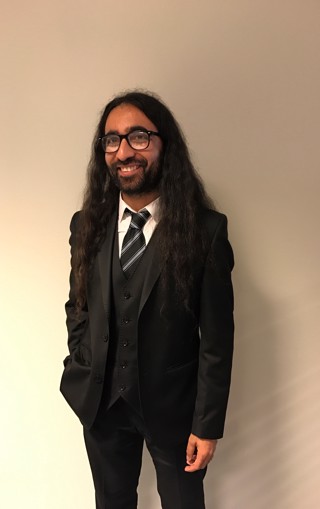

Inspiring hero, tragic victim, or just human?

Inspiring hero, tragic victim, or just human?

After four years of hard work Gagan Chhabra will defend his thesis Friday June 18th. In this episode Gagan looks back on his project where he has been comparing Norway to India focusing on disability policy reforms and employment experiences of young adults with visual impairments. Gagan shares the love for his projects but also the many hurdles he has met on the journey. Listen: “Ask, don’t assume” March 2019 - https://vitenogsnakkis.oslomet.no/2019/03/31/ask-dont-assume/ “What is ableism?” July 2020 - https://vitenogsnakkis.oslomet.no/2020/07/31/what-is-disablism/ Read more: Den norske velferdsstaten imponerte Gagan. Men så begynte han å undre seg - https://www.handikapnytt.no/den-norske-velferdsstaten-imponerte-gagan-men-sa-begynte-han-a-undre-seg/ June 18th 2021: Public Defense: Gagan Chhabra https://www.oslomet.no/en/about/events/public-defense-gagan-chhabra Scientific publications by Gagan: https://www.oslomet.no/en/about/employee/gagach/ Transcript Hallvard: Welcome back to a new podcast from Viten og Snakkis and welcome back Gagan Chhabra. How are you doing? Gagan: I’m really swell Hallvard, it's fantastic to be here with you the third time, in the third year. [laughter] Hallvard: It's so good to have you back and it's a special occasion. We first talked in 2019 in March, we made a podcast, I introduced you, your project, your PhD project. And we met again a year later and talked about ableism and now suddenly, you finished. What happened? [laughter] Gagan: I wish I could explain what happened. It has been an inexplicable journey. Like yes, the PhD-journey is at the end, and I am going to be defending my labor of love, my competitive research wherein I contrast disability policy reforms and the experiences of young adults with visual impairments, employment inclusion experiences into, from Norway and India. Hallvard: Yeah. It's been long journey, are you fed up with your project now? [laughter] Gagan: No, a part of me is like quite delighted, elated, ecstatic to be over with, because this has been almost like four years, four months and 29 days. Hallvard: You have been counting. [laughter] Gagan: Through this entire journey and with multiple publications, research publications, and it is it's been quite emotionally gratifying, intellectually rewarding, but at the same time, very arduous task to compare Norway and India. And to ensure that the competitive research stays on track. It delivers the outcomes which it's supposed to deliver, and it gets accepted in the wider milieu of comparative disability research. So yeah, it's been an exhausting journey in that sense, but I'm very, very thankful that it has happened and it's kind of a privilege to do a PhD in the first place and now it's getting over some feeling. Wow, time has flown so quickly. Hallvard: But Gagan, how was the reaction when you first came with this project? Wanting to look at India and Norway together, that's two very different countries. Is it like, is it possible to compare those two countries at all? Gagan: Yes, and oh my gosh! This is the exact question which people have been asking me from, from the time I thought about this project, like 2015. Late 2015, early 2016, I thought it would be nice to compare Norway in India. There was a lot of resistance towards it, because people always intuitively thought “oh Norway has to be compared to the rich developed, advanced, industrialized world. The OECD, Organization of Economic Cooperation and Development countries.” You know? Like Norway should be compared to Sweden, to Denmark, to Finland, the US, Canada, Australia, UK, but, what? You plan to compare Norway to India? Why would you do that? First of all, if you do that, can you do that? So many, many people thought in the beginning of this whole journey that this project was quite outlandish, and some were quite outraged as well because, both Norway and India are worlds apart and that's why, for instance, even my PhD is titled “To Worlds apart, yet similar.”. So, the idea is that I understand, I appreciate, acknowledge the fact that Norway is one of the best countries in the world when it comes to the human Development index. It was ranked number one in 2019. It's fantastic to live in Norway. Great social benefits, great social services. And India is not doing that well. We all have heard all these tragic stories about health care inequities in India right now. The challenges with COVID vaccine and the rest, and there's tremendous poverty and inequality in the society and discrimination. But, the important thing for me in this whole journey was to stay focused on what I was comparing and bring that to light because I think when we compare, we get a chance to learn from other experiences, other perspectives, other countries. Hallvard: Yeah. So some of the similarities then, you proved them wrong I guess, and found some similarities, maybe? Gagan: Exactly. If I would take 2 steps back, I would like to recollect, or retell rather, this one incident which happened back in the early days in 2017. I was attending a conference in Lucerne. It was a European conference, ALTAR. And just before the day of my presentation, we were having like a gala dinner, and I was having food. Just chopping the beef trying to make sense that how should I eat it and right next to me was this big demographer from France. Max is his name and he's asking me, “so young man what are you researching about?”. And I explained to him I'm comparing Norway and India and I'm comparing disability policies and employment experiences of young people with visual disabilities. So, his first reaction instantaneously was, “tell me you did not find anything worth comparing? because these countries are so different”. And, you know, like I was struggling with my chopping of the beef and chewing it, because to be honest it was a gala dinner. But the, the quality of the beef was not the best. [laughter] Steak was not very good, so I'm like, I chewed, chewed over the meat for some time. And then I looked towards him, to Max, and said, “Max Listen. Not only am I comparing these two countries or the disability policies, but I'm also finding similarities. And if you want to know more about this, I'll be presenting my findings, preliminary findings tomorrow, next day. So why don't you just come?” And he came to the presentation, and once when my presentation and the question-and-answer session was over. He asked a question and he said “yesterday I met this young man at the dinner table, and I was quite premature to judge that, oh, you can never compare Norway to India, and you will not find anything worth comparing. And not only has he proven me wrong, but I'm convinced that you can really compare and that's a fantastic achievement for you, so it's important to stay curious and open minded” and at the end he said “I want to take a picture of you and post it on the website”. [laughter] So that was kind of like the whole circle of you know, being dismissed, off the cuff just because of the fact that we don't hear this topic, or we have not explored the idea of comparing Norway to countries from other part of the globe. And, yes, I feel that it's so important to kind of not jump on those conclusions or these prejudicial attitudes which people often have. It's better to stay curious, open minded and not indulge into scientific dogmatism. Hallvard: So, what did you find? Can Norway learn something? Gagan: What I ended up doing is like I took a [pause]. I try to map the landscape, of the disability policies across northern India from the early 1990s and now, and you know, people would ask why the early 1990s? Why not prior to that? So, the idea was that prior to early 1990s, there were no major regulations, legislations, which protected the rights of persons with disabilities in law. So, Americans with Disabilities Act was passed in 1990s and that kind of opened the floodgates when it comes to disability inclusion, disability rights, disability justice and disability empowerment. So, I thought that could be a fine way to start 1990s. I'll start comparing from that and when I started seeing the policy landscape, you know I immediately understood that it's very complex. It's very rich. There are policies which are linked to social benefits. Like disability pensions (trygd) and their policies linked to social services like user controlled personal assistance. And then there are policies which are linked to social regulations. For instance, anti-discrimination which talks about, or universal design, or accessibility, which talks about creating a level playing field you know. It instantaneously dawned on me that I cannot compare Norway and India when it comes to social benefits and social services because these two countries are so different. You know? One country is, as I mentioned, top of the pyramid on Human Development Index. Extremely Rich, spends 4.3% of its GDP on disability protection and the other country is languishing far below, you know, on human development index. And spends very miniscule part of its GDP on disability protection for persons with disabilities. So, then I thought, perhaps a nice way it would be to compare social regulations. These policies linked to anti-discrimination, universal design, accessibility and inclusion. So I started from there and what I found is that, generally, people have an assumption, again, or prejudice or misconception that these policies the anti-discrimination, universal design, disability inclusion are only there in the global north. The rich developed world. Like you find these policies in the US. You'll find it in Norway. You'll find it in the UK. But, not in the developing world. So, one thing which came as shock to,...

Tämä jakso on lisätty Podme-palveluun avoimen RSS-syötteen kautta eikä se ole Podmen omaa tuotantoa. Siksi jakso saattaa sisältää mainontaa.

Jaksot(300)

Folk lever 6,7 år kortere på Sagene enn Vestre Aker

Folk lever 6,7 år kortere på Sagene enn Vestre Aker

Livsstil, utdanningsnivå, inntekt og flere andre variabler spiller inn på hvor lenge vi lever i Oslo. Bortsatt fra om du bor i Bydel Bjerke. I denne episoden møter vi forsker ved NOVA, Kristian Hegge...

2 Loka 22min

Legges det opp til ulikhet i Oslo-skolen?

Legges det opp til ulikhet i Oslo-skolen?

Vi har fritt skolevalg til videregående skoler, men er det egentlig så fritt? Eller er det kun fritt for de flinkeste? Håvard Helland fra OsloMet, Marianne Nordli Hansen og Oskar Grannæs Olsen fra Uni...

25 Syys 0s

Grøtstriden på 1800-tallet: Bondekvinner mot ernæringseksperter

Grøtstriden på 1800-tallet: Bondekvinner mot ernæringseksperter

Grøtstriden var en offentlig debatt i Norge på 1860-tallet der tusen års grøttradisjon ble stilt opp mot den nye ernæringsvitenskapen. Debatten ble frontet at Peter Christen Asbjørnsen og Eilert Sundt...

18 Touko 5min

Hva avgjør om du blir lenge i arbeidslivet?

Hva avgjør om du blir lenge i arbeidslivet?

Forsker Hans Christoffer Aargaard Terjesen gir deg fem vanlige forklaringer på hvorfor man velger å bli eller forlate arbeidslivet når man blir eldre. Terjesen har skrevet rapporten «Fra hvorfor til ...

9 Huhti 7min

Grønland kan bli uavhengig når som helst

Grønland kan bli uavhengig når som helst

Etter danskleidd modernisering og assimilering har fleire grønlendarar jobba for full lausriving frå Danmark. Kva stoppar dei? Og kva har Grønland med Noreg å gjere? I denne episoden av Viten og snakk...

17 Helmi 11min
Må vi bare akseptere at segregering finner sted i Norge?

Må vi bare akseptere at segregering finner sted i Norge?

I Norge har vi mange ulike typer byer og nabolag, og ulike nabolag tiltrekker seg ulike grupper.Mye tyder på at hvor du bor, former hvem du blir. Men vi former også omgivelsene våre.Hvordan fungerer d...

12 Helmi 11min

Bør barn være på sosiale medier?

Bør barn være på sosiale medier?

Et nytt lovforslag fra regjeringen vil forby barn under 15 år å være på sosiale medier. Hva kan konsekvensene bli av å stenge dem ute? Er en aldersgrense det vi trenger for å beskytte barn fra teknolo...

28 Tammi 21min

Hva tenkte kirken om homofile på 90-tallet?

Hva tenkte kirken om homofile på 90-tallet?

I oktober 2025 sa Den norske kirke unnskyld til skeive for skam, smerte og skade kirken har påført dem. Kunne kirken sagt unnskyld på 1990-tallet allerede? Og hvordan var synet på homofile den gangen?...

23 Tammi 16min

Suosittua kategoriassa Koulutus

rss-murhan-anatomia
aamukahvilla
psykopodiaa-podcast
rss-arkea-ja-aurinkoa-podcast-espanjasta
voi-hyvin-meditaatiot-2
psykologia
rss-rahamania
adhd-podi
rss-valo-minussa-2
rss-liian-kuuma-peruna
kesken
rss-hereilla
rss-duodecim-lehti
koulu-podcast-2
rss-narsisti
rss-vapaudu-voimaasi
aloita-meditaatio
solu-ja-molekyylibiologian-perusteet
rss-paikoillenne-valmiit-laakikseen
rahapuhetta