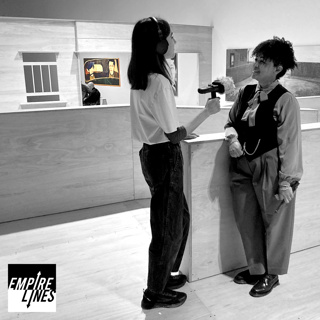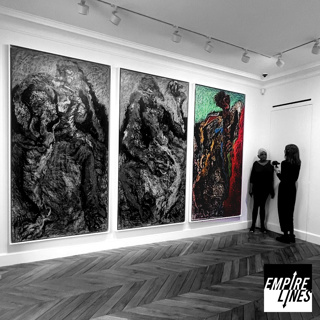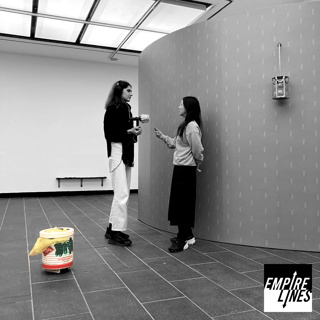
Giolo’s Lament, Pio Abad (2023) (EMPIRE LINES x Ashmolean Museum)
EMPIRE LINES28 Maalis 2024

Giolo’s Lament, Pio Abad (2023) (EMPIRE LINES x Ashmolean Museum)

Artist and archivist Pio Abad draws out lines between Oxford, the Americas, and the Philippines, making personal connections with historic collections, and reconstructing networks of trafficking, tattooing, and 20th century dictatorships. Pio Abad’s practice is deeply informed by global histories, with a particular focus on the Philippines. Here, he was born and raised in a family of activists, at a time of conflict and corruption under the conjugal dictatorship of Ferdinand and Imelda Marcos (1965-1986). His detailed reconstructions of their collection - acquired under the pseudonyms of Jane Ryan and William Saunders - expose Western/Europe complicities in Asian colonial histories, from Credit Suisse to the American Republican Party, and critique how many museums collect, display, and interpret the objects they hold today.


In his first UK exhibition in a decade, titled for Mark Twain’s 1901 anti-imperial satire, Pio connects these local and global histories. With works spanning engraving, sculpture, and jewellery, produced in collaboration with his partner, Frances Wadworth Jones, he reengages objects found at the University of Oxford, the Pitt Rivers Museum, St John’s College, and Blenheim Palace - often marginalised, ignored, or forgotten. With an etching of Prince Giolo or the ‘Painted Prince’, a 17th century slave depicted by John Savage, Pio outlines why his practice is anchored around the body. We also look at two reconstructed tiaras, which connect the Romanovs of the Russian Empire, to the Royal Family in the UK, all via Christie’s auction house.
Pio shares why he often shows his work alongside others, like the Filipino American artist and art historian Carlos Villa, plus the politics, collections, and textiles of Pacita Abad, his aunt. He details his use of monumental media like marble and bronze, ‘the material of history’. Pio explains his approach to ‘diasporic objects’, not things, but travelling ‘networks of relationships’, which challenge binaries between the East and West, and historic and contemporary experiences - thus locating himself within Oxford’s archives.

Ashmolean NOW: Pio Abad: To Those Sitting in Darkness runs at the Ashmolean Museum in Oxford until 8 September 2024, accompanied by a full exhibition catalogue.

Fear of Freedom Makes Us See Ghosts, Pio’s forthcoming exhibition book, is co-published by Ateneo Art Gallery and Hato Press, and available online from the end of May 2025.


For other artists who’ve worked with objects in Oxford’s museum collections, read about:

- Ashmolean NOW: Flora Yukhnovich and Daniel Crews-Chubbs, at the Ashmolean Museum.

- Marina Abramović: Gates and Portals, at Modern Art Oxford and the Pitt Rivers Museum.

For more about the history of the Spanish Empire in the Philippines, listen to Dr. Stephanie Porras’ EMPIRE LINES on an ⁠Ivory Statue of St. Michael the Archangel, Basilica of Guadalupe (17th Century)⁠.

And hear Taloi Havini, another artist working with Silverlens Gallery in the Philippines, on Habitat (2017), at Mostyn Gallery for Artes Mundi 10.


WITH: Pio Abad, London-based artist, concerned with the personal and political entanglements of objects. His wide-ranging body of work, encompassing drawing, painting, textiles, installation and text, mines alternative or repressed historical events and offers counternarratives that draw out threads of complicity between incidents, ideologies and people. He is also the curator of the estate of his aunt, the Filipino American artist Pacita Abad. PRODUCER: Jelena Sofronijevic.


Follow EMPIRE LINES on Instagram: ⁠instagram.com/empirelinespodcast⁠

And Twitter: ⁠twitter.com/jelsofron/status/1306563558063271936⁠

Support EMPIRE LINES on Patreon: ⁠patreon.com/empirelines

Jaksot(158)

Br’er Rabbit and the Tar Baby, Sequoia Danielle Barnes (2024) (EMPIRE LINES x Edinburgh Sculpture Workshop, Edinburgh Art Festival 2024)

Br’er Rabbit and the Tar Baby, Sequoia Danielle Barnes (2024) (EMPIRE LINES x Edinburgh Sculpture Workshop, Edinburgh Art Festival 2024)

Artist and academic Sequoia Danielle Barnes redresses the ugly side of kitsch and ‘cute’ toy cultures, telling histories of trickster rabbits from Peter Rabbit to Bugs Bunny, appropriated from Black Southern American folklore from the 16th century to now. With ceramics, fabrics, and super sticky slugs, Sequoia Danielle Barnes’ new installation is an Afro-surrealist retelling of Br’er Rabbit and the Tar Baby, a folktale developed by her enslaved ancestors after being ripped from Africa and displaced in Alabama, in the United States - the place she grew up before pursuing her practice in ‘transatlantic’ institutions. Here, stories about figures like Uncle Remus, Uncle Ben, and Aunt Jemima, often first told as a means of action guidance for outsmarting slavemasters, were mainstreamed into 20th century pop art and cultures. Sequoia’s exhibition takes its title from the 1946 film, Song of the South, a nostalgic representation of the antebellum, pre-Confederate South, revealing how ‘cuteness’ masks anti-Black racist tropes and propaganda. We discuss how popular consumption of Western/European films, TV adverts, and commercials can perpetuate forms of oppression and marginalisation, including racialisation, infantilism, violence, and the cannibalisation of enslaved peoples. Sequoia tells of her interest in ‘Tellytubby lore’, how children’s cartoons and animations can sustain critical traditions of surrealism, and why younger people more readily engage with her work than adults. From her creepy and uncanny collectibles, we discuss why major institutions protect and preserve golliwogs, golly, and ‘piccaninny’ dolls, and Sequoia’s ‘Black radical art practice’ in spaces like CCA Glasgow, Fruitmarket, and the National Museum of Scotland. Sequoia shares her subversive influences from the Black diaspora, including Faith Ringgold, Betye Saars, Robert Colescott,and Eddie Chambers. With Theaster Gates, Patrick Kelly, Joe Casely-Hayford,, we explore Afrofuturism, and find entanglements in their own practice, between works with textiles, fashion, and pottery. Beneath the dark humour and sweet surfaces of their works, Sequoia speaks of connections between contemporary consumption and capitalism, and historic sugar cane plantations. exposing how legacies of colonialism, slavery, and global trade still shape society today. Sequoia Danielle Barnes: Everything Is Satisfactual runs at Edinburgh Sculpture Workshop until 28 August 2024. The exhibition is part of Edinburgh Art Festival (EAF) 2024, which continues in Scotland until 25 August 2024. For more about Black Southern Assemblage, hear Raina Lampkins-Felder, curator at the Souls Grown Deep Foundation and Royal Academy in London, on the Quiltmakers of Gee’s Bend (20th Century-Now): pod.link/1533637675/episode/2cab2757a707f76d6b5e85dbe1b62993 Read about Sonia Boyce’s Feeling Her Way (2022), her Golden Lion-winning British Pavilion (2022), at the Turner Contemporary in Margate, in gowithYamo: gowithyamo.com/blog-post-app/feeling-her-way-sonia-boyces-noisy-exhibition And read about Edinburgh Art Festival (EAF) 2023, in gowithYamo: gowithyamo.com/blog-post-app/edinburgh-art-festivals-reckoning-with-the-citys-colonial-legacies EDITOR: Alex Rees. PRODUCER: Jelena Sofronijevic. Follow EMPIRE LINES on Instagram: ⁠instagram.com/empirelinespodcast⁠ And Twitter: ⁠twitter.com/jelsofron/status/1306563558063271936⁠ Support EMPIRE LINES on Patreon: ⁠patreon.com/empirelines

15 Elo 202421min

Casa de Maria, Beatriz Milhazes (1992) (EMPIRE LINES x Tate St Ives, Turner Contemporary)

Casa de Maria, Beatriz Milhazes (1992) (EMPIRE LINES x Tate St Ives, Turner Contemporary)

Contemporary artist Beatriz Milhazes collages arabesques from Baroque Portugal and Brazil’s many indigenous communities, tracing religious and natural patterns in Roman Catholicism, Islamic architectures, and the islands of Japan, through Casa de Maria (1992). Known for her colourful, large-scale abstract paintings, Beatriz Milhazes’ practice reflects how Brazilian culture has long ‘assimilated’ plural influences, particularly the effects of Portuguese and Spanish colonial rule between the 17th and 19th centuries. Arches, doors, stained glass windows, and burnished golds, drawn from churches across South America, recur as motifs in works spanning forty years. Beatriz layers ruffles and rosettes, precursors to the circles in her more recent paintings, from royal Hispanic costumes, and textiles found in city markets and Carnival parades. Her studio overlooks Rio de Janeiro’s botanical garden, another construct of colonial rule, and environment which inspires her creations. For the artist, flowers are both ‘natural’ and ‘plastic’ bodies - like the water, and ‘salty sea breeze’ which connects her home in Brazil and the coastal cities of Britain, where her work is currently on display. Beatriz outlines the centrality of nature in popular and indigenous cultural production, and interest in ornamental ‘body drawings’ by women in the Kadiwéu tribe. She shares how she adapts the concept of collage to painting on canvas, calling on Western/European modernism, geometric abstraction, and ‘scientific research’ into colour for her exhibition at the Venice Biennale in 2024. From a kimono in the collection of the V&A, a diplomatic gift from the emperor of Japan, Beatriz travels to her Yellow Flower Dream (2018) for the 'Art House Project' on Inujima - an island in the country’s Seto Island Sea, also recreated in Kensington, at Japan House London. We touch on more histories of migration in São Paulo, home to Japan’s largest diasporic community, and the ‘union’ of cultural, economic, and ecological regeneration taking place across continents today. Beatriz Milhazes: Maresias runs at Tate St Ives in Cornwall until 29 September 2024. For more, you can read my article from the first exhibition at the Turner Contemporary in Margate in 2023, in gowithYamo: gowithyamo.com/blog/colour-and-abstraction-beatriz-milhazes-at-margates-turner-contemporary For more from Tate St Ives in Cornwall, hear curator Morad Montazami on the Casablanca Art School (1962-1987). For more from Japan House London, hear curator Hashimoto Mari on Hasegawa Akira’s Antique French Military Uniform with Kumihimo (2021), and read about WAVE: Currents in Japanese Graphic Arts (2023), in gowithYamo: gowithyamo.com/blog/wave-currents-in-japanese-graphic-arts-at-japan-house-london PRODUCER: Jelena Sofronijevic. Follow EMPIRE LINES on Instagram: instagram.com/empirelinespodcast And Twitter: twitter.com/jelsofron/status/1306563558063271936 Support EMPIRE LINES on Patreon: patreon.com/empirelines

25 Heinä 202413min

Avi-Alarm, Hanna Tuulikki (2023) (EMPIRE LINES x Invasion Ecology)

Avi-Alarm, Hanna Tuulikki (2023) (EMPIRE LINES x Invasion Ecology)

Artist Hanna Tuulikki connects plantation landscapes in Finland, Scotland, and across the South West of England, making kin across species and with birds. Glasgow-based artist, composer, and performer Hanna Tuulikki considers ‘reworlding’ in times of planetary crisis. Avi-Alarm (2023), a collection of augmented reality filters for social media, transforms the faces of user-participants into hybrid human-avian beings. Each one recalls a critically-endangered bird in the British Isles archipelago – the capercaillie, curlew, lapwing, mistle thrush, and puffin. Their alarm calls signal danger, a form of communication that crosses species boundaries, and can save many recipients of different species simultaneously. This altruistic behaviour challenges Darwinian evolutionary theory, the idea of ‘natural selection’ or 'survival of the fittest' or that also underpins capitalism. Standing amongst the silver birch trees at Southcombe, Hanna details her practice across environments, from Helsinki in Finland, to Scotland. We discuss works both inspired by and critical of romanticised representations of natural landscapes, contrasting the 'wilderness' with the reality of Finland’s monoculture plantations, and their role in establishing Finnish independence from Sweden in 1917. Hanna details how national identities and ideas of masculinity are constructed through folklore and traditions. Through the practice of mimesis or imitation, and participatory performance, we explore how they've made ‘more-than-human’ kin with other animals like deer, cows, and seals. Hanna shares their work for British Art Show 9, which travelled from COP26 in Glasgow to Plymouth, addressing contemporary eco-anxiety or grief over biodiversity loss. We discuss their recent work with bats, connecting between rave and electronic music, and echolocation, as a model for ecological coexistence - and find another link between Scotland and the South West, at Buckfast Abbey. ⁠Invasion Ecology⁠ is co-curated by Jelena Sofronijevic for Radical Ecology, and Southcombe Barn on Dartmoor. It is a season of contemporary land art across South West England in summer 2024, questioning what we mean by ‘native’ and what it means to belong. The central group exhibition, featuring Ingrid Pollard, Iman Datoo, Hanna Tuulikki, Ashish Ghadiali, Fern Leigh Albert, and Ashanti Hare, runs from 1 June to 10 August 2024. The wider programme includes anti-colonial talks and workshops with exhibiting artists, writers, researchers, and gardeners, reimagining more empathic connections between humans, plants, animals, and landscapes. For other 'invasive species' in the Gardens, join EMPIRE LINES in conversation with Iman Datoo and Jessica J. Lee, author of Dispersals: On Plants, Borders and Belonging, on 30 July 2024. For more information, follow ⁠Radical Ecology⁠ and ⁠Southcombe Barn⁠ on social media, and visit: radicalecology.earth/events/invasion-ecology-exhibition. You can also listen to the ⁠EMPIRE LINES x Invasion Ecology Spotify playlist⁠, for episodes with Paul Gilroy, Lubaina Himid, Johny Pitts, and Imani Jacqueline Brown, plus partners from the University of Exeter, KARST, CAST, and the Eden Project in Cornwall. Read about under forest cover (2021) in Deep Rooted at City Art Centre in Edinburgh, in gowithYamo: gowithyamo.com/blog/edinburghs-environmental-exhibitions-the-localHear about another performance at Glasgow International, with Paul Maheke's Taboo Durag (2021) at MOSTYN in Wales. And listen to Ingrid Pollard’s episode from Carbon Slowly Turning (2022) at the Turner Contemporary in Margate, marking their participation in Invasion Ecology (2024). IMAGES: Jassy Earl, Amber Amare. PRODUCER: Jelena Sofronijevic. Follow EMPIRE LINES on Instagram: ⁠instagram.com/empirelinespodcast⁠ And Twitter: ⁠twitter.com/jelsofron/status/1306563558063271936⁠ Support EMPIRE LINES on Patreon: ⁠patreon.com/empirelines

11 Heinä 202417min

The Time is Always Now, Ekow Eshun (2024) (EMPIRE LINES x National Portrait Gallery, The Box)

The Time is Always Now, Ekow Eshun (2024) (EMPIRE LINES x National Portrait Gallery, The Box)

Curator Ekow Eshun reframes the Black figure in historic and contemporary art, surveying its presences, absences, and representations in Western/European art history, the African diaspora, and beyond, via The Time is Always Now (2024). In 1956, the American author James Baldwin wrote: ‘There is never time in the future in which we will work out our salvation. The challenge is in the moment, the time is always now.’ Heeding Baldwin’s urgent call, Ekow Eshun’s new exhibition brings together 22 leading contemporary African diasporic artists from the UK and the US, whose practices emphasise the Black figure through mediums such as painting, drawing, and sculpture. These figurative artists and artworks address difficult histories like slavery, colonialism, and racism and, at the same time, speak to contemporary experiences of Blackness from their own personal perspectives. Ekow explains how artists like Kerry James Marshall, Amy Sherald, and Thomas J. Price acknowledge the paradox of race, and the increased cultural visibility and representation of lived experiences. Beyond celebration, though, The Time Is Always Now follow the consequences of these artists’ practices, and what is at stake in depicting the Black figure today. We discuss the plurality of perspectives on view, and how fragmented, collage-like works by Nathaniel Mary Quinn, Lorna Simpson, and Titus Kaphar reconsider W.E.B. Du Bois’ understanding of ‘double consciousness’ (1897) as a burden, to a 21st century vantage point. Ekow shares the real people depicted in Michael Armitage’s surrealistic, religious scenes, whilst connecting works with shared motifs from Godfried Donkor’s boxers, to Denzil Forrester and Chris Ofili’s dancing forms. We talk about how how history is not just in the past, and how we might think more ‘historically from the present’. Plus, we consider the real life relationships in works by Njideka Akunyili Crosby and Jordan Casteel - and those shared between artists like Henry Taylor and Noah Davis - shifting the gaze from one of looking at, to looking with, Black figures. Starting at the National Portrait Gallery in London, The Time is Always Now: Artists Reframe the Black Figure travels to The Box in Plymouth from 28 June to 29 September 2024. It will then tour to the Philadelphia Museum of Art and North Carolina Museum of Art in the US into 2025. Join me at The Box in Plymouth in conversation with Ekow on Saturday 29 June. And as promised, some news - EMPIRE LINES will go on, returning to a fortnightly basis. For more about Claudette Johnson, hear curator (and exhibition text-contributor!) Dorothy Price on And I Have My Own Business in This Skin (1982) at the Courtauld Gallery in London. Listen to Lubaina Himid on Lost Threads (2021, 2023) at the Holburne Museum in Bath. Hear curator Isabella Maidment on Hurvin Anderson’s Barbershop series (2006-2023) at the Hepworth Wakefield. Read about that show, and their work in Soulscapes at Dulwich Picture Gallery in London, in recessed.space. Hear Kimathi Donkor on John Singer Sargent’s Madame X (1883-1884) and Study of Mme Gautreau (1884) at Tate Britain in London. For more about Barbara Walker’s Vanishing Point series, hear curators Jake Subryan Richards and Vicky Avery on Black Atlantic: Power, People, Resistance (2023) at the Fitzwilliam Museum in Cambridge. And on W.E.B. Du Bois, hear Professor Paul Gilroy live in conversation with EMPIRE LINES at the Black Atlantic Symposium (2023) in Plymouth, marking the 30th anniversary of his formative text. PRODUCER: Jelena Sofronijevic. Follow EMPIRE LINES on Instagram: instagram.com/empirelinespodcast And Twitter: twitter.com/jelsofron/status/1306563558063271936 Support EMPIRE LINES on Patreon: patreon.com/empirelines

27 Kesä 202417min

Taboo Durag, Paul Maheke (2021) (EMPIRE LINES x MOSTYN, Glasgow International)

Taboo Durag, Paul Maheke (2021) (EMPIRE LINES x MOSTYN, Glasgow International)

Contemporary and performance artist Paul Maheke moves between France, Congo, and Canada, exploring the ‘archive of their body’ through drawing and dance, via Taboo Durag (2021). To Be Blindly Hopeful emerged from the very last sentence of a journal that Paul Maheke kept between August 2020 and June 2021, capturing the turbulence of the COVID pandemic on paper. Central to his practice is a delicate dance between the individual and the collective, personal and broader sociopolitical contexts, echoing the sentiment expressed by bell hooks, who reminds us that ‘the space of our lack is also the space of possibility.’ Currently based in France, Paul shares work ‘staged’ in previous exhibitions at South London Gallery, Chisenhale Gallery, and Tate Modern, highlighting how these ‘new’ drawings, prints, book illustrations, and paintings of birds have long formed part of his practice. He explains how performance and dance can be both emancipatory and trapping, with respect to queerness, masculinity, and gender, and the reality of being ‘brown body looked at by a white audience’. Exploring these lived experiences through movement, Paul’s work suggests of Stuart Hall’s thinking about living archives - but the artist also shares his lifelong admiration for the French-born ice skater, Surya Bonaly. We delve into Paul’s plural popular culture and academic Influences like Grace Jones and Félix González-Torres, Audre Lorde and Édouard Glissant, and Bruce Nauman to Paul B. Preciado - not as icons but real, complex people. Finally, Paul highlights how his work changes in its global travels, from Paris, to the Baltic Triennale in Estonia, and Johanneburg, South Africa. He also speaks of his collaborations with family members and the fellow artist Melika Ngombe Kolongo (Nkisi) for the Congo Biennale in 2021, his personal relationship with arts institutions on the continent, as a diasporic artist. Paul Maheke: To Be Blindly Hopeful runs at MOSTYN in Wales until 29 June 2024. It includes Taboo Durag (2021), produced as a performance to camera for Glasgow International 2021. This episode marks this iteration of Scotland’s biennale festival of contemporary art, which continues until 23 June 2024. Paul has also shown work as part of the Diaspora Pavilion at the 58th Venice Biennale in 2019, the first to feature an official performance programme co-produced with the Delfina Foundation, and in the Drawing Biennal 2024, which runs at the Drawing Room in London until 3 July 2024. Hear another of Paul’s collaborators, Barby Asante, on Declaration of Independence (2023), part of Art on the Underground in London: pod.link/1533637675/episode/aa2803b68933ab974ca584cf6a18479c For another exhibition from MOSTYN, hear artist and curator Taloi Havini on Habitat (2017) and Artes Mundi 10: pod.link/1533637675/episode/e30bd079e3b389a1d7e68f5e2937a797 For more about bell hooks, hear Professor Paul Gilroy, on The Black Atlantic (1993-Now): pod.link/1533637675/episode/90a9fc4efeef69e879b7b77e79659f3f And on Édouard Glissant, listen to Manthia Diawara, co-curator of The Trembling Museum at the Hunterian in Glasgow, and artist Billy Gerard Frank on Palimpsest: Tales Spun From Sea And Memories (2019), part of PEACE FREQUENCIES 2023: instagram.com/p/C0mAnSuodAZ PRODUCER: Jelena Sofronijevic. Follow EMPIRE LINES on Instagram: instagram.com/empirelinespodcast And Twitter: twitter.com/jelsofron/status/1306563558063271936 Support EMPIRE LINES on Patreon: patreon.com/empirelines

13 Kesä 202416min

Ingrid Pollard: Carbon Slowly Turning (2022) (EMPIRE LINES x Invasion Ecology)

Ingrid Pollard: Carbon Slowly Turning (2022) (EMPIRE LINES x Invasion Ecology)

In this special episode, EMPIRE LINES returns to Ingrid Pollard’s 2022 exhibition, Carbon Slowly Turning, the first major survey of her career photographing Black experiences beyond the city and urban environments, in the English countryside. It marks the artist’s participation in Invasion Ecology, a season of contemporary land art across South West England in summer 2024, questioning what we mean by ‘native’ and what it means to belong. Since the 1980s, artist Ingrid Pollard has explored how Black and British identities are socially constructed, often through historical representations of the rural landscape. Born in Georgetown, Guyana, Ingrid draws on English and Caribbean photographic archives, with works crossing the borders of printmaking, sculpture, audio, and video installations. Their practice confronts complex colonial histories, and their legacies in our contemporary lived experiences, especially concerning race, sexuality, and identity. Curated by the artist and Gilane Tawadros, Carbon Slowly Turning led to Pollard’s shortlisting for the Turner Prize 2022. From its iteration at the Turner Contemporary in Margate, Ingrid exposes the pre-Windrush propaganda films beneath works like Bow Down and Very Low -123 (2021), her plural influences from Maya Angelou to Muhammad Ali, and playing on popular culture with works in the Self Evident series (1992). As a Stuart Hall Associate Fellow at the University of Sussex, and with a PhD-by-publication, the artist discusses the role of research in her media-based practice. Finally, Ingrid opens her archive of depictions of African figures 'hidden in plain sight' in English towns and villages - from classical portraiture, to ‘Black Boy’ pub signs. Ingrid Pollard: Carbon Slowly Turning ran at MK Gallery in Milton Keynes, the Turner Contemporary in Margate, and Tate Liverpool, throughout 2022. The exhibition was supported by the Freelands Foundation and Paul Mellon Centre for Studies in British Art, and the episode first released as part of EMPIRE LINES at 50. Invasion Ecology is co-curated by Jelena Sofronijevic for Radical Ecology, and Vashti Cassinelli at Southcombe Barn, an arts space and gardens on Dartmoor. The central group exhibition, featuring Ingrid Pollard, Iman Datoo, Hanna Tuulikki, Ashish Ghadiali, Fern Leigh Albert, and Ashanti Hare, runs from 1 June to 10 August 2024. The wider programme includes anti-colonial talks and workshops with exhibiting artists, writers, researchers, and gardeners, reimagining more empathic connections between humans, plants, animals, and landscapes. Ingrid will join EMPIRE LINES in conversation with Corinne Fowler, Professor of Colonialism and Heritage in Museum Studies at the University of Leicester, Director of Colonial Countryside: National Trust Houses Reinterpreted, and author of Our Island Stories: Country Walks through Colonial Britain (2024), on 18 July 2024. For more information, follow ⁠⁠Radical Ecology⁠⁠ and ⁠⁠Southcombe Barn⁠⁠ on social media, and visit: ⁠radicalecology.earth/events/invasion-ecology-exhibition⁠. You can also listen to the ⁠⁠EMPIRE LINES x Invasion Ecology Spotify playlist⁠⁠, for episodes with Paul Gilroy, Lubaina Himid, Johny Pitts, and Imani Jacqueline Brown, plus partners from the University of Exeter, KARST, CAST, and the Eden Project in Cornwall. Ingrid Pollard’s Three Drops of Blood (2022), commissioned by talking on corners (Dr Ella S. Mills and Lorna Rose), also explores representations of ferns, botany, and folk traditions in Devon’s historic lace-making industry. First exhibited at Thelma Hubert Gallery in Honiton, it is now part of the permanent collection of The Box in Plymouth, where it will be displayed from 19 October 2024. SOUNDS: no title, Ashish Ghadiali (2024). PRODUCER: Jelena Sofronijevic. Follow EMPIRE LINES on Instagram: instagram.com/empirelinespodcast And Twitter: twitter.com/jelsofron/status/1306563558063271936 Support EMPIRE LINES on Patreon: patreon.com/empirelines

30 Touko 202414min

Twist, LR Vandy (2024) (EMPIRE LINES x October Gallery, Chatham Ropery)

Twist, LR Vandy (2024) (EMPIRE LINES x October Gallery, Chatham Ropery)

Artist LR (Lisa) Vandy shows EMPIRE LINES the ropes in a studio visit to Chatham’s Royal Navy Dockyard in Kent, unravelling entangled imperial and industrial relationships, dance in the African diaspora, and women’s work in abstract sculpture. In 2022, sculptor LR (Lisa) Vandy relocated her studio from the city of London to Chatham Ropery which, with original machinery from the 19th century, has preserved traditional practices and knowledges. Rope became essential to Britain’s burgeoning maritime industry during the Georgian and Victorian eras, tied to the construction of empires, colonial hierarchies, and sites of slavery. Building in collaboration with the resident Master Ropemakers, her sculptures allude to and playfully subvert the media’s historic associations and legacy now. From her five-metre-high figure for Liverpool’s Canning Dock, to her new, smaller body of works, Lisa walks through her collection and archive on Kent’s waterfront. Born in Coventry in the Midlands, she shares her experiences of growing up ‘by the sea’ in Sussex as a young person of Nigerian and Irish heritages, and the racialised exclusion some face from leisurely pursuits in natural environments. Inspired by Barbara Ehrenreich’s 2006 book, Dancing In The Streets, Lisa unravels ‘collective joy’ and the central role of Black women. We see how dance has been used to resist oppression across continents, with spirit dances, raves, festivals, and carnival masquerades, interests shared by contemporaries like Theaster Gates, Hew Locke, Romuald Hazoumè, Zak Ové, and Hassan Hajjaj. Straw-fibre figures recall Grain Mother deities, corn dollies, and Kumpo, spinning dances from the Casamance (Senegal) and Gambia. With her ongoing series of Hulls, comprised of found objects, boats, and fishing floats ‘plundered’ from DIY stores, we discuss her interest in the ‘underbelly of empire’, knotty relationships between rail, sail, and transport, and ‘migrant crises’ in the Mediterranean Sea today. Drawing on her research in museum collections, ancient silverwares, and indigo trade routes, Lisa moves on the discussion about globalised ’African masks’ as symbols of ‘aggressive protection’. We discuss gender and identity, and how her curvilinear copper sculptures challenge conventional representations of the ‘female form’. Dynamic drawings of tornados tell of her designs for statues in the landscape - role models for those subject to the male gaze - exposing the empowering potential of contemporary art. Plus, Lisa shares why her tactile public artworks are designed to be destroyed. LR Vandy: Twist runs at the October Gallery in London until 25 May 2024. Dancing In Time: The Ties That Bind Us, commissioned by Liverpool Museums for the International Slavery Museum’s Martin Luther King celebrations in 2023, stands at the Historic Dockyard Chatham in Kent until 17 November 2024. On harvest rituals and minkisi figures, hear about Ashanti Hare’s performances at Against Apartheid at KARST in Plymouth (2023) and Invasion Ecology on Dartmoor (2024), and Learning from Artemisia (2019-2020) by Uriel Orlow and Orchestre Jeunes Étoiles des Astres, at the Eden Project in Cornwall. For more photographs of Black experiences in English coastal towns, and on the transatlantic ‘Triangular Trade’ between Europe, Africa, and the Americas, hear Ingrid Pollard on ⁠Carbon Slowly Turning (2022)⁠ at Turner Contemporary in Margate. For more women working in port cities, read into: Lisetta Carmi: Identities, at the Estorick Collection in London. Magdalena Abakanowicz: Every Tangle of Thread and Rope, at Tate Modern in London. And hear Chris Spring on ‘African’ textiles and Thabo, Thabiso and Blackx by Araminta de Clermont (2010)⁠ at the British Museum in London. EDITOR: Alex Rees. PRODUCER: Jelena Sofronijevic. Follow EMPIRE LINES on Instagram: instagram.com/empirelinespodcast And Twitter: twitter.com/jelsofron/status/1306563558063271936 Support EMPIRE LINES on Patreon: patreon.com/empirelines

16 Touko 202430min

Melted into the Sun, Saodat Ismailova (2024) (EMPIRE LINES x Fondazione In Between Art Film, Venice Biennale)

Melted into the Sun, Saodat Ismailova (2024) (EMPIRE LINES x Fondazione In Between Art Film, Venice Biennale)

Filmmaker Saodat Ismailova traces stories of spirituality, dissent, and environmental extraction around the Aral Sea from post-Soviet Uzbekistan and Central Asia, via Melted into the Sun (2024). Uzbekistan is at the crossroads of diverse material histories and migratory legacies. Part of ‘Central Asia’ - first defined by the Prussian geographer Alexander von Humboldt in 1843 - the region was governed by the Uzbek branch of the Soviet Russian Communist Party in the 20th century, until the Union’s collapse in 1990. As one of the first gener­ations of post-Soviet Central Asian contemporary artists, Saodat Ismailova often draws on shared traditions and transnational connections with groups including Uyghurs in China, to Arabic communities further west, distinguishing between migration and displacement in her practice. From her documentary, Aral: Fishing in an Invisible Sea (2004), to her more recent works on Chillpiq, we discuss the cultural importance of water in this double landlocked country; the Aral Sea, now the Aral Desert, was one of the world’s largest lakes until the Soviet government steadily diverted its water sources, reducing it to 10% of its original size. Her most recent film focusses on Al-Muqanna (The Veiled One), an 8th century textile dyer and alchemist who became a ‘protosocialist’ political revolutionary in now-Iran. We consider the syncretism of religions and faiths including Islam, Zoroastrianism and Mazdakism, Buddhism, and Christianity, as evidence of cosmopolitan coexistence within empires, and how this figure was appropriated in 20th century communist propaganda. Saodat shares her interests in oriental classical music, and improvision within maqam and raga, as living archives ‘deadened’ by notation, alongside archaeology, and the number 40. We discuss her collaborative practice with Davra Collective at documenta in Kassel. From her first residency with Fabrica, to her participation in the Venice Biennale in 2013 as part of the Central Asian Pavilion, Saodat explains her long connection with Italy, ‘the start of her life in Europe'. Saodat Ismailova’s film, Melted into the Sun (2024), is on view as part of Nebula, produced by Fondazione In Between Art Film, which runs at Complesso dell’Ospedaletto in Venice until 24 November 2024. Part of EMPIRE LINES at Venice, a series of episodes leading to Foreigners Everywhere (Stranieri Ovunque), the 60th Venice Biennale or International Art Exhibition in Italy, in April 2024. For more about Zoroastrianism, listen to Dr. Talinn Grigor on Persian Revival architecture, and Parsi patronage in India, via the Vatcha Adaran Zoroastrian Fire Temple in Bombay (Mumbai) (1881). On music, memory, and history, hear Barbican curator Eleanor Nairne on Julianknxx’s Chorus in Rememory of Flight (2023), and Professor Paul Gilroy, on The Black Atlantic (1993-Now). Find out more about textiles and embroidery across Central and South West Asia and North Africa with Rachel Dedman, curator of Material Power: Palestinian Embroidery at Kettle’s Yard in Cambridge and the Whitworth in Manchester: On an ⁠UNRWA Dress from Ramallah, Palestine (1930s)⁠, on EMPIRE LINES. On the exhibition more widely, in this gowithYamo article. Hear Nil Yalter, awardee of the Golden Lion for Lifetime Achievement at the Venice Biennale in 2024, and fellow Paris-practicing artist, at Ab Anbar during London Gallery Weekend 2023, with ⁠Exile is a Hard Job (1974-Now)⁠. WITH: Saodat Ismailova, filmmaker and artist who lives and works between Tashkent, Uzbekistan and Paris, France. She is the initiator of the educational program CCA Lab, Tashkent Film Encounters, and the DAVRA research group, which is dedicated to studying, documenting, and disseminating Central Asian culture and knowledge. PRODUCER: Jelena Sofronijevic. Follow EMPIRE LINES on Instagram: ⁠instagram.com/empirelinespodcast⁠ And Twitter: ⁠twitter.com/jelsofron/status/1306563558063271936⁠ Support EMPIRE LINES on Patreon: ⁠patreon.com/empirelines

2 Touko 202415min

Suosittua kategoriassa Yhteiskunta

olipa-kerran-otsikko
kolme-kaannekohtaa
i-dont-like-mondays
siita-on-vaikea-puhua
sita
aikalisa
poks
rss-ootsa-kuullut-tasta
antin-palautepalvelu
yopuolen-tarinoita-2
kaksi-aitia
mamma-mia
gogin-ja-janin-maailmanhistoria
ootsa-kuullut-tasta-2
rss-murhan-anatomia
murha-joka-tapahtui-2
meidan-pitais-puhua
lahko
terapeuttiville-qa
loukussa