Princesses of Amarna, Wives of Gods with Courtney Marx and ARCE

Princesses of Amarna, Wives of Gods with Courtney Marx and ARCE

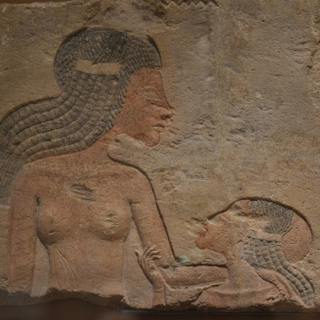
Recorded 2024. The daughters of Akhenaten and Nefertiti were not just "ornaments" for their parents. Like many princesses, they also participated in the religious rituals and royal pageantry of the Egyptian government. In this interview, Courtney Marx (MA, George Mason University) joins us on behalf of the American Research Center in Egypt, to discuss the Amarna princesses and their role as priestesses. We also explore the history of royal women as priestesses and the unique roles they played in the temple rituals. Finally, we explore the aftermath of Amarna: how the visible roles, titles, and imagery of princesses changed following the death of Akhenaten and Nefertiti. The American Research Center in Egypt is celebrating 75 years of work in the Nile Valley. Dedicated to scholarship of the ancient, medieval, and modern worlds, the ARCE supports researchers and students, funds archaeological and scholarly work, and organises many public outreach programs. Learn more about ARCE at their website and follow the ARCE Podcast online and on all podcasting apps. The History of Egypt Podcast Website: www.egyptianhistorypodcast.com. Support the show via Patreon www.patreon.com/egyptpodcast. Make a one-time donation via PayPal payments. Logo image: Block fragment showing two Amarna princesses (Metropolitan Museum of Art 1985.328.6). Photo by Courtney Marx. Select Bibliography (provided by Courtney Marx): Ayad, Mariam F. “The God's Wife of Amun: origins and rise to power.” In Carney, Elizabeth D. and Sabine Müller (eds), The Routledge companion to women and monarchy in the ancient Mediterranean world, 47-60. New York: Routledge, 2021. Ayad, Mariam F. God's Wife, God's Servant: The God's Wife of Amun (ca.740–525 BC). United Kingdom: Taylor & Francis, 2009. Bryan, Betsy M. “Property and the God’s Wives of Amun.” In D. Lyons and R. Westbrook, eds. Women and Property in Ancient Near Eastern and Mediterranean Societies. Washington, DC: Center For Hellenic Studies, Harvard University, 2005. Pawlicki, Franciszek. Princess Neferure in the Temple of Queen Hatshepsut at Deir el-Bahari: Failed Heiress to the Pharaoh’s Throne? Études et Travaux 21, 109-127. 2007. Xekalaki, Georgia. Symbolism in the Representation of Royal Children During the New Kingdom. Oxford: Archaeopress, 2011. Troy, Lana. “Patterns of Queenship in Ancient Egyptian Myth and History.” PhD diss., Uppsala University, 1986. Williamson, Jacquelyn. “Death and the Sun Temple: New Evidence for Private Mortuary Cults at Amarna.” The Journal of Egyptian Archaeology 103, no. 1 (June 2017): 117–123. Learn more about your ad choices. Visit megaphone.fm/adchoices

Jaksot(408)

210: Ramesses II The Eyes of Ra, The House of Life

210: Ramesses II The Eyes of Ra, The House of Life

Ramesses goes back to school. Luxor Temple is a magnificent monument, in a city full of them. The sanctuary you visit today is, in large part, the work of Ramesses' early reign. New pylons, colossal s...

30 Touko 202529min

209: Ramesses II vs the Sea Peoples

209: Ramesses II vs the Sea Peoples

Delta raiders. Decades before their famous migrations, the "Sea Peoples" were already active and visible in the eastern Mediterranean; and Ramesses II had his own dealings with these groups. In year 2...

16 Touko 202524min
Thutmose III & Hatshepsut: The New Kingdom Defined with Prof. Aidan Dodson

Thutmose III & Hatshepsut: The New Kingdom Defined with Prof. Aidan Dodson

The new royal tomb, and how two 18th Dynasty rulers defined the "New Kingdom" as we know it. Prof. Aidan Dodson is a dedicated and prolific scholar, whose research covers many facets of ancient Egypti...

9 Touko 20251h 30min

208: Ramesses II The Oracle & The Sphinx

208: Ramesses II The Oracle & The Sphinx

A death at Karnak, and a lion amongst men. In regnal year 1 (c.1292 BCE), Ramesses II was at Abdju / Abydos. While there, he appointed a new First Priest of Amun (Hem Netjer Tepy en Imen). He chose hi...

2 Touko 202529min

207: Ramesses II Shadow of Two Fathers

207: Ramesses II Shadow of Two Fathers

Ramesses had a lot to plan for, in his first year of rule (c.1292 BCE). Staying in Waset / Luxor, the new pharaoh began building work on his tomb (KV7) and his memorial temple (The Ramesseum). Archaeo...

25 Huhti 202543min

206: Ramesses II Usir-Ma'at-Ra

206: Ramesses II Usir-Ma'at-Ra

In the annals of Egyptian history there is no one quite like Ramesses II. He is arguably the most famous, or infamous, of Egypt’s pharaohs. His reign would be long (67 years!) and his influence would ...

18 Huhti 202547min
Sety's Borrowed Coffin with Dr. Peter Lacovara

Sety's Borrowed Coffin with Dr. Peter Lacovara

The coffin of Sety I (now in the NMEC) was probably reworked from an earlier piece, during the reburials in DB320 (the royal cache). But how can we tell? Dr. Peter Lacovara explains. Dr. Lacovara's w...

11 Huhti 202512min

205: Sety I The Finest Tomb

205: Sety I The Finest Tomb

Sety’s royal burial. Valley of the Kings tomb 17 (KV17) came to light in October 1817. Discovered by a team of Egyptian workers, employed by Giovanni Belzoni, the tomb is the most beautiful, and one o...

4 Huhti 20251h 33min

Suosittua kategoriassa Yhteiskunta

olipa-kerran-otsikko
siita-on-vaikea-puhua
kaksi-aitia
i-dont-like-mondays
gogin-ja-janin-maailmanhistoria
uutiscast
poks
antin-palautepalvelu
joku-tietaa-jotain-2
kolme-kaannekohtaa
sita
mamma-mia
aikalisa
yopuolen-tarinoita-2
lahko
rss-palmujen-varjoissa
rss-nikotellen
rss-murhan-anatomia
meidan-pitais-puhua
loukussa