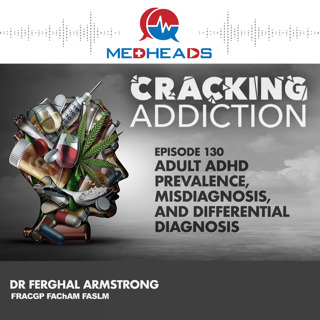
Adult ADHD: Prevalence, Misdiagnosis, and Differential Diagnosis
Cracking Addiction14 Helmi 2024

Adult ADHD: Prevalence, Misdiagnosis, and Differential Diagnosis

Dr. Ferghal Armstrong and Dr. Manu Bhatnagar delve into the complex and often misunderstood topic of adult ADHD. They discuss the prevalence of ADHD in adults, the potential role of environmental factors in its development, and the challenges in diagnosing and treating this condition in adulthood. Listeners will gain valuable insights into the differential diagnosis of ADHD, the potential impact of trauma and substance use on inattention, and the nuances of medication management for individuals with ADHD.

Keywords: Adult ADHD, diagnosis, differential diagnosis, trauma, substance use, medication management.


Learning outcomes:


1. Understanding the prevalence and presentation of adult ADHD: The episode sheds light on the prevalence of adult ADHD and how the symptoms may manifest differently in adults compared to children. Listeners will learn about the challenges in accurately diagnosing adult ADHD and the potential impact of environmental factors on its development.


2. Exploring differential diagnoses: The speakers discuss the importance of exploring differential diagnoses for acquired inattention syndrome, including substance use, PTSD, and borderline personality disorder. Listeners will gain insights into how these conditions may present similarly to ADHD but require distinct diagnostic and treatment approaches.


3. Examining the impact of trauma and substance use: The episode addresses the role of trauma and substance use in exacerbating inattention and emotional dysregulation. Listeners will understand the complex interplay between trauma, substance use, and the development of inattention symptoms, particularly in the context of ADHD.


4. Navigating medication management for ADHD: The speakers provide valuable insights into the complexities of medication management for individuals with ADHD, including potential comorbidities such as substance use disorders. Listeners will learn about the need for comprehensive treatment approaches that go beyond pharmacotherapy to address the functional impairments associated with ADHD.


Actionable takeaways:


1. Conduct a thorough differential diagnosis: When evaluating patients for suspected adult ADHD, consider a comprehensive differential diagnosis that encompasses trauma, substance use, and other mental health conditions that may present similarly to ADHD. This approach can ensure accurate diagnosis and tailored treatment plans.


2. Consider the impact of trauma and substance use: Take into account the potential impact of trauma and substance use on inattention and emotional dysregulation when assessing individuals for ADHD. By addressing underlying trauma and substance use issues, healthcare providers can better support individuals with ADHD.


3. Incorporate non-pharmacological interventions: Recognize the importance of incorporating non-pharmacological interventions, such as ADHD coaching and psychosocial support, alongside medication management for individuals with ADHD. This comprehensive approach can address the long-term functional impairments associated with the condition.


4. Advocate for comprehensive care: Encourage a multidisciplinary approach to the management of adult ADHD, involving collaboration between mental health professionals, addiction specialists, and primary care providers. By advocating for comprehensive care, healthcare providers can address the diverse needs of individuals with ADHD.


Insight: "All roads lead to Rome. So really, the inattentive prefrontal cortex is the final common pathway of the vast majority of mental health disorders, including substance use disorders." - Dr. Ferghal Armstrong


Hashtags: #ADHD #AdultADHD #MentalHealth #SubstanceUse #Trauma #Diagnosis #DifferentialDiagnosis #MedicationManagement #PsychosocialSupport #ComprehensiveCare

Jaksot(238)

Dopamine, Relapse, and Recovery: Why Addiction Needs Long-Term Management

Dopamine, Relapse, and Recovery: Why Addiction Needs Long-Term Management

A lot of people still think addiction recovery is just about willpower.But addiction neuroscience tells a different story: dopamine, the reward system, and relapse risk all help explain why recovery o...

25 Maalis 5min

Why You Can Be Detoxed and Still Addicted

Why You Can Be Detoxed and Still Addicted

Addiction neuroscience, dopamine, cravings: detox ends withdrawal, but it does not end addiction.The MythA common myth in addiction recovery is that once detox is over, the problem is solved. Many peo...

18 Maalis 5min

Relapse Happens to Everyone: Here's the Science Why - Addiction Basics 06

Relapse Happens to Everyone: Here's the Science Why - Addiction Basics 06

Dr. Fergal Armstrong reframes relapse in addiction, explaining why it's not a personal failure but a common part of the recovery journey, comparable to chronic illnesses. Understanding the neuroscienc...

11 Maalis 5min

The Science of Withdrawal: What's Actually Happening? - Addiction Basics #5

The Science of Withdrawal: What's Actually Happening? - Addiction Basics #5

Withdrawal is one of the most feared parts of addiction recovery.But neuroscience shows something important:Withdrawal isn’t a failure of willpower — it’s the brain restoring balance after long-term c...

4 Maalis 5min

Addiction vs Dependence vs Tolerance: The Critical Medical Difference

Addiction vs Dependence vs Tolerance: The Critical Medical Difference

🚨 TOLERANCE ≠ ADDICTION 🚨Most people — even healthcare professionals — use these terms incorrectly.And that confusion is hurting patients.In this episode, we break down:🧠 The real definition of add...

25 Helmi 5min

Why Buprenorphine Is Safer Than Full Opioid Agonists

Why Buprenorphine Is Safer Than Full Opioid Agonists

Most people think methadone is the only real option for opioid addiction.Wrong.Buprenorphine — especially long-acting injectable depot — is flipping the entire system upside down.No daily pharmacy vis...

23 Helmi 28min

How Cravings Work: Limbic System vs Prefrontal Cortex - Addiction Basics EP3

How Cravings Work: Limbic System vs Prefrontal Cortex - Addiction Basics EP3

Addiction neuroscience explains why wanting to quit isn’t the same as being able to quit. Dopamine reshapes the brain’s reward system.In Episode 3 of Addiction Basics, we tackle one of the most painfu...

18 Helmi 6min

Dopamine and Addiction: The Science of Cravings - Addiction Basics EP2

Dopamine and Addiction: The Science of Cravings - Addiction Basics EP2

Addiction neuroscience explained. Dopamine, cravings, brain recovery, and neuroplasticity — backed by research.If you’ve ever wondered how addiction works in the brain, this is the science most people...

12 Helmi 6min

Suosittua kategoriassa Terveys ja hyvinvointi

unicast
rss-hanna-tikander
voi-hyvin-meditaatiot-2
tiedenaiset-podcast
rss-pitaisko-erota
psykopodiaa-podcast
rss-narsisti
rss-kuumilla-aalloilla
vakeva-elama-viisaampi-mieli-vahvempi-keho
puhu-muru
junnut-pelissa
meditaatiot-suomeksi
rss-pt-paahtio
rss-kyykkya-ja-kuoharia
terapiassa
fitnessvastaanotto
katilon-kahvitunti
selviytyjat-tarinoita-elamasta
paritellen
rss-seuraava-potilas