The Futureverse: The World Will Be a Better Place in 5, 50 and 500 Years

The Futureverse: The World Will Be a Better Place in 5, 50 and 500 Years

We live in a time of greater uncertainty than ever before in human history. We are poised between the twin precipices of climate change and rapidly accelerating technological development. How we manage them will determine whether our future is one where humans will thrive, falter or something in between. Welcome to the Futureverse – brought to you by Intelligence Squared and Y TREE – a space to explore the ideas that will shape our future. In this episode, three leading thinkers come together to debate the motion, ‘Will The World Be A Better Place in 5, 50 and 500 Years?’ The sculptor Sir Antony Gormley champions the role of art in public spaces in a future society that puts community and care at its centre. Climate change activist Clover Hogan argues that the next ten years will be crucial for determining the next 50. Tech entrepreneur and former chief business officer at Google X, Mo Gawdat considers how we can imbue AI with values aligned to those of humanity. Expertly hosted by broadcaster Jon Sopel, this is a conversation that is guaranteed to change the way you think about the future. Learn more about your ad choices. Visit podcastchoices.com/adchoices

Tämä jakso on lisätty Podme-palveluun avoimen RSS-syötteen kautta eikä se ole Podmen omaa tuotantoa. Siksi jakso saattaa sisältää mainontaa.

Jaksot(1642)

Has Tech Lost All Humanity? With Mark Little

Has Tech Lost All Humanity? With Mark Little

The internet was once imagined as a place that would bring us closer together – a shared space for curiosity, creativity and connection. So how did it become a machine for capturing our attention, amp...

18 Syys 42min
Luke Harding and Alastair Campbell: Trump, Putin and the New Age of Conquest (Part Two)

Luke Harding and Alastair Campbell: Trump, Putin and the New Age of Conquest (Part Two)

The post-war international order is under increasing strain. The principle that borders cannot be changed by force is being challenged –not only by Russia’s invasion of Ukraine, but by Donald Trump’s ...

15 Syys 36min
Luke Harding and Alastair Campbell: Trump, Putin and the New Age of Conquest (Part One)

Luke Harding and Alastair Campbell: Trump, Putin and the New Age of Conquest (Part One)

The post-war international order is under increasing strain. The principle that borders cannot be changed by force is being challenged –not only by Russia’s invasion of Ukraine, but by Donald Trump’s ...

13 Syys 33min
Francis Fukuyama on the New World Order (Part Two)

Francis Fukuyama on the New World Order (Part Two)

Francis Fukuyama is one of the most influential political thinkers of our time. His famous 1989 essay, The End of History? – written as the Berlin Wall fell and communism collapsed – posed a provocati...

12 Syys 39min
What Comes After the End of History? with Francis Fukuyama (Part One)

What Comes After the End of History? with Francis Fukuyama (Part One)

Francis Fukuyama is one of the most influential political thinkers of our time. His famous 1989 essay, The End of History? – written as the Berlin Wall fell and communism collapsed – posed a provocati...

10 Syys 36min
The New Silencing: Women Versus the Manosphere (Part Two)

The New Silencing: Women Versus the Manosphere (Part Two)

When the MeToo movement ignited in 2017, many believed it would be a turning point for women after which positive change would become inevitable. And for a brief time, it felt like the world was final...

8 Syys 34min
The New Silencing: Women Versus the Manosphere (Part One)

The New Silencing: Women Versus the Manosphere (Part One)

When the MeToo movement ignited in 2017, many believed it would be a turning point for women after which positive change would become inevitable. And for a brief time, it felt like the world was final...

6 Syys 37min
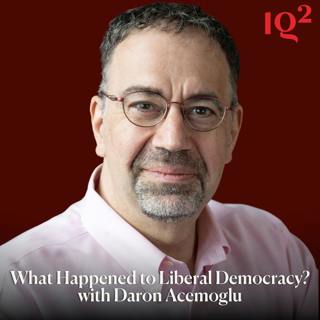
Why Did the Working Class Abandon the Left? With Nobel Economist Daron Acemoglu

Why Did the Working Class Abandon the Left? With Nobel Economist Daron Acemoglu

Liberal democracy was once a radical force. It challenged monarchies, expanded political rights and, at its most successful, helped deliver rising wages and shared prosperity. So how did it become ass...

5 Syys 37min
Suosittua kategoriassa Politiikka ja uutiset

uutiscast
vallattomat
aikalisa
politiikan-puskaradio
rss-viihde-media
ootsa-kuullut-tasta-2
rss-vaalirankkurit-podcast
rss-ootsa-kuullut-tasta
rss-voi-venaja
et-sa-noin-voi-sanoo-esittaa
rss-raha-talous-ja-politiikka
tervo-halme
otetaan-yhdet
rss-asiastudio
rikosmyytit
rss-kaikki-uusiksi
rss-ulkopoditiikkaa
rss-seksicast
rss-pinnalla
the-ulkopolitist