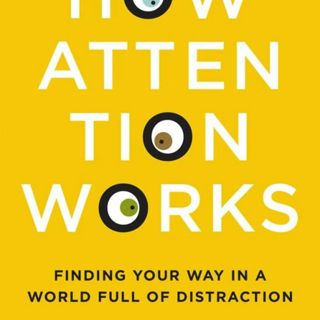

How Attention Works: Finding Your Way in a World Full of Distraction

How Attention Works: Finding Your Way in a World Full of Distraction

Stefan Van der Stigchel discusses how we filter out what is irrelevant so we can focus on what we need to know. We are surrounded by a world rich with visual information, but we pay attention to very little of it, filtering out what is irrelevant so we can focus on what we think we need to know. Advertisers, web designers, and other "attention architects" try hard to get our attention, promoting products with videos on huge outdoor screens, adding flashing banners to websites, and developing computer programs with blinking icons that tempt us to click. Often they succeed in distracting us from what we are supposed to be doing. In How Attention Works, Stefan Van der Stigchel explains the process of attention and what the implications are for our everyday lives. The visual attention system is efficient, Van der Stigchel writes, because it doesn't waste energy processing every scrap of visual data it receives; it gathers only relevant information. We focus on one snippet of information and assume that everything else is stable and consistent with past experience; that's why most people miss even the most glaring continuity errors in films. If an object doesn't meet our expectations, chances are we won't see it. Van der Stigchel makes his case with examples from real life, explaining, among other things, the limitations of color perception (and why fire trucks shouldn't be red); the importance of location (security guards and radiologists, for example, have to know where to look); the attention-getting properties of faces and spiders; what we can learn from someone else's eye movements; why we see what we expect to see (magicians take advantage of this); and visual neglect and unattended information.

Tämä jakso on lisätty Podme-palveluun avoimen RSS-syötteen kautta eikä se ole Podmen omaa tuotantoa. Siksi jakso saattaa sisältää mainontaa.

Jaksot(576)

Are Capitalism and Democracy Fundamentally Incompatible? A Conversation with Mordecai Kurz

Are Capitalism and Democracy Fundamentally Incompatible? A Conversation with Mordecai Kurz

Today I'm speaking with Mordecai Kurz, Joan Kenney Professor of Economics Emeritus at Stanford University. We are discussing his latest book, Private Power and Democracy's Decline: How to Make Capital...

9 Heinä 1h 3min

Joe P. L. Davidson, "Saving Utopia: Imagining Hopeful Futures in Dystopian Times" (MIT Press, 2026)

Joe P. L. Davidson, "Saving Utopia: Imagining Hopeful Futures in Dystopian Times" (MIT Press, 2026)

There is no alternative. The End of History. Climate Apocalypse. It seems that our contemporary moment is defined by the idea that things can only get worse or, in the most optimistic reading, perha...

17 Kesä 1h 4min

Michael Brownstein et al., "Somebody Should Do Something: How Anyone Can Help Create Social Change" (MIT Press, 2025)

Michael Brownstein et al., "Somebody Should Do Something: How Anyone Can Help Create Social Change" (MIT Press, 2025)

A novel and scientific approach to creating transformative social change—and the surprising ways that each of us can help make a real difference. Changing the world is difficult. One reason is that th...

6 Kesä 1h 11min

Rahul Mukherjee, "Unlimited: Aspirational Politics and Mobile Media Distribution" (MIT Press, 2026)

Rahul Mukherjee, "Unlimited: Aspirational Politics and Mobile Media Distribution" (MIT Press, 2026)

Around 2016, buoyed by so-called data kranti  ("data revolution"), an aspirational neo-middle class of users in India accessed internet for the first time on their mobile phones. Unlimited: Aspiration...

2 Kesä 1h 1min

Yosef Grodzinsky, "How Deeply Human Is Language?: Chomsky, the Brain, and the AI Fantasy" (MIT Press, 2026)

Yosef Grodzinsky, "How Deeply Human Is Language?: Chomsky, the Brain, and the AI Fantasy" (MIT Press, 2026)

How Deeply Human Is Language? Chomsky, the Brain, and the AI Fantasy (MIT Press, 2026) is Yosef Grodzinsky’s exploration of the criticality of the linguistic theories to the design of LLMs. The book ...

24 Touko 48min

Aymar Jèan Escoffery, "Reparative Media: Cultivating Stories and Platforms to Heal Our Culture" (MIT Press, 2025)

Aymar Jèan Escoffery, "Reparative Media: Cultivating Stories and Platforms to Heal Our Culture" (MIT Press, 2025)

Can producing stories and developing platforms to support people who have been harmed by multiple, intersecting systems heal those systems? In Reparative Media: Cultivating Stories and Platforms to He...

15 Touko 1h

Silvia Danielak, "Peace Infrastructures: How UN Peace Operations Build Roads, Bridges, and Solar Farms in the Pursuit of Sustainability" (MIT Press, 2026)

Silvia Danielak, "Peace Infrastructures: How UN Peace Operations Build Roads, Bridges, and Solar Farms in the Pursuit of Sustainability" (MIT Press, 2026)

Roads, bridges, a renewable power plant, and an electricity grid: UN peacekeepers might be unusual infrastructure builders, but they’re certainly not unambitious. Since the beginning of the UN’s peace...

15 Touko 34min

Scott Solomon, "Becoming Martian: How Living in Space Will Change Our Bodies and Minds" (MIT Press, 2026)

Scott Solomon, "Becoming Martian: How Living in Space Will Change Our Bodies and Minds" (MIT Press, 2026)

How living in space will affect future generations—and what the potential unintended consequences of space settlements are.We are on the cusp of a golden age of space travel in which, for the first ti...

30 Huhti 1h 1min

Suosittua kategoriassa Koulutus

rss-murhan-anatomia
psykopodiaa-podcast
rss-arkea-ja-aurinkoa-podcast-espanjasta
voi-hyvin-meditaatiot-2
rss-liian-kuuma-peruna
rss-narsisti
kesken
adhd-podi
rahapuhetta
rss-luonnollinen-synnytys-podcast
rss-vuosikymmenen-ilmastoteko
aamukahvilla
aloita-meditaatio
jari-sarasvuo-podcast
filocast-filosofian-perusteet
ihminen-tavattavissa-tommy-hellsten-instituutti
rss-psykalab
rss-laadukasta-ensihoitoa
salainen-paivakirja
rss-tietoinen-yhteys-podcast-2