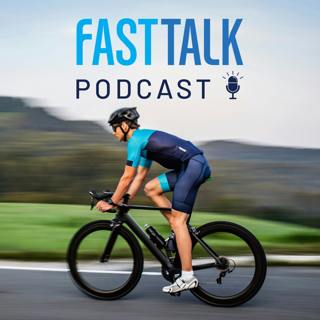
138: Q&A on Training Without Power, Optimizing Time at Your Desk, “Lunch Ride Syndrome,” and the Benefits of Fixies, with Amos Brumble
Fast Talk19 Marras 2020

138: Q&A on Training Without Power, Optimizing Time at Your Desk, “Lunch Ride Syndrome,” and the Benefits of Fixies, with Amos Brumble

Amos Brumble is a New England legend. Is it because of his racing palmarès? His charm? His collection of guinea pigs? Or all of those things? We find out, and then we dive into some listener questions. David H. of Seattle, Washington asks: “Suppose a 55-year old athlete is training with a heart rate monitor and perceived effort and recovery scales and is able to train between 10-16 hours/week. No power measurements. The athlete's goal is to maximize performance on gravel races—about 100 miles and about 10,000 feet of climbing—which, with the exception of the first 20 miles or so, basically means a long time trial effort. Given that goal and training context, how would you recommend that a training plan be structured? I ask this question because so much of the discussion on your podcast references power. I understand why, but I don't have a power meter in part, for cost, and in part because heart rate is enough 'quantification.' I'm interested in the meaning and aesthetics of riding hard.” The next series of questions on low-cadence work comes from Ray Farris: “My impression from your podcast is that the low cadence sessions talked about in the session were fairly short efforts at high power. However, Steve Neal of the Cycling Gym, whom you have had on Fast Talk a couple of times, seems to like to give his athletes sessions of several intervals of 20-40 min at low cadence at tempo power, generally 83% of FTP, subject to an 83% of max heart rate limit on power. And I just watched a Lionel Sanders YouTube video in which his coach had him do multiple sessions of 40 minutes at 50-60rpm at what I roughly estimate is about 80% of FTP. What’s the thinking about these types of interval workouts? 1) Do these build FTP? 2) Are these “hard” workouts in the Seiler polarized model? Do they have a place in a polarized model and if so what is it and when is it in terms of periodization blocks? 3) Do these raise the athlete toward his theoretical VO2 max, but at the cost of lowering VLa max? Does this trade-off even matter for anyone other than pro level sprinters?” Our next question comes from Russ Sanka, in Bristol, Tennessee. And it’s a good one for anyone who has a desk job. He asks: “What can I do at a desk job to aid in training/recovery? I have been using a stand up desk and a desk cycle I would like to hear your opinions and the research on the subject.” This next question comes from Ivan S. from Milan, Italy. He asks: “I love to ride my fixie in the ‘off-season’ to train on. I feel like it helps me with training and strength that I can’t get on a geared bike. Is this true? If so, what am I gaining and how does that help me when I go back to the geared bike?” Our final question comes from Peter Burghardt. He asks: “Can you address 'lunch ride syndrome'—the tendency to go out the door and immediately hammer down because you've only got 45 minutes. Do you have suggestions for lunch ride workouts of an hour or less?” Learn more about your ad choices. Visit megaphone.fm/adchoices

Jaksot(456)

8: Stop your legs from fighting (themselves)

8: Stop your legs from fighting (themselves)

Want some free watts? Your legs are fighting themselves, and we want them to stop. Episode 8 is all about neuromuscular training, decreasing what is called coactivation, which is when your muscles act...

8 Joulu 201638min

7: Cold, bare legs make you dumb, not tough

7: Cold, bare legs make you dumb, not tough

Why do you need to cover your legs when it’s cold? It’s not about comfort, it’s about getting the most out of your training. We dig into the physiology behind pedaling in cold weather and offer up a f...

1 Joulu 201639min

 6: Like it or not, you should be lifting

6: Like it or not, you should be lifting

Is it enough to just ride your bike for training? In this episode of Fast Talk, we explain why serious cyclists should be spending time in the gym, incorporating weight lifting into their weekly progr...

17 Marras 201628min

5: How much speed can $2,000 buy?

5: How much speed can $2,000 buy?

Can you buy speed? Yes, if you spend wisely. Fretz and Connor are joined by tech experts Dan Cavallari and Kristen Legan, and they try to answer a simple hypothetical: If you have $2,000 to spend and ...

4 Marras 201642min

4: The myth of the useless HR monitor

4: The myth of the useless HR monitor

You thought you could ditch that heart rate strap since you bought a power meter? Think again. In episode 4, coach Trevor Connor and editor Caley Fretz are joined by one of the world’s leading cycling...

21 Loka 201642min

3: How to structure your training plan

3: How to structure your training plan

Episode 3 is all about execution of solid training program with limited time. The theme remains the same as episode 2, but the discussion moves from theory to practice. Precisely how should you struct...

7 Loka 201622min

2: High vs. low intensity

2: High vs. low intensity

The VeloNews Fast Talk podcast is your source for the best advice and most interesting insight on what it takes to become a better cyclist. Listen in as VeloNews columnist Trevor Connor and editor Cal...

23 Syys 201625min

1: Why you aren’t a pro

1: Why you aren’t a pro

The VeloNews Fast Talk podcast is your source for the best advice and most interesting insight on what it takes to become a better cyclist. Listen in as VeloNews columnist Trevor Connor and editor Cal...

9 Syys 201630min

Suosittua kategoriassa Tiede

tiedekulma-podcast
rss-mita-tulisi-tietaa
rss-poliisin-mieli
utelias-mieli
rss-metsantuntijat-podcast
rss-duodecim-lehti
mielipaivakirja
rss-luontopodi-samuel-glassar-tutkii-luonnon-ihmeita
docemilia
filocast-filosofian-perusteet
menologeja-tutkimusmatka-vaihdevuosiin
rss-bios-podcast
rss-astetta-parempi-elama-podcast
rss-tiedetta-vai-tarinaa
rss-lapsuuden-rakentajat-podcast
rss-sosiopodi
rss-miljonaarien-tasavalta