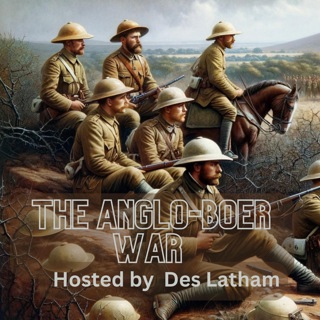
Episode 39 - General Buller defeats the Boers at Allemansnek and enters the Transvaal
We’re up to episode 39, and we’re concentrating on the Natal front - or what was known as the Eastern Front. The Natal town of Ladysmith was relieved by General Sir Redvers Buller on 28 February 1900, following the battle of the Thukela Heights. Buller rode into the town on 1 March 1900 and if you’ll remember, made movie history by being the first general filmed entering a town to relieve a siege. On 19 May, Buller planned the next stage. The Boers had crossed the Drakensberg at Lang's Nek and those who could be persuaded to remain had established well concealed trenches on either side of the pass. Realizing this, Buller decided to create the impression that Lang's Nek was his target, rather than his true objective which was actually Botha's Pass named after the Boer Leader, Louis Botha. The 4th Brigade and the 1st West Surrey Regiment were ordered to form the advance guard. They marched to Ingogo or what the Boers called Schuinshoogte where they bivouacked for nine days. Their camp could be clearly observed as usual by the burghers from their positions at Lang's Nek. Lyttelton's division commenced clearing the Doornberg to the south-east near Landman's Drift, while general Hildyard reached Utrecht on 29 May. After a considerable amount of discussion, the landdrost or magistrate formally surrendered the town of Utrecht and the Boers retreated, taking up a position on the hills above in return for the assurance by the British that Utrecht would not be shelled if they remained there. The Transvaal flag and six rifles were taken away as a sign of submission and Buller's proclamation of surrender by the town was posted up on its notice boards. But Hildyard had hardly left Utrecht before the Boers returned, re-occupied the town, tore down the proclamation and arrested the landdrost who had surrendered. Despite the comical aspect of this incident, it proved once again how adept Buller's commanders were at wasting time. He had halted in Newcastle for no less than sixteen days and had failed to move further than Ingogo and Utrecht. Meanwhile Lyttelton moved his division northwards having cleared Christiaan Botha's force from the Doornberg, and advanced as Wakkerstroom in the eastern Traasvaal which he captured on 13 June. So at this stage that we shall leave Lyttelton and return to Buller and the remainder of the Natal Army. It may be recalled that during the vacillation following the relief of Ladysmith, Lord Roberts eventually gave up any hope of co-operation from Buller and informed him by telegram on 25 May that he could manage without him.
17 Kesä 201826min
Episode 38 - Roberts marches into Pretoria but de Wet assaults Roodewal
For those who’ve followed this story from our start in October you know that we’re tracking the weeks of the war itself, and it’s now the first week of June 1900. This moment is what Lord Roberts has been waiting for - the triumphant march into the Transvaal Capital Pretoriathus putting an end to the uppity Boers. But there’s more bad news mixed with the good for the British. Christian de Wet, Koos de la Rey and Louis Botha along with other Boer leaders, are going to make the English lives a misery over the next 24 months, so Roberts and his men may as well enjoy the Indian Summer while they can. In the traditional mode of warfare in Europe, the army arrives at the capital, destroys the opposing army, the generals hand over their swords, the monarchy or political leadership kow tows and the war is over. Reparations and various modes of punishment follow. As Napoleon found out when he ransacked and burnt Moscow, its not that simple. And in Africa, things are far more complex. Often there’s no capital, there’s no proper army, there’s just an vague hint of force - then its gone. Its like a myth, a legend and momentarily it appears to cut your throat or knock your commander from his horse at a distance of 2 kilometers. For proper soldiers brought up on dignified marches and saluting, parade ground discipline, stratified leadership, court martials and empire states, the war in Africa is still infuriating and mysterious. General Christian de Wet was about to attack Roodewal Station in the Free State, way behind British lines, in an incident which shook the British and caused the loss of half a million pounds of goods - which in 1900 was a real fortune.
10 Kesä 201820min
Episode 37 - Johannesburg falls to the British
We are into week 37 of this series and Johannesburg lies before Lord Roberts’ army. But he’s using a Velvet Glove which in retrospect is one of the biggest bungles of his career. While he frets over the details in Johannesburg, Colvile is given a severe case of bloody nose by the Boers in Lindley in the Free State. Lord Robert’s large army has made its way over 1400 kilometers from Cape Town to Johannesburg, and in the north, the Transvaal Republic Capital Pretoria awaits his khaki dressed soldiers. The mines are safe, and that’s been one of the main worries facing the British commander as he marched northwards, with Oom or Uncle Paul Kruger the Boer President threatening to blow them up, while his General, Louis Botha, was threatening to protect these mines saying it would be cowardly to destroy them. Lord Roberts thought it best to allow the Boers to withdraw as the commander of Johannesburg, a Mr Krause, asked that the last commandos be allowed out and avoid the killing of women and children who remained in the city. Their commander in chief, their hero Kruger, remained at large. For black workers in Johannesburg It must have been an utter shock to discover that the English were not their saviours, that the plan was to force the 14 000 back to role serving the gold mine owners for measly few shillings a month.
3 Kesä 201821min
Episode 36 - The Battle of Doornkop near Johannesburg & Churchill rides a bicycle
This episode is going to concentrate on the minutiae of the British army surrounding the city of Gold, Johannesburg. Its the city that was the main cause of this war with its gold and uitlanders or immigrants, who were mainly English speaking and had demanded the right to vote in the Transvaal. It was Kruger who denied them this vote knowing that his government would disappear under the weight of the uitlander city men and women who were colonials through and through and his culture would end. That was the belief. For black Johannesburgers who lived under the harsh Calvinistic overtones of the Boer rule, it was the possibility of freedom that beckoned. Little did they know that the British would impose far harsher rule on blacks than the Boers, and in fact the British adherance to their imperial bureaucracy meant that the weak control over black movement for example would be beefed up with the arrival of the super-efficient British Empire. So as the townships of the Witwatersrand echoed with happy sounds as black residents waited in expectation for the British arrival, the Boer administrators were rushing to empty the city of all its valuables. Twenty six kilometres away to the south west, Roberts was coming to visit. The main song sung by troops in his army was “We’re marching to Pretoria” which became a clarion call and a morale booster during tough times. The pattern of the advance rarely faltered, and surprised even Lord Roberts and one of the most famous war reporters riding alongside - Winston Churchill. He’d already been imprisoned and escaped from Pretoria, only to return to report for the Morning Post newspaper on the battles since. However, Churchill was beginning to have his doubts about the British role in this war.
27 Touko 201824min
Episode 35 - Mafeking becomes a verb
It’s been a brutal seven months but for the English, they are beginning to see the light at the end of the tunnel. Or so it appears, because as the joke goes, the light at the end of the tunnel could be an oncoming train. The Boers are falling back across a broad front, to the East in Natal, General Redvers Buller finally has found his military mojo and is approaching the Boer lines across the Biggarsberg to the north of Ladysmith. This is where the Highveld or the high plains of South Africa lie, and between him and the plains are Boers ensconsed in the three main passes. In the centre, and about to cross the Vaal River, is Lord Roberts with his massive army of around 50 000 marching steadily towards Pretoria, and in the West, Lord Methuen’s unit under Mahon is moving up towards Mafeking and Plumer is north of the same town - they plan to join up there with the Canadians who approached via Beira in Portuguese East Africa. Throughout South Africa, the British plan is finally falling into place. It has taken seven months to subdue the Boers and now for the first time in this conflict, the British Empire appears just that. If you can cast your mind back to October 1899 when the Anglo-Boer war burst onto the global consciousness, the British really believed they’d crush these insolent burghers in the space of a few weeks.
20 Touko 201823min
Episode 34 - Crossing the Vaal and a Finishing Touch in Mafeking
The ongoing march north by Lord Robert’s army continues, and also swing around to Mafeking just before Plumer’s relieving force arrives because the Boers have a surprise in store for the towns’ commander in chief, Lord Baden-Powell. The British had accomplished half their journey to Pretoria, and it was obvious that on the south side of the Vaal no serious resistance awaited them. Burghers were freely surrendering themselves with their arms, and returning to their farms again. Although as we’ve already heard, many of these surrendered arms were delapidated single shot elephant guns or even muskets. Surrendering Boers were burying their valuable Mausers and ammunition and biding their time. In the south-east Rundle and Brabant slowly advanced, while the Boers who faced them fell back towards the Vaal River. In the west, Hunter had crossed the Vaal at Windsorton, and Barton's Fusilier Brigade had fought a sharp action at Rooidam, while Mahon's Mafeking relief column had slipped past the Boer flank, escaping the observation of the British public, but certainly not that of the Boers themselves. The casualties in the Rooidam action were nine killed and thirty wounded, but the advance of the Fusiliers was irresistible, and for once the Boer loss, as they were hustled from kopje to kopje, appears to have been greater than that of the British. The Boer forces fell back after the action along the line of the Vaal, making for Christiana and Bloemhof in the far north of Orange Free State republic. Hunter entered into the Transvaal in pursuit of them, being the first to cross the border, with the exception of raiding Rhodesians early in the war. Meanwhile Methuen was following a course parallel to Hunter but south of him, Hoopstad being the immediate objective. As Arthur Conan-Doyle writes in his history of the Boer War, “The little union jacks which were stuck in the war maps in so many British households were now moving swiftly upwards.”
13 Touko 201825min
Episode 33 - Lord Roberts takes Kroonstad & the Canadians march
Mafikeng is still besieged, but columns of British soldiers are advancing on the town from both the North and South. The Boers are falling back across both the Free State and Natal fronts. President Steyn of the Free State is about to retreat still further north from his temporary capital, Kroonstad, while in the Natal theatre of operations, the Boers are finding General Redvers Buller more than a match as the burghers vascillate between farming and fighting. Its been seven months of grind in a war that the British thought would take a few weeks. It was supposed to be a relatively inexpensive clash launched ostensibly to secure the important gold mines of Johannesburg for the Empire but has become expensive and politically taxing. Before quitting Kroonstad which is around 120 kilometers north of Bloemfontein on the main road and railway line from the Cape to Johannesburg .. a number of crucial meetings have been held by the Boers. These are led by President Steyn who continues to be a source of strength for the defenders, secure in his knowledge that they are fighting a just war against an invasion of Empire. But as we know, believing your cause is just doesn’t mean success is guaranteed
6 Touko 201820min
Episode 32 - The English swarm over South Africa
This is episode 32 - the English swarm over South Africa. I have borrowed the title from a Chapter in Christian De Wet’s book published in 1902 called "Three Years War" and this week we will prepare to march with British Army commander in chief Lord Roberts towards his goal, Pretoria. Its also a perfect moment to take a closer look at some of the international soldiers fighting on the side of the Boers and spend some time with Deneys Reitz in the saddle and sniping at the British as they roll across the veld. And a big shout out to thank all the listeners who’ve sent me messages of support and for your suggestions. There’re too many to mention all but in particular to Stoffel Nel for the background and research material, thanks for sharing its helped greatly. And Kevin Jackson who has sent photographs of a Boer War memorial in Nelson, New Zealand’s south island, I’ve loaded these on the website and Facebook page - thanks so much. To Mike in the U.S. who’s asked for more maps to be published on the website, I’ve scanned a few more and other interesting tit-bits including adverts of the time and you can find them at the ABWARPODCAST.COM website this week. To Jacques Holland’s who has been so supportive as well as Louw de Beer, thanks for the review and Bill Yeo, thank you for the wonderful words and messages. Chantal Geldenhuys, thank you too along with Daniel Cuevas Fisch. The interest in this series has gone global which is both surprising and heartwarming. It has had many downloads from places like Singapore and even Seoul in South Korea which was completely unexpected. In this week's episode, there’s a disconnect here between the goal and what really accounts for victory. As with other commanders, Lord Roberts who now leads a large army of 50 000 men believes once Pretoria is taken, the Boers will be beaten. While he was plotting his next moves, Lord Kitchener had not been idle, leading a column through April to De Aar which is in the Cape. Another column led by Sam Hughes an intelligence officer, had managed to make it all the way north to Upington on the edge of the Desert. During April and much of May 1900, small scale skirmishes dominate. Boer Commander Jooste who’d held Upington had made a strategic withdrawal to the Orange River through what’s known as Griqualand, and eventually into the Transvaal. It’s also time to investigate the lesser known stories around the war - with its international significance at the time, largely forgotten as we forge ahead in the 21st century. For example, Canadian troops were the main force known as the Karoo Expedition between March and April 1900 but disease continued to play havoc. On the way into the Karoo a dozen men fell ill and one died, but by the time they exited the semi-desert Karoo in March, fifty men were extremely sick with dysentry and enteric. A number of horses had given out and had to be shot, with many of the mounted infantry in the Canadian 1st Battalion mounted rifles preferring to walk alongside their emaciated horses and in some cases, feeding them hard tack biscuits and suffering hunger themselves.
29 Huhti 201824min