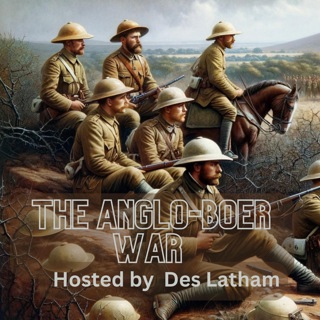
Episode 23 - Kitchener, Cronje and the Battle of Paardeberg
The siege of Kimberley has been lifted and the enigmatic and colorful General French and his 5000 strong cavalry are in charge of the city. The Boers have withdrawn just in time to avoid being caught by the flying column which had itself suffered from the speed of the trip between the Riet River and Kimberley. We heard last week how hundreds of horses dropped dead and the great flying columm was now a limping wreck, only about 1400 horses remained in operational health. De Beer’s diamond kingpin Cecil John Rhodes had demanded he be saved and his wailing had led to the rush to Kimberley. But in so doing, French had overstretched his horses and men and they were exhausted. The commander in Chief of the British Army Corps, Lord Roberts, was tracking the boer force of around 5000 which had retreated north eastwards towards Bloemfontein from their trenches. It was a strange cavalcade, oxwagons and horses and carts with the Boers entire families on board, moving at around 20 kilometers a day. So we arrive at another destructive battle where Lord Kitchener was to play an unfortunate role and condemned hundreds of his own men through his infatuation with action.
25 Helmi 201820min
Episode 22 - The relief of Kimberley
We’re up to Episode 22 in this series, and this week the story shifts to Kimberley itself. Earlier - around podcasts 2 and 3, I described how this town was really in the hands of the de Beers Mining company with its CEO, Cecil John Rhodes, very much in charge of affairs. However, the actual military commander in chief of the town was Lieutenant colonel RG Kekewitch. And in this town there had been a four month struggle between Kekewitch and one of the world’s richest men at the time, Cecil John Rhodes. So it worked like this - Rhodes was de Beers, and de Beers was Kimberley. His colossal ego had reduced the siege at times to a dangerous melodrama. Rhodes had implied during the siege that if the British didn’t hurry up and rescue him, he may hand over the town to the Boers. We need to go back a few days in February to reveal what was happening, and how Lord Roberts who was in command of the British Army Cops and based just south of Kimberley near the Modder River, lost patience with Rhodes and ordered Kekewitch to lock up any one who threatened surrender to the Boers.
18 Helmi 201822min
Episode 21 - Lord Roberts’ Steamroller
After the last few weeks of skop skiet and donder - which means kick, shoot and beating (In Afrikaans) - we’re shifting our gaze back to the Western Reaches of South Africa, back towards the Cape and Kimberley. There are many subtleties at play here which we must address. General Redvers Buller has been demoted as Commander in Chief of the British Army Corps in South Africa, and his replacement Lord Roberts has already arrived in Cape Town. The original British plan was to drive a large army straight up the centre of South Africa northwards towards Pretoria, driving the Boers before this grand force. It was Buller who changed his mind in November and split the force in order to attempt to relieve 13000 men trapped in Ladysmith. The result had been catastrophic for his army as they were defeated in two big battles at Colenso in December and at Spion Kop in January. Now Lord Roberts' 40 000 strong force begins it march northwards.
11 Helmi 201824min
Episode 20 - The Acre of Death part 3
It’s 24th January 1900 and the battle of Spion Kop has been under way for ten hours. More than 1000 British soldiers are casualties and the entire senior officer corps on the summit of the mountain are dead. General Redvers Buller who’d put two thirds of his Natal Army in the hands of the newly arrived General Warren now realised that things had gone from bad to worse on the top of Spion Kop. This was supposed to be a two pronged attack with Warren on controlling 2/3rds of the force and strangely, the commander Buller with 1/3rd followed by a push straight to Ladysmith. But it didn’t quite work out that way.
4 Helmi 201823min
Episode 19 - The Acre of death, Spion Kop part 2
This week we continue with the battle of Spion Kop and as you’ll hear, its a battle that horrified those who took part with its hand-to-hand fighting, terrible artillery barrages and massacre of British troops who’d been trapped on the summit of Spion Kop where there was no escape from the Boer Mauser rounds. It’s also a tale of confusion which is often what happens in war. One of the people involved in this clash is 17 year-old Deneys Reitz who published his book called “Commando” in 1902. It’s a remarkable story about a remarkable life and the best minute-by-minute chronicle of Spion Kop. One of the major ironies is that Deneys Reitz ends up fighting in the First World War on the British side on the Western Front, commanding a unit of the Royal Scots Fusiliers in 1918.
28 Tammi 201825min
Episode 18 - The Acre of death – the Battle of Spion Kop part 1
It's January 1900 and we're at the eponymous battle of Spion Kop. In part one of the two part coverage of the battle, we will take a look at preparations for the battle and discuss the tactics. Right now its January 1900 and it’s midsummer in South Africa, heat waves top 40 degrees celcius in places and in the region close to Ladysmith in Natal, humidity adds to the uncomfortable conditions. The high temperatures create violent thunderstorms which can drench the parched landscape in more than 30 millimeters of rain in half an hour. Rivers that wind languidly through deep canyons surrounded by thick bush suddenly turn into gushing monsters that sweep all before them. And one of the most powerful is the Tugela River which the British must cross successfully along with their equipment in order to get to Ladysmith where 13 000 of their troops are besieged.
21 Tammi 201820min
Episode 17- The centipede approaches Spion Kop
We have arrived at the most momentous battle of the Boer War, the Battle of Spion Kop. Its notoriety continues to this day with war buffs traveling to the steep sided hill half an hours drive South West of Ladysmith in the Natal – or KwaZulu Natal as its now known. The battle highlighted the failure of the British Army and its leadership to understand the requirements of modern warfare. They failed to cope with powerful long range artillery and magazine rifle fire, they used outdated communication and intelligence gathering, their chain of command was still the same as the Napoleonic era and their leadership suffered from a lack of flexibility. You’d think that by now, after nearly three months of warfare in South Africa, that they would have reconsidered tactics. But imperialism and nationalism are hard coded in people’s minds, why change something that has led to an empire upon which the sun never sets?
14 Tammi 201814min
Episode 16 - Winston Churchill escapes but Spion Kop looms
Winston Churchill who had been captured near Chieverley on the railway line between Escourt and Ladysmith in October and was lucky not to have been shot on the spot. While ostensibly working as a war correspondent for the Morning Post newspaper, he really was more than an imbedded reporter. Churchill’s father was Lord Randolph, a British Lord and well-known politician. Churchill literally took over the situation when his train was ambushed and issued orders to the commander who followed his orders. The Boers capture of one the empire’s famous sons was deeply embarrassing for the British commander Redvers Buller. But Churchill's escape coincides with a terrible battle called Spion Kop which resonates to this day in so many ways.
7 Tammi 201817min