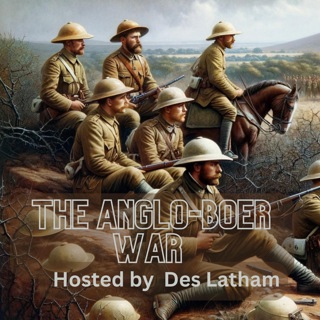
Episode 140 - General Cronje demands a St Helena mounted guard & Peace Talks back on in Pretoria
The Anglo-Boer War24 Touko 2020

Episode 140 - General Cronje demands a St Helena mounted guard & Peace Talks back on in Pretoria

The first large group of Boer prisoners were taken by the British at the battle of Elandslaagte on 21st October 1899. The army had failed to plan for prisoners because the idea was the Boers would be beaten in a few weeks so why spend money on POW camps? The first 188 Boers taken at Elandslaagte were temporarily housed with the naval guard in Simonstown on board the guard ship HMS Penelope. Several other ships were used as floating prisons until eventually permanent camps were established at Green Point, Cape Town, Bellevue and Simonstown. At the end of December 1900 more than 2500 Boers were placed on board the Kildonan Castle guardship where they remained for six weeks before they were removed to two other transports at Simonstown. The English army base at Ladysmith in Natal was used between December 1900 and January 1902 but was merely a staging area. Another staging area was established at Umbilo south of Durban in Natal where POWs would be placed on board ships and then routed to Cape Town. But it soon became clear that the Cape prisoner of war camps were targets for attacks and the British then shifted the burghers offshore. There were four main regions used to house Boer POWs, St Helena, Ceylon or modern day Sri Lanka, Bermuda and India. As you’ll hear in a moment, a few hundred were also taken to Portugal. During the war, the British captured around 56 000 Boer prisoners and eventually ran out of space in host countries. India was only used as a last resort after the other three main camps became overcrowded. Of course, the most feared of all these was the camp in St Helena, but by the end of the war disease was more rampant in the other regions – mainly because of the climate. St Helena has a fairly benign climate, its much cooler than Bermuda, Ceylon and India. One of the first contingents of Boers to arrive in St Helena included general Piet Cronje who was captured along with thousands of his men after the battle of Paardeberg in February 1900. Cronje and 514 his commando arrived on the island in the middle of the Atlantic after disembarking from the troopship Milwaukee on 27th February that year. Cronje had surrendered to Lord Roberts after being caught in the battle which shook the Free State Boers as Cronje was cornered with a powerful commando. Illustrating his arrival on the island of St Helena, Punch Magazine published a cartoon of the general saluting the ghost of Napoleon and saying “Same enemy, Same result..” Prior to the Boers arrival, the governor of St Helena RA Sterndale had published a proclamation which read : “.. His Excellency expresses the hope that the population will treat the prisoners of war with that courtesy and consideration which should be extended to all men who have fought bravely for what they considered the cause and their country” So as General Cronje prepared to make that winding march up the hill from the tiny port of Jamestown at St Helena, his men fully expected to be subjected to humiliation. Instead, there was silence, no jeering nor rude remarks, as the Boers passed the crowds of islanders on their way to Deadwood Camp inland. Being escorted along with Cronje was his wife, whom Lord Roberts had allowed to accompany her husband. The Boer general and his wife were accommodated at Kent Cottage, not in Deadwood Camp itself and were surrounded by a strong military guard which changed every day. Of course, Cronje was a general and for once, it was the Boers demanding special attention. Whereas the culture was supposedly based on a democratic principle of equality, Piet Cronje insisted that proper respect be shown to his rank and that a mounted guard should be provided.

Jaksot(143)

Episode 15 - Ladysmith and the Music of the Guns

Episode 15 - Ladysmith and the Music of the Guns

The last six weeks have been a short sharp shock for our British friends who’ve visited the veld and the semi-desert in the Northern Cape and the green hills of Natal. Things have moved apace since war was declared on October 10th. It’s Christmas 1899 and across South Africa, few people are feeling festive. In the South West, Methuen has been held up as he tried to race to Kimberley to relieve the siege and where the arch imperialist Cecil John Rhodes is residing, demanding a saviour rescue him. In Natal, a disaster befell the British at Colenso with over 1 thousand 130 casualties as Sir Redvers Buller tried to reach Ladysmith where 13 000 British soldiers were holed up - besieged. That led to Buller being fired as the commander in chief of forces in South Africa. Lord Roberts who was in Ireland was assigned the job of leading the Army Corps after Buller’s shambolic record and strategic blunders. Roberts, however, is still preparing to depart for Cape Town and there’s still time for Buller to create mischief and so he does as we’ll see next week with the terrible battle of Spion kop. If ever the word “carnage” summed up a singular event, its Spion Kop. But before we hear about Spion Kop our focus must shift this week into Ladysmith itself, where the small town on a railway line between the port of Durban and Johannesburg has become a strategic imperative. General Piet Joubert the Boer commander had surrounded the town and then betted on General White eventually surrendering without too deadly a clash. He was wrong. The British were not going to make the same mistake they made in 1881 after they were defeated at Majuba. This time they wanted the Boers to surrender in utter defeat whatever the human cost to both sides.

31 Joulu 201724min

Episode 14 - The end of Black Week

Episode 14 - The end of Black Week

It’s December 1899 and the British have already registered 3 000 casualties in various battles across South Africa. The latest we heard about was the Battle of Colenso on 15th December in Natal where the British casualty rate topped 1 130 with over 700 wounded and the result cost Commander in Chief General Buller his job . These are numbers that alarmed the public and the government back in London. The Boers had been perceived as a shambolic rabble ripe for the plucking, the gold bugs who owned the mines and financed the gold diggings back in Johannesburg had propagated and pushed for a war, now their brethren were paying the price in blood for their greed and their Imperialist aims. The Boers were no pushovers. In fact, in all major battles between October and December, they had consistently outfought and outthought the British across the country in different environments.

24 Joulu 201717min

Episode 13 - The Battle of Colenso

Episode 13 - The Battle of Colenso

So here we are, the battle of Colenso, December 15th 1899. Four Victoria Crosses were awarded in this clash but it also led to defeat for the British who stumbled repeatedly under the command of their beloved yet faulty Sir Redvers Buller. The Boers, although victorious, began to appreciate the true fire power their opponents possessed. It’s also a battle that led to the death of a Field Marshall’s son Freddie Roberts. The end of the battle saw the stretcher bearers called "bodysnatchers" which included Mahatma Gandhi. Queen Victoria's beloved grandson was wounded in this battle which was incredibly one-sided where the British lost over 1137 casualties, the Boers, around 38.

17 Joulu 201728min

Episode 12 - Buller, Botha, Gandhi and Colenso

Episode 12 - Buller, Botha, Gandhi and Colenso

We heard last week how General Methuen had been roundly defeated at the battle of Magersfontein in the Northern Cape and had withdrawn his force back to the Modder River. North east across South Africa and in the province of Natal, the commander of the British troops Sir Redvers Buller was preparing to face his own sword of damocles. The second terrible battle of black week was about to break upon the shores of the British Empire Colenso. And Mahatma Gandhi makes an appearance.

10 Joulu 201720min

Episode 11- Magersfontein and Black Week

Episode 11- Magersfontein and Black Week

The Battle of Magersfontein destroyed a Highland Brigade and taught the English a lesson they'd forget almost immediately. Do not launch a frontal attack on a hidden enemy unless you do proper reconnaissance. Magersfontein would also lead directly to General Methuen losing his command as the commander of British Forces in the West of South Africa.

3 Joulu 201724min

Episode 10 - the Battle of Modder River

Episode 10 - the Battle of Modder River

The Battle of Modder River took place after two other skirmishes which are called soldiers’ battles. These are bloody affairs where men die in droves, The battles of Belmont and Graspan then elicited a strategic master stroke by the Boers where they figured out how to exact high casualties by placing trenches at the base of hills and using their high powered Mauser bolt-action rifles to sow mayhem amongst the attacking British force.

28 Marras 201719min

Episode 9 -Kimberley and the dreaded Rhodes

Episode 9 -Kimberley and the dreaded Rhodes

Our view shifts to the Western reaches of South Africa - the south western to be specific. Last week we watched how Winston Churchill as captured at Chieverly south of Colenso on the main line to Ladysmith where the wretched 13 000 British troops were surrounded by Boers. That was near the mighty Tugela River. Now we’re near the Orange River, the longest in South Africa. It lies North of Cape Town between the port and Kimberley. The decision had been taken for the British Army Corp central group to push on over the river and towards Kimberley where Cecil John Rhodes had been telegraphing almost daily that the city was soon to be overrun by Boers.

19 Marras 201721min

Episode 8 - The Boers move south and Winston Churchill is captured

Episode 8 - The Boers move south and Winston Churchill is captured

It’s just over a month since hostilities were declared formally on 10th October 1899, a number of battles have been fought that dispelled British notions of a quick and easy war. Thousands of casualties have been reported and there’s some consternation in London. By this time, about a third of the 47 000 strong Army Corps which British Commander General Redvers Buller would lead had arrived in Cape Town and some had been sent on to Durban to prepare to march to relieve Ladysmith. And in the midst of all this, Winston Churchill is taken prisoner.

12 Marras 201723min

Suosittua kategoriassa Koulutus

rss-murhan-anatomia
voi-hyvin-meditaatiot-2
psykopodiaa-podcast
adhd-podi
jari-sarasvuo-podcast
rss-liian-kuuma-peruna
psykologia
rss-niinku-asia-on
aamukahvilla
rss-koira-haudattuna
puhutaan-koiraa
ihminen-tavattavissa-tommy-hellsten-instituutti
rss-monarch-talk-with-alexandra-alexis
rss-narsisti
rss-vapaudu-voimaasi
hyvan-mielen-joulukalenteri-podcast
aloita-meditaatio
salainen-paivakirja
rss-duodecim-lehti
rss-luonnollinen-synnytys-podcast