
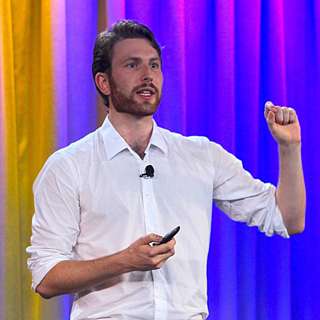
#39 - Spencer Greenberg on the scientific approach to solving difficult everyday questions

#39 - Spencer Greenberg on the scientific approach to solving difficult everyday questions

Will Trump be re-elected? Will North Korea give up their nuclear weapons? Will your friend turn up to dinner?

Spencer Greenberg, founder of ClearerThinking.org has a process for working out such real life problems.

Let’s work through one here: how likely is it that you’ll enjoy listening to this episode?

The first step is to figure out your ‘prior probability’; what’s your estimate of how likely you are to enjoy the interview before getting any further evidence?

Other than applying common sense, one way to figure this out is called reference class forecasting: looking at similar cases and seeing how often something is true, on average.

Spencer is our first ever return guest. So one reference class might be, how many Spencer Greenberg episodes of the 80,000 Hours Podcast have you enjoyed so far? Being this specific limits bias in your answer, but with a sample size of at most 1 - you’d probably want to add more data points to reduce variability.

Zooming out, how many episodes of the 80,000 Hours Podcast have you enjoyed? Let’s say you’ve listened to 10, and enjoyed 8 of them. If so 8 out of 10 might be your prior probability.

But maybe the two you didn’t enjoy had something in common. If you’ve liked similar episodes in the past, you’d update in favour of expecting to enjoy it, and if you’ve disliked similar episodes in the past, you’d update negatively.

You can zoom out further; what fraction of long-form interview podcasts have you ever enjoyed?

Then you’d look to update whenever new information became available. Do the topics seem interesting? Did Spencer make a great point in the first 5 minutes? Was this description unbearably self-referential?

Speaking of the Question of Evidence: in a world where Spencer was not worth listening to, how likely is it that we’d invite him back for a second episode?

Links to learn more, summary and full transcript.

We’ll run through several diverse examples, and how to actually work out the changing probabilities as you update. But that’s only a fraction of the conversation. We also discuss:

* How could we generate 20-30 new happy thoughts a day? What would that do to our welfare?
* What do people actually value? How do EAs differ from non EAs?
* Why should we care about the distinction between intrinsic and instrumental values?
* Would hedonic utilitarians really want to hook themselves up to happiness machines?
* What types of activities are people generally under-confident about? Why?
* When should you give a lot of weight to your prior belief?
* When should we trust common sense?
* Does power posing have any effect?
* Are resumes worthless?
* Did Trump explicitly collude with Russia? What are the odds of him getting re-elected?
* What’s the probability that China and the US go to War in the 21st century?
* How should we treat claims of expertise on diets?
* Why were Spencer’s friends suspicious of Theranos for years?
* How should we think about the placebo effect?
* Does a shift towards rationality typically cause alienation from family and friends? How do you deal with that?

Get this episode by subscribing to our podcast on the world’s most pressing problems and how to solve them: type 80,000 Hours into your podcasting app. Or read the transcript below.

The 80,000 Hours podcast is produced by Keiran Harris.

Jaksot(325)

Rob Wiblin on plastic straws, nicotine, doping, & whether changing the long-term is really possible

Rob Wiblin on plastic straws, nicotine, doping, & whether changing the long-term is really possible

Today's episode is a compilation of interviews I recently recorded for two other shows, Love Your Work and The Neoliberal Podcast.  If you've listened to absolutely everything on this podcast feed, y...

25 Syys 20193h 14min

Have we helped you have a bigger social impact? Our annual survey, plus other ways we can help you.

Have we helped you have a bigger social impact? Our annual survey, plus other ways we can help you.

1. Fill out our annual impact survey here. 2. Find a great vacancy on our job board. 3. Learn about our key ideas, and get links to our top articles. 4. Join our newsletter for an email about what's n...

16 Syys 20193min

#63 – Vitalik Buterin on better ways to fund public goods, blockchain's failures, & effective giving

#63 – Vitalik Buterin on better ways to fund public goods, blockchain's failures, & effective giving

Historically, progress in the field of cryptography has had major consequences. It has changed the course of major wars, made it possible to do business on the internet, and enabled private communicat...

3 Syys 20193h 18min
#62 – Paul Christiano on messaging the future, increasing compute, & how CO2 impacts your brain

#62 – Paul Christiano on messaging the future, increasing compute, & how CO2 impacts your brain

Imagine that – one day – humanity dies out. At some point, many millions of years later, intelligent life might well evolve again. Is there any message we could leave that would reliably help them out...

5 Elo 20192h 11min

#61 - Helen Toner on emerging technology, national security, and China

#61 - Helen Toner on emerging technology, national security, and China

From 1870 to 1950, the introduction of electricity transformed life in the US and UK, as people gained access to lighting, radio and a wide range of household appliances for the first time. Electricit...

17 Heinä 20191h 54min
#60 - Phil Tetlock on why accurate forecasting matters for everything, and how you can do it better

#60 - Phil Tetlock on why accurate forecasting matters for everything, and how you can do it better

Have you ever been infuriated by a doctor's unwillingness to give you an honest, probabilistic estimate about what to expect? Or a lawyer who won't tell you the chances you'll win your case? Their beh...

28 Kesä 20192h 11min
#59 – Cass Sunstein on how change happens, and why it's so often abrupt & unpredictable

#59 – Cass Sunstein on how change happens, and why it's so often abrupt & unpredictable

It can often feel hopeless to be an activist seeking social change on an obscure issue where most people seem opposed or at best indifferent to you. But according to a new book by Professor Cass Sunst...

17 Kesä 20191h 43min

#58 – Pushmeet Kohli of DeepMind on designing robust & reliable AI systems and how to succeed in AI

#58 – Pushmeet Kohli of DeepMind on designing robust & reliable AI systems and how to succeed in AI

When you're building a bridge, responsibility for making sure it won't fall over isn't handed over to a few 'bridge not falling down engineers'. Making sure a bridge is safe to use and remains standin...

3 Kesä 20191h 30min

Suosittua kategoriassa Koulutus

rss-murhan-anatomia
voi-hyvin-meditaatiot-2
rss-narsisti
adhd-podi
psykopodiaa-podcast
rss-rahamania
rss-valo-minussa-2
rss-uskonto-on-tylsaa
rss-niinku-asia-on
mielipaivakirja
rss-vapaudu-voimaasi
rss-duodecim-lehti
rahapuhetta
ilona-rauhala
aamukahvilla
kesken
dear-ladies
rss-eron-alkemiaa
rss-arkea-ja-aurinkoa-podcast-espanjasta
rss-koira-haudattuna