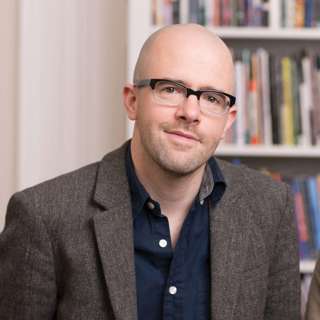

#48 - Brian Christian on better living through the wisdom of computer science
80,000 Hours Podcast22 Marras 2018

#48 - Brian Christian on better living through the wisdom of computer science

Please let us know if we've helped you: Fill out our annual impact survey

Ever felt that you were so busy you spent all your time paralysed trying to figure out where to start, and couldn't get much done? Computer scientists have a term for this - thrashing - and it's a common reason our computers freeze up. The solution, for people as well as laptops, is to 'work dumber': pick something at random and finish it, without wasting time thinking about the bigger picture.

Bestselling author Brian Christian studied computer science, and in the book Algorithms to Live By he's out to find the lessons it can offer for a better life. He investigates into when to quit your job, when to marry, the best way to sell your house, how long to spend on a difficult decision, and how much randomness to inject into your life. In each case computer science gives us a theoretically optimal solution, and in this episode we think hard about whether its models match our reality.

Links to learn more, summary and full transcript.

One genre of problems Brian explores in his book are 'optimal stopping problems', the canonical example of which is ‘the secretary problem’. Imagine you're hiring a secretary, you receive *n* applicants, they show up in a random order, and you interview them one after another. You either have to hire that person on the spot and dismiss everybody else, or send them away and lose the option to hire them in future.

It turns out most of life can be viewed this way - a series of unique opportunities you pass by that will never be available in exactly the same way again.

So how do you attempt to hire the very best candidate in the pool? There's a risk that you stop before finding the best, and a risk that you set your standards too high and let the best candidate pass you by.

Mathematicians of the mid-twentieth century produced an elegant optimal approach: spend exactly one over *e*, or approximately 37% of your search, just establishing a baseline without hiring anyone, no matter how promising they seem. Then immediately hire the next person who's better than anyone you've seen so far.

It turns out that your odds of success in this scenario are also 37%. And the optimal strategy and the odds of success are identical regardless of the size of the pool. So as *n* goes to infinity you still want to follow this 37% rule, and you still have a 37% chance of success. Even if you interview a million people.

But if you have the option to go back, say by apologising to the first applicant and begging them to come work with you, and you have a 50% chance of your apology being accepted, then the optimal explore percentage rises all the way to 61%.

Today’s episode focuses on Brian’s book-length exploration of how insights from computer algorithms can and can't be applied to our everyday lives. We cover:

* Computational kindness, and the best way to schedule meetings
* How can we characterize a computational model of what people are actually doing, and is there a rigorous way to analyse just how good their instincts actually are?
* What’s it like being a human confederate in the Turing test competition?
* Is trying to detect fake social media accounts a losing battle?
* The canonical explore/exploit problem in computer science: the multi-armed bandit
* What’s the optimal way to buy or sell a house?
* Why is information economics so important?
* What kind of decisions should people randomize more in life?
* How much time should we spend on prioritisation?

Get this episode by subscribing: type '80,000 Hours' into your podcasting app.

The 80,000 Hours Podcast is produced by Keiran Harris.

Jaksot(321)

#61 - Helen Toner on emerging technology, national security, and China

#61 - Helen Toner on emerging technology, national security, and China

From 1870 to 1950, the introduction of electricity transformed life in the US and UK, as people gained access to lighting, radio and a wide range of household appliances for the first time. Electricit...

17 Heinä 20191h 54min

#60 - Phil Tetlock on why accurate forecasting matters for everything, and how you can do it better

#60 - Phil Tetlock on why accurate forecasting matters for everything, and how you can do it better

Have you ever been infuriated by a doctor's unwillingness to give you an honest, probabilistic estimate about what to expect? Or a lawyer who won't tell you the chances you'll win your case? Their beh...

28 Kesä 20192h 11min

#59 – Cass Sunstein on how change happens, and why it's so often abrupt & unpredictable

#59 – Cass Sunstein on how change happens, and why it's so often abrupt & unpredictable

It can often feel hopeless to be an activist seeking social change on an obscure issue where most people seem opposed or at best indifferent to you. But according to a new book by Professor Cass Sunst...

17 Kesä 20191h 43min

#58 – Pushmeet Kohli of DeepMind on designing robust & reliable AI systems and how to succeed in AI

#58 – Pushmeet Kohli of DeepMind on designing robust & reliable AI systems and how to succeed in AI

When you're building a bridge, responsibility for making sure it won't fall over isn't handed over to a few 'bridge not falling down engineers'. Making sure a bridge is safe to use and remains standin...

3 Kesä 20191h 30min

Rob Wiblin on human nature, new technology, and living a happy, healthy & ethical life

Rob Wiblin on human nature, new technology, and living a happy, healthy & ethical life

This is a cross-post of some interviews Rob did recently on two other podcasts — Mission Daily (from 2m) and The Good Life (from 1h13m). Some of the content will be familiar to regular listeners — bu...

13 Touko 20192h 18min

#57 – Tom Kalil on how to do the most good in government

#57 – Tom Kalil on how to do the most good in government

You’re 29 years old, and you’ve just been given a job in the White House. How do you quickly figure out how the US Executive Branch behemoth actually works, so that you can have as much impact as poss...

23 Huhti 20192h 50min

#56 - Persis Eskander on wild animal welfare and what, if anything, to do about it

#56 - Persis Eskander on wild animal welfare and what, if anything, to do about it

Elephants in chains at travelling circuses; pregnant pigs trapped in coffin sized crates at factory farms; deers living in the wild. We should welcome the last as a pleasant break from the horror, rig...

15 Huhti 20192h 57min

#55 – Lutter & Winter on founding charter cities with outstanding governance to end poverty

#55 – Lutter & Winter on founding charter cities with outstanding governance to end poverty

Governance matters. Policy change quickly took China from famine to fortune; Singapore from swamps to skyscrapers; and Hong Kong from fishing village to financial centre. Unfortunately, many governmen...

31 Maalis 20192h 31min

Suosittua kategoriassa Koulutus

rss-murhan-anatomia
psykopodiaa-podcast
rss-narsisti
voi-hyvin-meditaatiot-2
rss-liian-kuuma-peruna
rss-vapaudu-voimaasi
aamukahvilla
dear-ladies
leveli
rss-duodecim-lehti
rahapuhetta
kesken
psykologia
adhd-podi
ihminen-tavattavissa-tommy-hellsten-instituutti
avara-mieli
rss-uskonto-on-tylsaa
rss-ai-mita-siskopodcast
rss-tietoinen-yhteys-podcast-2
rss-monarch-talk-with-alexandra-alexis


















