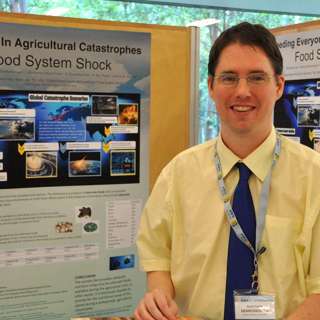
#50 - David Denkenberger on how to feed all 8b people through an asteroid/nuclear winter

#50 - David Denkenberger on how to feed all 8b people through an asteroid/nuclear winter

If an asteroid impact or nuclear winter blocked the sun for years, our inability to grow food would result in billions dying of starvation, right? According to Dr David Denkenberger, co-author of Feeding Everyone No Matter What: no. If he's to be believed, nobody need starve at all.

Even without the sun, David sees the Earth as a bountiful food source. Mushrooms farmed on decaying wood. Bacteria fed with natural gas. Fish and mussels supported by sudden upwelling of ocean nutrients - and more.

Dr Denkenberger is an Assistant Professor at the University of Alaska Fairbanks, and he's out to spread the word that while a nuclear winter might be horrible, experts have been mistaken to assume that mass starvation is an inevitability. In fact, the only thing that would prevent us from feeding the world is insufficient preparation.

Links to learn more, summary and full transcript

Not content to just write a book pointing this out, David has gone on to found a growing non-profit - the Alliance to Feed the Earth in Disasters (ALLFED) - to prepare the world to feed everyone come what may. He expects that today 10% of people would find enough food to survive a massive disaster. In principle, if we did everything right, nobody need go hungry. But being more realistic about how much we're likely to invest, David thinks a plan to inform people ahead of time could save 30%, and a decent research and development scheme 80%.

∙ 80,000 Hours' updated article on How to find the best charity to give to
∙ A potential donor evaluates ALLFED

According to David's published cost-benefit analyses, work on this problem may be able to save lives, in expectation, for under $100 each, making it an incredible investment.

These preparations could also help make humanity more resilient to global catastrophic risks, by forestalling an ‘everyone for themselves' mentality, which then causes trade and civilization to unravel.

But some worry that David's cost-effectiveness estimates are exaggerations, so I challenge him on the practicality of his approach, and how much his non-profit's work would actually matter in a post-apocalyptic world. In our extensive conversation, we cover:

* How could the sun end up getting blocked, or agriculture otherwise be decimated?
* What are all the ways we could we eat nonetheless? What kind of life would this be?
* Can these methods be scaled up fast?
* What is his organisation, ALLFED, actually working on?
* How does he estimate the cost-effectiveness of this work, and what are the biggest weaknesses of the approach?
* How would more food affect the post-apocalyptic world? Won't people figure it out at that point anyway?
* Why not just leave guidebooks with this information in every city?
* Would these preparations make nuclear war more likely?
* What kind of people is ALLFED trying to hire?
* What would ALLFED do with more money?
* How he ended up doing this work. And his other engineering proposals for improving the world, including ideas to prevent a supervolcano explosion.

Get this episode by subscribing to our podcast on the world’s most pressing problems and how to solve them: type '80,000 Hours' into your podcasting app.

The 80,000 Hours Podcast is produced by Keiran Harris.

Jaksot(326)

#44 - Paul Christiano on how we'll hand the future off to AI, & solving the alignment problem

#44 - Paul Christiano on how we'll hand the future off to AI, & solving the alignment problem

Paul Christiano is one of the smartest people I know. After our first session produced such great material, we decided to do a second recording, resulting in our longest interview so far. While challe...

2 Loka 20183h 51min
#43 - Daniel Ellsberg on the institutional insanity that maintains nuclear doomsday machines

#43 - Daniel Ellsberg on the institutional insanity that maintains nuclear doomsday machines

In Stanley Kubrick’s iconic film Dr. Strangelove, the American president is informed that the Soviet Union has created a secret deterrence system which will automatically wipe out humanity upon detect...

25 Syys 20182h 44min
#42 - Amanda Askell on moral empathy, the value of information & the ethics of infinity

#42 - Amanda Askell on moral empathy, the value of information & the ethics of infinity

Consider two familiar moments at a family reunion. Our host, Uncle Bill, takes pride in his barbecuing skills. But his niece Becky says that she now refuses to eat meat. A groan goes round the table; ...

11 Syys 20182h 46min
#41 - David Roodman on incarceration, geomagnetic storms, & becoming a world-class researcher

#41 - David Roodman on incarceration, geomagnetic storms, & becoming a world-class researcher

With 698 inmates per 100,000 citizens, the U.S. is by far the leader among large wealthy nations in incarceration. But what effect does imprisonment actually have on crime? According to David Roodman...

28 Elo 20182h 18min
#40 - Katja Grace on forecasting future technology & how much we should trust expert predictions

#40 - Katja Grace on forecasting future technology & how much we should trust expert predictions

Experts believe that artificial intelligence will be better than humans at driving trucks by 2027, working in retail by 2031, writing bestselling books by 2049, and working as surgeons by 2053. But ho...

21 Elo 20182h 11min
#39 - Spencer Greenberg on the scientific approach to solving difficult everyday questions

#39 - Spencer Greenberg on the scientific approach to solving difficult everyday questions

Will Trump be re-elected? Will North Korea give up their nuclear weapons? Will your friend turn up to dinner? Spencer Greenberg, founder of ClearerThinking.org has a process for working out such real...

7 Elo 20182h 17min
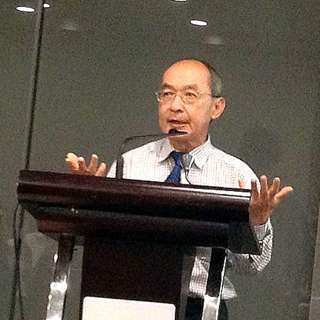
#38 - Yew-Kwang Ng on anticipating effective altruism decades ago & how to make a much happier world

#38 - Yew-Kwang Ng on anticipating effective altruism decades ago & how to make a much happier world

Will people who think carefully about how to maximize welfare eventually converge on the same views? The effective altruism community has spent a lot of time over the past 10 years debating how best t...

26 Heinä 20181h 59min
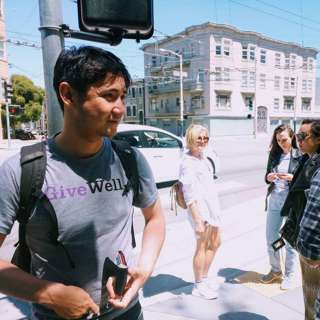
#37 - GiveWell picks top charities by estimating the unknowable. James Snowden on how they do it.

#37 - GiveWell picks top charities by estimating the unknowable. James Snowden on how they do it.

What’s the value of preventing the death of a 5-year-old child, compared to a 20-year-old, or an 80-year-old? The global health community has generally regarded the value as proportional to the numbe...

16 Heinä 20181h 44min

Suosittua kategoriassa Koulutus

rss-murhan-anatomia
voi-hyvin-meditaatiot-2
rss-narsisti
psykopodiaa-podcast
adhd-podi
rahapuhetta
rss-uskonto-on-tylsaa
rss-liian-kuuma-peruna
rss-rahamania
kesken
rss-vapaudu-voimaasi
rss-niinku-asia-on
salainen-paivakirja
rss-duodecim-lehti
rss-tietoinen-yhteys-podcast-2
rss-koira-haudattuna
aloita-meditaatio
mielipaivakirja
esa-saarinen-filosofia-ja-systeemiajattelu
filocast-filosofian-perusteet