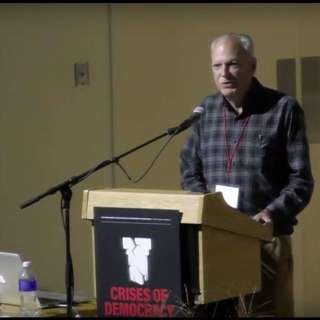
#51 - Martin Gurri on the revolt of the public & crisis of authority in the information age

#51 - Martin Gurri on the revolt of the public & crisis of authority in the information age

Politics in rich countries seems to be going nuts. What's the explanation? Rising inequality? The decline of manufacturing jobs? Excessive immigration?

Martin Gurri spent decades as a CIA analyst and in his 2014 book The Revolt of The Public and Crisis of Authority in the New Millennium, predicted political turbulence for an entirely different reason: new communication technologies were flipping the balance of power between the public and traditional authorities.

In 1959 the President could control the narrative by leaning on his friends at four TV stations, who felt it was proper to present the nation's leader in a positive light, no matter their flaws. Today, it's impossible to prevent someone from broadcasting any grievance online, whether it's a contrarian insight or an insane conspiracy theory.

Links to learn more, summary and full transcript.

According to Gurri, trust in society's institutions - police, journalists, scientists and more - has been undermined by constant criticism from outsiders, and exposed to a cacophony of conflicting opinions on every issue, the public takes fewer truths for granted. We are now free to see our leaders as the flawed human beings they always have been, and are not amused.

Suspicious they are being betrayed by elites, the public can also use technology to coordinate spontaneously and express its anger. Keen to 'throw the bastards out' protesters take to the streets, united by what they don't like, but without a shared agenda or the institutional infrastructure to figure out how to fix things. Some popular movements have come to view any attempt to exercise power over others as suspect.

If Gurri is to be believed, protest movements in Egypt, Spain, Greece and Israel in 2011 followed this script, while Brexit, Trump and the French yellow vests movement subsequently vindicated his theory.

In this model, politics won't return to its old equilibrium any time soon. The leaders of tomorrow will need a new message and style if they hope to maintain any legitimacy in this less hierarchical world. Otherwise, we're in for decades of grinding conflict between traditional centres of authority and the general public, who doubt both their loyalty and competence.

But how much should we believe this theory? Why do Canada and Australia remain pools of calm in the storm? Aren't some malcontents quite concrete in their demands? And are protest movements actually more common (or more nihilistic) than they were decades ago?

In today's episode we ask these questions and add an hour-long discussion with two of Rob's colleagues - Keiran Harris and Michelle Hutchinson - to further explore the ideas in the book.

The conversation covers:

* How do we know that the internet is driving this rather than some other phenomenon?
* How do technological changes enable social and political change?
* The historical role of television
* Are people also more disillusioned now with sports heroes and actors?
* Which countries are finding good ways to make politics work in this new era?
* What are the implications for the threat of totalitarianism?
* What is this is going to do to international relations? Will it make it harder for countries to cooperate and avoid conflict?

Get this episode by subscribing to our podcast on the world’s most pressing problems and how to solve them: type '80,000 Hours' into your podcasting app.

The 80,000 Hours Podcast is produced by Keiran Harris.

Jaksot(317)

We just put up a new compilation of ten core episodes of the show

We just put up a new compilation of ten core episodes of the show

We recently launched a new podcast feed that might be useful to you and people you know. It's called Effective Altruism: Ten Global Problems, and it's a collection of ten top episodes of this show, se...

20 Loka 20213min

#113 – Varsha Venugopal on using gossip to help vaccinate every child in India

#113 – Varsha Venugopal on using gossip to help vaccinate every child in India

Our failure to make sure all kids globally get all of their basic vaccinations leads to 1.5 million child deaths every year.According to today’s guest, Varsha Venugopal, for the great majority this ha...

18 Loka 20212h 5min

#112 – Carl Shulman on the common-sense case for existential risk work and its practical implications

#112 – Carl Shulman on the common-sense case for existential risk work and its practical implications

Preventing the apocalypse may sound like an idiosyncratic activity, and it sometimes is justified on exotic grounds, such as the potential for humanity to become a galaxy-spanning civilisation.But the...

5 Loka 20213h 48min

#111 – Mushtaq Khan on using institutional economics to predict effective government reforms

#111 – Mushtaq Khan on using institutional economics to predict effective government reforms

If you’re living in the Niger Delta in Nigeria, your best bet at a high-paying career is probably ‘artisanal refining’ — or, in plain language, stealing oil from pipelines. The resulting oil spills da...

10 Syys 20213h 20min
#110 – Holden Karnofsky on building aptitudes and kicking ass

#110 – Holden Karnofsky on building aptitudes and kicking ass

Holden Karnofsky helped create two of the most influential organisations in the effective philanthropy world. So when he outlines a different perspective on career advice than the one we present at 80...

26 Elo 20212h 46min

#109 – Holden Karnofsky on the most important century

#109 – Holden Karnofsky on the most important century

Will the future of humanity be wild, or boring? It's natural to think that if we're trying to be sober and measured, and predict what will really happen rather than spin an exciting story, it's more l...

19 Elo 20212h 19min

#108 – Chris Olah on working at top AI labs without an undergrad degree

#108 – Chris Olah on working at top AI labs without an undergrad degree

Chris Olah has had a fascinating and unconventional career path. Most people who want to pursue a research career feel they need a degree to get taken seriously. But Chris not only doesn't have a P...

11 Elo 20211h 33min

#107 – Chris Olah on what the hell is going on inside neural networks

#107 – Chris Olah on what the hell is going on inside neural networks

Big machine learning models can identify plant species better than any human, write passable essays, beat you at a game of Starcraft 2, figure out how a photo of Tobey Maguire and the word 'spider' ar...

4 Elo 20213h 9min

Suosittua kategoriassa Koulutus

rss-murhan-anatomia
psykopodiaa-podcast
voi-hyvin-meditaatiot-2
rss-valo-minussa-2
rss-niinku-asia-on
aamukahvilla
rss-narsisti
adhd-podi
rss-duodecim-lehti
rahapuhetta
aloita-meditaatio
kesken
rss-elamankoulu
koulu-podcast-2
salainen-paivakirja
rss-uskonto-on-tylsaa
rss-liian-kuuma-peruna
rss-luonnollinen-synnytys-podcast
rss-koira-haudattuna
rss-hereilla