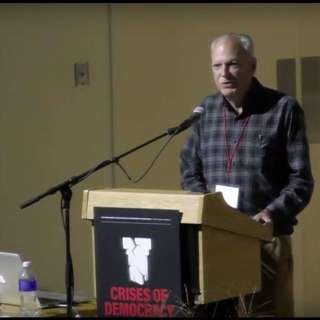

#51 - Martin Gurri on the revolt of the public & crisis of authority in the information age

#51 - Martin Gurri on the revolt of the public & crisis of authority in the information age

Politics in rich countries seems to be going nuts. What's the explanation? Rising inequality? The decline of manufacturing jobs? Excessive immigration?

Martin Gurri spent decades as a CIA analyst and in his 2014 book The Revolt of The Public and Crisis of Authority in the New Millennium, predicted political turbulence for an entirely different reason: new communication technologies were flipping the balance of power between the public and traditional authorities.

In 1959 the President could control the narrative by leaning on his friends at four TV stations, who felt it was proper to present the nation's leader in a positive light, no matter their flaws. Today, it's impossible to prevent someone from broadcasting any grievance online, whether it's a contrarian insight or an insane conspiracy theory.

Links to learn more, summary and full transcript.

According to Gurri, trust in society's institutions - police, journalists, scientists and more - has been undermined by constant criticism from outsiders, and exposed to a cacophony of conflicting opinions on every issue, the public takes fewer truths for granted. We are now free to see our leaders as the flawed human beings they always have been, and are not amused.

Suspicious they are being betrayed by elites, the public can also use technology to coordinate spontaneously and express its anger. Keen to 'throw the bastards out' protesters take to the streets, united by what they don't like, but without a shared agenda or the institutional infrastructure to figure out how to fix things. Some popular movements have come to view any attempt to exercise power over others as suspect.

If Gurri is to be believed, protest movements in Egypt, Spain, Greece and Israel in 2011 followed this script, while Brexit, Trump and the French yellow vests movement subsequently vindicated his theory.

In this model, politics won't return to its old equilibrium any time soon. The leaders of tomorrow will need a new message and style if they hope to maintain any legitimacy in this less hierarchical world. Otherwise, we're in for decades of grinding conflict between traditional centres of authority and the general public, who doubt both their loyalty and competence.

But how much should we believe this theory? Why do Canada and Australia remain pools of calm in the storm? Aren't some malcontents quite concrete in their demands? And are protest movements actually more common (or more nihilistic) than they were decades ago?

In today's episode we ask these questions and add an hour-long discussion with two of Rob's colleagues - Keiran Harris and Michelle Hutchinson - to further explore the ideas in the book.

The conversation covers:

* How do we know that the internet is driving this rather than some other phenomenon?
* How do technological changes enable social and political change?
* The historical role of television
* Are people also more disillusioned now with sports heroes and actors?
* Which countries are finding good ways to make politics work in this new era?
* What are the implications for the threat of totalitarianism?
* What is this is going to do to international relations? Will it make it harder for countries to cooperate and avoid conflict?

Get this episode by subscribing to our podcast on the world’s most pressing problems and how to solve them: type '80,000 Hours' into your podcasting app.

The 80,000 Hours Podcast is produced by Keiran Harris.

Jaksot(317)

#91 – Lewis Bollard on big wins against factory farming and how they happened

#91 – Lewis Bollard on big wins against factory farming and how they happened

I suspect today's guest, Lewis Bollard, might be the single best person in the world to interview to get an overview of all the methods that might be effective for putting an end to factory farming an...

15 Helmi 20212h 33min

Rob Wiblin on how he ended up the way he is

Rob Wiblin on how he ended up the way he is

This is a crosspost of an episode of the Eureka Podcast. The interviewer is Misha Saul, a childhood friend of Rob's, who he has known for over 20 years. While it's not an episode of our own show, we...

3 Helmi 20211h 57min

#90 – Ajeya Cotra on worldview diversification and how big the future could be

#90 – Ajeya Cotra on worldview diversification and how big the future could be

You wake up in a mysterious box, and hear the booming voice of God: “I just flipped a coin. If it came up heads, I made ten boxes, labeled 1 through 10 — each of which has a human in it. If it ca...

21 Tammi 20212h 59min

Rob Wiblin on self-improvement and research ethics

Rob Wiblin on self-improvement and research ethics

This is a crosspost of an episode of the Clearer Thinking Podcast: 022: Self-Improvement and Research Ethics with Rob Wiblin. Rob chats with Spencer Greenberg, who has been an audience favourite in...

13 Tammi 20212h 30min

#73 - Phil Trammell on patient philanthropy and waiting to do good [re-release]

#73 - Phil Trammell on patient philanthropy and waiting to do good [re-release]

Rebroadcast: this episode was originally released in March 2020. To do good, most of us look to use our time and money to affect the world around us today. But perhaps that's all wrong. If you too...

7 Tammi 20212h 41min

#75 – Michelle Hutchinson on what people most often ask 80,000 Hours [re-release]

#75 – Michelle Hutchinson on what people most often ask 80,000 Hours [re-release]

Rebroadcast: this episode was originally released in April 2020. Since it was founded, 80,000 Hours has done one-on-one calls to supplement our online content and offer more personalised advice. We ...

30 Joulu 20202h 14min

#89 – Owen Cotton-Barratt on epistemic systems and layers of defense against potential global catastrophes

#89 – Owen Cotton-Barratt on epistemic systems and layers of defense against potential global catastrophes

From one point of view academia forms one big 'epistemic' system — a process which directs attention, generates ideas, and judges which are good. Traditional print media is another such system, and we...

17 Joulu 20202h 38min

#88 – Tristan Harris on the need to change the incentives of social media companies

#88 – Tristan Harris on the need to change the incentives of social media companies

In its first 28 days on Netflix, the documentary The Social Dilemma — about the possible harms being caused by social media and other technology products — was seen by 38 million households in about 1...

3 Joulu 20202h 35min

Suosittua kategoriassa Koulutus

rss-murhan-anatomia
psykopodiaa-podcast
voi-hyvin-meditaatiot-2
rss-valo-minussa-2
rss-narsisti
adhd-podi
rss-niinku-asia-on
aamukahvilla
rss-duodecim-lehti
kesken
rahapuhetta
aloita-meditaatio
salainen-paivakirja
rss-elamankoulu
psykologia
rss-uskonto-on-tylsaa
rss-psykalab
rss-selvat-savelet
rss-koira-haudattuna
rss-hereilla