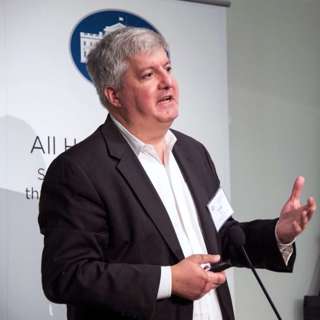
#57 – Tom Kalil on how to do the most good in government

#57 – Tom Kalil on how to do the most good in government

You’re 29 years old, and you’ve just been given a job in the White House. How do you quickly figure out how the US Executive Branch behemoth actually works, so that you can have as much impact as possible - before you quit or get kicked out?

That was the challenge put in front of Tom Kalil in 1993.

He had enough success to last a full 16 years inside the Clinton and Obama administrations, working to foster the development of the internet, then nanotechnology, and then cutting-edge brain modelling, among other things.

But not everyone figures out how to move the needle. In today's interview, Tom shares his experience with how to increase your chances of getting an influential role in government, and how to make the most of the opportunity if you get in.

Links to learn more, summary and full transcript.

Interested in US AI policy careers? Apply for one-on-one career advice here.

Vacancies at the Center for Security and Emerging Technology.

Our high-impact job board, which features other related opportunities.

He believes that Congressional gridlock leads people to greatly underestimate how much the Executive Branch can and does do on its own every day. Decisions by individuals change how billions of dollars are spent; regulations are enforced, and then suddenly they aren't; and a single sentence in the State of the Union can get civil servants to pay attention to a topic that would otherwise go ignored.

Over years at the White House Office of Science and Technology Policy, 'Team Kalil' built up a white board of principles. For example, 'the schedule is your friend': setting a meeting date with the President can force people to finish something, where they otherwise might procrastinate.

Or 'talk to who owns the paper'. People would wonder how Tom could get so many lines into the President's speeches. The answer was "figure out who's writing the speech, find them with the document, and tell them to add the line." Obvious, but not something most were doing.

Not everything is a precise operation though. Tom also tells us the story of NetDay, a project that was put together at the last minute because the President incorrectly believed it was already organised – and decided he was going to announce it in person.

In today's episode we get down to nuts & bolts, and discuss:
• How did Tom spin work on a primary campaign into a job in the next White House?
• Why does Tom think hiring is the most important work he did, and how did he decide who to bring onto the team?
• How do you get people to do things when you don't have formal power over them?
• What roles in the US government are most likely to help with the long-term future, or reducing existential risks?
• Is it possible, or even desirable, to get the general public interested in abstract, long-term policy ideas?
• What are 'policy entrepreneurs' and why do they matter?
• What is the role for prizes in promoting science and technology? What are other promising policy ideas?
• Why you can get more done by not taking credit.
• What can the White House do if an agency isn't doing what it wants?
• How can the effective altruism community improve the maturity of our policy recommendations?
• How much can talented individuals accomplish during a short-term stay in government?

Get this episode by subscribing to our podcast on the world’s most pressing problems and how to solve them: type '80,000 Hours' into your podcasting app.

The 80,000 Hours Podcast is produced by Keiran Harris.

Jaksot(321)

#191 (Part 1) – Carl Shulman on the economy and national security after AGI

#191 (Part 1) – Carl Shulman on the economy and national security after AGI

This is the first part of our marathon interview with Carl Shulman. The second episode is on government and society after AGI. You can listen to them in either order!The human brain does what it does ...

27 Kesä 20244h 14min
#190 – Eric Schwitzgebel on whether the US is conscious

#190 – Eric Schwitzgebel on whether the US is conscious

"One of the most amazing things about planet Earth is that there are complex bags of mostly water — you and me – and we can look up at the stars, and look into our brains, and try to grapple with the ...

7 Kesä 20242h
#189 – Rachel Glennerster on why we still don’t have vaccines that could save millions

#189 – Rachel Glennerster on why we still don’t have vaccines that could save millions

"You can’t charge what something is worth during a pandemic. So we estimated that the value of one course of COVID vaccine in January 2021 was over $5,000. They were selling for between $6 and $40. So...

29 Touko 20242h 48min

#188 – Matt Clancy on whether science is good

#188 – Matt Clancy on whether science is good

"Suppose we make these grants, we do some of those experiments I talk about. We discover, for example — I’m just making this up — but we give people superforecasting tests when they’re doing peer revi...

23 Touko 20242h 40min

#187 – Zach Weinersmith on how researching his book turned him from a space optimist into a "space bastard"

#187 – Zach Weinersmith on how researching his book turned him from a space optimist into a "space bastard"

"Earth economists, when they measure how bad the potential for exploitation is, they look at things like, how is labour mobility? How much possibility do labourers have otherwise to go somewhere else?...

14 Touko 20243h 6min

#186 – Dean Spears on why babies are born small in Uttar Pradesh, and how to save their lives

#186 – Dean Spears on why babies are born small in Uttar Pradesh, and how to save their lives

"I work in a place called Uttar Pradesh, which is a state in India with 240 million people. One in every 33 people in the whole world lives in Uttar Pradesh. It would be the fifth largest country if i...

1 Touko 20241h 18min

#185 – Lewis Bollard on the 7 most promising ways to end factory farming, and whether AI is going to be good or bad for animals

#185 – Lewis Bollard on the 7 most promising ways to end factory farming, and whether AI is going to be good or bad for animals

"The constraint right now on factory farming is how far can you push the biology of these animals? But AI could remove that constraint. It could say, 'Actually, we can push them further in these ways ...

18 Huhti 20242h 33min
#184 – Zvi Mowshowitz on sleeping on sleeper agents, and the biggest AI updates since ChatGPT

#184 – Zvi Mowshowitz on sleeping on sleeper agents, and the biggest AI updates since ChatGPT

Many of you will have heard of Zvi Mowshowitz as a superhuman information-absorbing-and-processing machine — which he definitely is. As the author of the Substack Don’t Worry About the Vase, Zvi has s...

11 Huhti 20243h 31min

Suosittua kategoriassa Koulutus

rss-murhan-anatomia
psykopodiaa-podcast
voi-hyvin-meditaatiot-2
rss-narsisti
rss-liian-kuuma-peruna
rss-vapaudu-voimaasi
dear-ladies
psykologia
leveli
rss-duodecim-lehti
rss-valo-minussa-2
kesken
ihminen-tavattavissa-tommy-hellsten-instituutti
rss-uskonto-on-tylsaa
rss-hereilla
adhd-podi
rss-tietoinen-yhteys-podcast-2
rss-ai-mita-siskopodcast
rss-luonnollinen-synnytys-podcast
rss-arkea-ja-aurinkoa-podcast-espanjasta