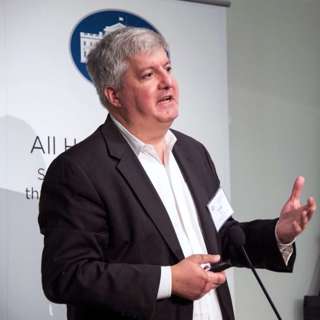

#57 – Tom Kalil on how to do the most good in government

#57 – Tom Kalil on how to do the most good in government

You’re 29 years old, and you’ve just been given a job in the White House. How do you quickly figure out how the US Executive Branch behemoth actually works, so that you can have as much impact as possible - before you quit or get kicked out?

That was the challenge put in front of Tom Kalil in 1993.

He had enough success to last a full 16 years inside the Clinton and Obama administrations, working to foster the development of the internet, then nanotechnology, and then cutting-edge brain modelling, among other things.

But not everyone figures out how to move the needle. In today's interview, Tom shares his experience with how to increase your chances of getting an influential role in government, and how to make the most of the opportunity if you get in.

Links to learn more, summary and full transcript.

Interested in US AI policy careers? Apply for one-on-one career advice here.

Vacancies at the Center for Security and Emerging Technology.

Our high-impact job board, which features other related opportunities.

He believes that Congressional gridlock leads people to greatly underestimate how much the Executive Branch can and does do on its own every day. Decisions by individuals change how billions of dollars are spent; regulations are enforced, and then suddenly they aren't; and a single sentence in the State of the Union can get civil servants to pay attention to a topic that would otherwise go ignored.

Over years at the White House Office of Science and Technology Policy, 'Team Kalil' built up a white board of principles. For example, 'the schedule is your friend': setting a meeting date with the President can force people to finish something, where they otherwise might procrastinate.

Or 'talk to who owns the paper'. People would wonder how Tom could get so many lines into the President's speeches. The answer was "figure out who's writing the speech, find them with the document, and tell them to add the line." Obvious, but not something most were doing.

Not everything is a precise operation though. Tom also tells us the story of NetDay, a project that was put together at the last minute because the President incorrectly believed it was already organised – and decided he was going to announce it in person.

In today's episode we get down to nuts & bolts, and discuss:
• How did Tom spin work on a primary campaign into a job in the next White House?
• Why does Tom think hiring is the most important work he did, and how did he decide who to bring onto the team?
• How do you get people to do things when you don't have formal power over them?
• What roles in the US government are most likely to help with the long-term future, or reducing existential risks?
• Is it possible, or even desirable, to get the general public interested in abstract, long-term policy ideas?
• What are 'policy entrepreneurs' and why do they matter?
• What is the role for prizes in promoting science and technology? What are other promising policy ideas?
• Why you can get more done by not taking credit.
• What can the White House do if an agency isn't doing what it wants?
• How can the effective altruism community improve the maturity of our policy recommendations?
• How much can talented individuals accomplish during a short-term stay in government?

Get this episode by subscribing to our podcast on the world’s most pressing problems and how to solve them: type '80,000 Hours' into your podcasting app.

The 80,000 Hours Podcast is produced by Keiran Harris.

Jaksot(321)

#153 – Elie Hassenfeld on 2 big picture critiques of GiveWell's approach, and 6 lessons from their recent work

#153 – Elie Hassenfeld on 2 big picture critiques of GiveWell's approach, and 6 lessons from their recent work

GiveWell is one of the world's best-known charity evaluators, with the goal of "searching for the charities that save or improve lives the most per dollar." It mostly recommends projects that help the...

2 Kesä 20232h 56min

#152 – Joe Carlsmith on navigating serious philosophical confusion

#152 – Joe Carlsmith on navigating serious philosophical confusion

What is the nature of the universe? How do we make decisions correctly? What differentiates right actions from wrong ones?Such fundamental questions have been the subject of philosophical and theologi...

19 Touko 20233h 26min

#151 – Ajeya Cotra on accidentally teaching AI models to deceive us

#151 – Ajeya Cotra on accidentally teaching AI models to deceive us

Imagine you are an orphaned eight-year-old whose parents left you a $1 trillion company, and no trusted adult to serve as your guide to the world. You have to hire a smart adult to run that company, g...

12 Touko 20232h 49min

#150 – Tom Davidson on how quickly AI could transform the world

#150 – Tom Davidson on how quickly AI could transform the world

It’s easy to dismiss alarming AI-related predictions when you don’t know where the numbers came from.For example: what if we told you that within 15 years, it’s likely that we’ll see a 1,000x improvem...

5 Touko 20233h 1min
Andrés Jiménez Zorrilla on the Shrimp Welfare Project (80k After Hours)

Andrés Jiménez Zorrilla on the Shrimp Welfare Project (80k After Hours)

In this episode from our second show, 80k After Hours, Rob Wiblin interviews Andrés Jiménez Zorrilla about the Shrimp Welfare Project, which he cofounded in 2021. It's the first project in the world f...

22 Huhti 20231h 17min

#149 – Tim LeBon on how altruistic perfectionism is self-defeating

#149 – Tim LeBon on how altruistic perfectionism is self-defeating

Being a good and successful person is core to your identity. You place great importance on meeting the high moral, professional, or academic standards you set yourself. But inevitably, something goes ...

12 Huhti 20233h 11min

#148 – Johannes Ackva on unfashionable climate interventions that work, and fashionable ones that don't

#148 – Johannes Ackva on unfashionable climate interventions that work, and fashionable ones that don't

If you want to work to tackle climate change, you should try to reduce expected carbon emissions by as much as possible, right? Strangely, no. Today's guest, Johannes Ackva — the climate research lead...

3 Huhti 20232h 17min

#147 – Spencer Greenberg on stopping valueless papers from getting into top journals

#147 – Spencer Greenberg on stopping valueless papers from getting into top journals

Can you trust the things you read in published scientific research? Not really. About 40% of experiments in top social science journals don't get the same result if the experiments are repeated.Two ke...

24 Maalis 20232h 38min

Suosittua kategoriassa Koulutus

rss-murhan-anatomia
rss-narsisti
psykopodiaa-podcast
voi-hyvin-meditaatiot-2
rss-liian-kuuma-peruna
rss-vapaudu-voimaasi
rss-hereilla
rss-valo-minussa-2
rss-uskonto-on-tylsaa
psykologia
kesken
dear-ladies
rss-luonnollinen-synnytys-podcast
rahapuhetta
rss-niinku-asia-on
ihminen-tavattavissa-tommy-hellsten-instituutti
leveli
rss-duodecim-lehti
rss-tietoinen-yhteys-podcast-2
rss-arkea-ja-aurinkoa-podcast-espanjasta