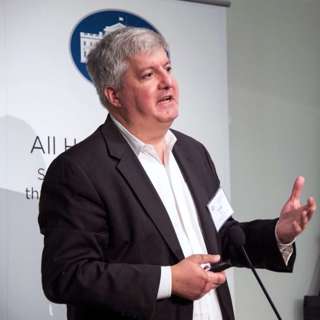
#57 – Tom Kalil on how to do the most good in government

#57 – Tom Kalil on how to do the most good in government

You’re 29 years old, and you’ve just been given a job in the White House. How do you quickly figure out how the US Executive Branch behemoth actually works, so that you can have as much impact as possible - before you quit or get kicked out?

That was the challenge put in front of Tom Kalil in 1993.

He had enough success to last a full 16 years inside the Clinton and Obama administrations, working to foster the development of the internet, then nanotechnology, and then cutting-edge brain modelling, among other things.

But not everyone figures out how to move the needle. In today's interview, Tom shares his experience with how to increase your chances of getting an influential role in government, and how to make the most of the opportunity if you get in.

Links to learn more, summary and full transcript.

Interested in US AI policy careers? Apply for one-on-one career advice here.

Vacancies at the Center for Security and Emerging Technology.

Our high-impact job board, which features other related opportunities.

He believes that Congressional gridlock leads people to greatly underestimate how much the Executive Branch can and does do on its own every day. Decisions by individuals change how billions of dollars are spent; regulations are enforced, and then suddenly they aren't; and a single sentence in the State of the Union can get civil servants to pay attention to a topic that would otherwise go ignored.

Over years at the White House Office of Science and Technology Policy, 'Team Kalil' built up a white board of principles. For example, 'the schedule is your friend': setting a meeting date with the President can force people to finish something, where they otherwise might procrastinate.

Or 'talk to who owns the paper'. People would wonder how Tom could get so many lines into the President's speeches. The answer was "figure out who's writing the speech, find them with the document, and tell them to add the line." Obvious, but not something most were doing.

Not everything is a precise operation though. Tom also tells us the story of NetDay, a project that was put together at the last minute because the President incorrectly believed it was already organised – and decided he was going to announce it in person.

In today's episode we get down to nuts & bolts, and discuss:
• How did Tom spin work on a primary campaign into a job in the next White House?
• Why does Tom think hiring is the most important work he did, and how did he decide who to bring onto the team?
• How do you get people to do things when you don't have formal power over them?
• What roles in the US government are most likely to help with the long-term future, or reducing existential risks?
• Is it possible, or even desirable, to get the general public interested in abstract, long-term policy ideas?
• What are 'policy entrepreneurs' and why do they matter?
• What is the role for prizes in promoting science and technology? What are other promising policy ideas?
• Why you can get more done by not taking credit.
• What can the White House do if an agency isn't doing what it wants?
• How can the effective altruism community improve the maturity of our policy recommendations?
• How much can talented individuals accomplish during a short-term stay in government?

Get this episode by subscribing to our podcast on the world’s most pressing problems and how to solve them: type '80,000 Hours' into your podcasting app.

The 80,000 Hours Podcast is produced by Keiran Harris.

Jaksot(317)

#43 - Daniel Ellsberg on the institutional insanity that maintains nuclear doomsday machines

#43 - Daniel Ellsberg on the institutional insanity that maintains nuclear doomsday machines

In Stanley Kubrick’s iconic film Dr. Strangelove, the American president is informed that the Soviet Union has created a secret deterrence system which will automatically wipe out humanity upon detect...

25 Syys 20182h 44min
#42 - Amanda Askell on moral empathy, the value of information & the ethics of infinity

#42 - Amanda Askell on moral empathy, the value of information & the ethics of infinity

Consider two familiar moments at a family reunion. Our host, Uncle Bill, takes pride in his barbecuing skills. But his niece Becky says that she now refuses to eat meat. A groan goes round the table; ...

11 Syys 20182h 46min
#41 - David Roodman on incarceration, geomagnetic storms, & becoming a world-class researcher

#41 - David Roodman on incarceration, geomagnetic storms, & becoming a world-class researcher

With 698 inmates per 100,000 citizens, the U.S. is by far the leader among large wealthy nations in incarceration. But what effect does imprisonment actually have on crime? According to David Roodman...

28 Elo 20182h 18min

#40 - Katja Grace on forecasting future technology & how much we should trust expert predictions

#40 - Katja Grace on forecasting future technology & how much we should trust expert predictions

Experts believe that artificial intelligence will be better than humans at driving trucks by 2027, working in retail by 2031, writing bestselling books by 2049, and working as surgeons by 2053. But ho...

21 Elo 20182h 11min

#39 - Spencer Greenberg on the scientific approach to solving difficult everyday questions

#39 - Spencer Greenberg on the scientific approach to solving difficult everyday questions

Will Trump be re-elected? Will North Korea give up their nuclear weapons? Will your friend turn up to dinner? Spencer Greenberg, founder of ClearerThinking.org has a process for working out such real...

7 Elo 20182h 17min

#38 - Yew-Kwang Ng on anticipating effective altruism decades ago & how to make a much happier world

#38 - Yew-Kwang Ng on anticipating effective altruism decades ago & how to make a much happier world

Will people who think carefully about how to maximize welfare eventually converge on the same views? The effective altruism community has spent a lot of time over the past 10 years debating how best t...

26 Heinä 20181h 59min
#37 - GiveWell picks top charities by estimating the unknowable. James Snowden on how they do it.

#37 - GiveWell picks top charities by estimating the unknowable. James Snowden on how they do it.

What’s the value of preventing the death of a 5-year-old child, compared to a 20-year-old, or an 80-year-old? The global health community has generally regarded the value as proportional to the numbe...

16 Heinä 20181h 44min

#36 - Tanya Singh on ending the operations management bottleneck in effective altruism

#36 - Tanya Singh on ending the operations management bottleneck in effective altruism

Almost nobody is able to do groundbreaking physics research themselves, and by the time his brilliance was appreciated, Einstein was hardly limited by funding. But what if you could find a way to unlo...

11 Heinä 20182h 4min

Suosittua kategoriassa Koulutus

rss-murhan-anatomia
psykopodiaa-podcast
voi-hyvin-meditaatiot-2
rss-valo-minussa-2
rss-narsisti
adhd-podi
psykologia
salainen-paivakirja
rss-liian-kuuma-peruna
rss-niinku-asia-on
rahapuhetta
aamukahvilla
aloita-meditaatio
rss-duodecim-lehti
rss-vapaudu-voimaasi
kesken
koulu-podcast-2
rss-psykalab
rss-koira-haudattuna
rss-hereilla