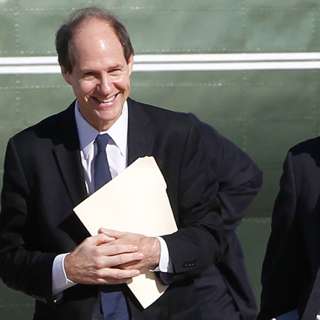

#59 – Cass Sunstein on how change happens, and why it's so often abrupt & unpredictable

#59 – Cass Sunstein on how change happens, and why it's so often abrupt & unpredictable

It can often feel hopeless to be an activist seeking social change on an obscure issue where most people seem opposed or at best indifferent to you. But according to a new book by Professor Cass Sunstein, they shouldn't despair. Large social changes are often abrupt and unexpected, arising in an environment of seeming public opposition.

The Communist Revolution in Russia spread so swiftly it confounded even Lenin. Seventy years later the Soviet Union collapsed just as quickly and unpredictably.

In the modern era we have gay marriage, #metoo and the Arab Spring, as well as nativism, Euroskepticism and Hindu nationalism.

How can a society that so recently seemed to support the status quo bring about change in years, months, or even weeks?

Sunstein — coauthor of Nudge, Obama White House official, and by far the most cited legal scholar of the late 2000s — aims to unravel the mystery and figure out the implications in his new book How Change Happens.

He pulls together three phenomena which social scientists have studied in recent decades: preference falsification, variable thresholds for action, and group polarisation. If Sunstein is to be believed, together these are a cocktail for social shifts that are chaotic and fundamentally unpredictable.

Links to learn more, summary and full transcript.
80,000 Hours Annual Review 2018.
How to donate to 80,000 Hours.

In brief, people constantly misrepresent their true views, even to close friends and family. They themselves aren't quite sure how socially acceptable their feelings would have to become, before they revealed them, or joined a campaign for social change. And a chance meeting between a few strangers can be the spark that radicalises a handful of people, who then find a message that can spread their views to millions.

According to Sunstein, it's "much, much easier" to create social change when large numbers of people secretly or latently agree with you. But 'preference falsification' is so pervasive that it's no simple matter to figure out when that's the case.

In today's interview, we debate with Sunstein whether this model of cultural change is accurate, and if so, what lessons it has for those who would like to shift the world in a more humane direction. We discuss:

• How much people misrepresent their views in democratic countries.
• Whether the finding that groups with an existing view tend towards a more extreme position would stand up in the replication crisis.
• When is it justified to encourage your own group to polarise?
• Sunstein's difficult experiences as a pioneer of animal rights law.
• Whether activists can do better by spending half their resources on public opinion surveys.
• Should people be more or less outspoken about their true views?
• What might be the next social revolution to take off?
• How can we learn about social movements that failed and disappeared?
• How to find out what people really think.

Chapters:
• Rob’s intro (00:00:00)
• Cass's Harvard lecture on How Change Happens (00:02:59)
• Rob & Cass's conversation about the book (00:41:43)

The 80,000 Hours Podcast is produced by Keiran Harris.

Tämä jakso on lisätty Podme-palveluun avoimen RSS-syötteen kautta eikä se ole Podmen omaa tuotantoa. Siksi jakso saattaa sisältää mainontaa.

Jaksot(334)

#132 Classic episode – Nova DasSarma on why information security may be critical to the safe development of AI systems

#132 Classic episode – Nova DasSarma on why information security may be critical to the safe development of AI systems

If a business has spent $100 million developing a product, it’s a fair bet that they don’t want it stolen in two seconds and uploaded to the web where anyone can use it for free.This problem exists in...

31 Tammi 20252h 41min

#138 Classic episode – Sharon Hewitt Rawlette on why pleasure and pain are the only things that intrinsically matter

#138 Classic episode – Sharon Hewitt Rawlette on why pleasure and pain are the only things that intrinsically matter

What in the world is intrinsically good — good in itself even if it has no other effects? Over the millennia, people have offered many answers: joy, justice, equality, accomplishment, loving god, wisd...

22 Tammi 20252h 25min
#134 Classic episode – Ian Morris on what big-picture history teaches us

#134 Classic episode – Ian Morris on what big-picture history teaches us

Wind back 1,000 years and the moral landscape looks very different to today. Most farming societies thought slavery was natural and unobjectionable, premarital sex was an abomination, women should obe...

15 Tammi 20253h 40min

#140 Classic episode – Bear Braumoeller on the case that war isn’t in decline

#140 Classic episode – Bear Braumoeller on the case that war isn’t in decline

Is war in long-term decline? Steven Pinker's The Better Angels of Our Nature brought this previously obscure academic question to the centre of public debate, and pointed to rates of death in war to a...

8 Tammi 20252h 48min

2024 Highlightapalooza! (The best of The 80,000 Hours Podcast this year)

2024 Highlightapalooza! (The best of The 80,000 Hours Podcast this year)

"A shameless recycling of existing content to drive additional audience engagement on the cheap… or the single best, most valuable, and most insight-dense episode we put out in the entire year, depend...

27 Joulu 20242h 50min

#211 – Sam Bowman on why housing still isn't fixed and what would actually work

#211 – Sam Bowman on why housing still isn't fixed and what would actually work

Rich countries seem to find it harder and harder to do anything that creates some losers. People who don’t want houses, offices, power stations, trains, subway stations (or whatever) built in their ar...

19 Joulu 20243h 25min
#210 – Cameron Meyer Shorb on dismantling the myth that we can’t do anything to help wild animals

#210 – Cameron Meyer Shorb on dismantling the myth that we can’t do anything to help wild animals

"I really don’t want to give the impression that I think it is easy to make predictable, controlled, safe interventions in wild systems where there are many species interacting. I don’t think it’s eas...

29 Marras 20243h 21min

#209 – Rose Chan Loui on OpenAI’s gambit to ditch its nonprofit

#209 – Rose Chan Loui on OpenAI’s gambit to ditch its nonprofit

One OpenAI critic calls it “the theft of at least the millennium and quite possibly all of human history.” Are they right?Back in 2015 OpenAI was but a humble nonprofit. That nonprofit started a for-p...

27 Marras 20241h 22min

Suosittua kategoriassa Koulutus

rss-murhan-anatomia
psykopodiaa-podcast
voi-hyvin-meditaatiot-2
adhd-podi
rss-rahamania
rss-arkea-ja-aurinkoa-podcast-espanjasta
rss-niinku-asia-on
taytta-tavaraa
kesken
rss-hereilla
rss-liian-kuuma-peruna
rahapuhetta
rss-duodecim-lehti
rss-valo-minussa-2
rss-tietoinen-yhteys-podcast-2
rss-narsisti
kehossa
dear-ladies
psykologia
rss-tyohyvinvoinnin-aakkoset