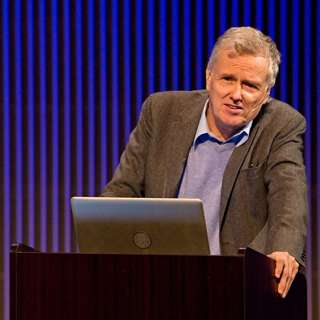

#60 - Phil Tetlock on why accurate forecasting matters for everything, and how you can do it better

#60 - Phil Tetlock on why accurate forecasting matters for everything, and how you can do it better

Have you ever been infuriated by a doctor's unwillingness to give you an honest, probabilistic estimate about what to expect? Or a lawyer who won't tell you the chances you'll win your case?

Their behaviour is so frustrating because accurately predicting the future is central to every action we take. If we can't assess the likelihood of different outcomes we're in a complete bind, whether the decision concerns war and peace, work and study, or Black Mirror and RuPaul's Drag Race.

Which is why the research of Professor Philip Tetlock is relevant for all of us each and every day.

He has spent 40 years as a meticulous social scientist, collecting millions of predictions from tens of thousands of people, in order to figure out how good humans really are at foreseeing the future, and what habits of thought allow us to do better.

Along with other psychologists, he identified that many ordinary people are attracted to a 'folk probability' that draws just three distinctions — 'impossible', 'possible' and 'certain' — and which leads to major systemic mistakes. But with the right mindset and training we can become capable of accurately discriminating between differences as fine as 56% as against 57% likely.

Links to learn more, summary and full transcript
The calibration training app
Sign up for the Civ-5 counterfactual forecasting tournament
A review of the evidence on good forecasting practices
Learn more about Effective Altruism Global

In the aftermath of Iraq and WMDs the US intelligence community hired him to prevent the same ever happening again, and his guide — Superforecasting: The Art and Science of Prediction — became a bestseller back in 2014.

That was five years ago. In today's interview, Tetlock explains how his research agenda continues to advance, today using the game Civilization 5 to see how well we can predict what would have happened in elusive counterfactual worlds we never get to see, and discovering how simple algorithms can complement or substitute for human judgement.

We discuss how his work can be applied to your personal life to answer high-stakes questions, like how likely you are to thrive in a given career path, or whether your business idea will be a billion-dollar unicorn — or fall apart catastrophically. (To help you get better at figuring those things out, our site now has a training app developed by the Open Philanthropy Project and Clearer Thinking that teaches you to distinguish your '70 percents' from your '80 percents'.)

We also bring some tough methodological questions raised by the author of a recent review of the forecasting literature. And we find out what jobs people can take to make improving the reasonableness of decision-making in major institutions that shape the world their profession, as it has been for Tetlock over many decades.

We view Tetlock's work as so core to living well that we've brought him back for a second and longer appearance on the show — his first was back in episode 15.

Get this episode by subscribing to our podcast on the world’s most pressing problems and how to solve them: type 80,000 Hours into your podcasting app.

The 80,000 Hours Podcast is produced by Keiran Harris.

Jaksot(332)

#186 – Dean Spears on why babies are born small in Uttar Pradesh, and how to save their lives

#186 – Dean Spears on why babies are born small in Uttar Pradesh, and how to save their lives

"I work in a place called Uttar Pradesh, which is a state in India with 240 million people. One in every 33 people in the whole world lives in Uttar Pradesh. It would be the fifth largest country if i...

1 Touko 20241h 18min
#185 – Lewis Bollard on the 7 most promising ways to end factory farming, and whether AI is going to be good or bad for animals

#185 – Lewis Bollard on the 7 most promising ways to end factory farming, and whether AI is going to be good or bad for animals

"The constraint right now on factory farming is how far can you push the biology of these animals? But AI could remove that constraint. It could say, 'Actually, we can push them further in these ways ...

18 Huhti 20242h 33min
#184 – Zvi Mowshowitz on sleeping on sleeper agents, and the biggest AI updates since ChatGPT

#184 – Zvi Mowshowitz on sleeping on sleeper agents, and the biggest AI updates since ChatGPT

Many of you will have heard of Zvi Mowshowitz as a superhuman information-absorbing-and-processing machine — which he definitely is. As the author of the Substack Don’t Worry About the Vase, Zvi has s...

11 Huhti 20243h 31min

AI governance and policy (Article)

AI governance and policy (Article)

Today’s release is a reading of our career review of AI governance and policy, written and narrated by Cody Fenwick.Advanced AI systems could have massive impacts on humanity and potentially pose glob...

28 Maalis 202451min

#183 – Spencer Greenberg on causation without correlation, money and happiness, lightgassing, hype vs value, and more

#183 – Spencer Greenberg on causation without correlation, money and happiness, lightgassing, hype vs value, and more

"When a friend comes to me with a decision, and they want my thoughts on it, very rarely am I trying to give them a really specific answer, like, 'I solved your problem.' What I’m trying to do often i...

14 Maalis 20242h 36min
#182 – Bob Fischer on comparing the welfare of humans, chickens, pigs, octopuses, bees, and more

#182 – Bob Fischer on comparing the welfare of humans, chickens, pigs, octopuses, bees, and more

"[One] thing is just to spend time thinking about the kinds of things animals can do and what their lives are like. Just how hard a chicken will work to get to a nest box before she lays an egg, the a...

8 Maalis 20242h 21min

#181 – Laura Deming on the science that could keep us healthy in our 80s and beyond

#181 – Laura Deming on the science that could keep us healthy in our 80s and beyond

"The question I care about is: What do I want to do? Like, when I'm 80, how strong do I want to be? OK, and then if I want to be that strong, how well do my muscles have to work? OK, and then if that'...

1 Maalis 20241h 37min
#180 – Hugo Mercier on why gullibility and misinformation are overrated

#180 – Hugo Mercier on why gullibility and misinformation are overrated

The World Economic Forum’s global risks survey of 1,400 experts, policymakers, and industry leaders ranked misinformation and disinformation as the number one global risk over the next two years — ran...

21 Helmi 20242h 36min

Suosittua kategoriassa Koulutus

rss-murhan-anatomia
psykopodiaa-podcast
voi-hyvin-meditaatiot-2
adhd-podi
rss-tietoinen-yhteys-podcast-2
rss-valo-minussa-2
psykologia
rss-liian-kuuma-peruna
rss-rahamania
kesken
rss-niinku-asia-on
rss-arkea-ja-aurinkoa-podcast-espanjasta
rahapuhetta
rss-uskonto-on-tylsaa
rss-vapaudu-voimaasi
jari-sarasvuo-podcast
ihminen-tavattavissa-tommy-hellsten-instituutti
rss-hereilla
aamukahvilla
dear-ladies